Edward Gibbon, the historian
- Sources yet to be consulted:

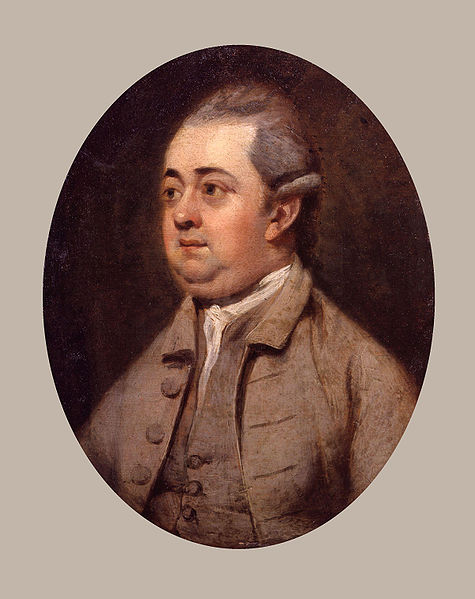
Edward Gibbon, 1773.
At
[NPG].
See
here.
From
Wikimedia Commons.
See
dispute over public domain status.
Edward Gibbon, the historian
(see
here
and
here
and
here),
born 27th Apr 1737,
one of the leading figures of the 18th century western Enlightenment,
educ
Magdalen College, Oxford,
engaged to Suzanne Curchod, but his father would not let him marry her,
she later became
Madame Necker,
author of
Decline and Fall of the Roman Empire
(see
here),
6 vols, 1776-88,
his gentle defense of classical paganism against the new Christianity
in
Chapters
15
and
16
of Vol.1
caused great scandal,
the phrase
"The Decline and Fall of ----"
has passed into the language,
moved to Lausanne, Switzerland, 1783,
died London, 16th Jan 1794, age 56 yrs,
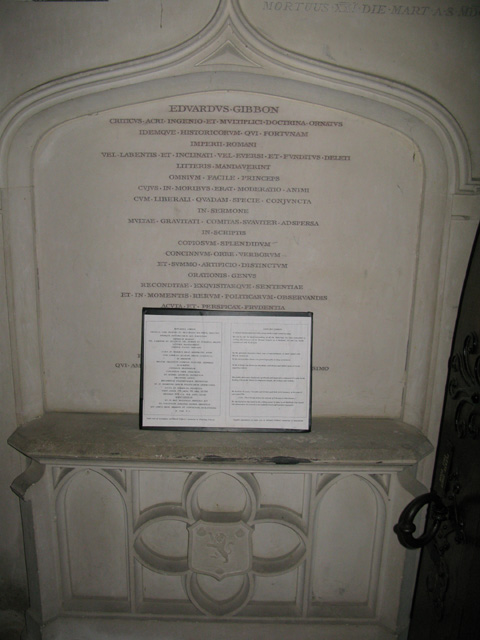
bur in the church at
Fletching,
East Sussex.
See his
deathbed.
See
[DNB].
See
biography
in
[Enc.Britannica, 1911].
See
images at
[NPG].

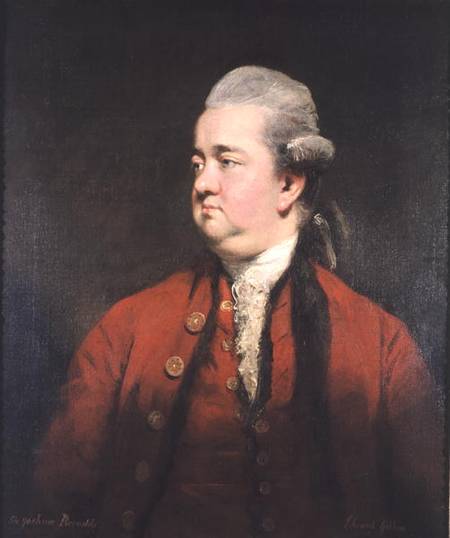
Edward Gibbon.
Public domain image from
here.
".. little more than the register of the crimes, follies and misfortunes of mankind"
- Gibbon on history.
"Another damned, thick, square, book! Always scribble, scribble, scribble! Eh! Mr. Gibbon?"
- William Henry, Duke of Gloucester,
upon receiving the second volume from the author, 1781.
Gibbon the ape
- Gibbon, the ape
(and here
and here)
- The family of apes
called
gibbons
were given their name
by the great French naturalist
Buffon
(also here)
in his
Nomenclature of the Apes,
1766.
- The origin of "gibbon":
- The standard theory seems to be that
the word "gibbon" was brought to Europe
from the French colonies of India
(gibbons are found in India, SE Asia, Indonesia and China)
by Joseph François Dupleix,
French governor general in India 1742-54
(died 1763).
-
Some sources say "gibbon" is French
(perhaps purely because it is from Buffon,
or was the word used by the French in India).
Some sources say it is Indian
(from French India).
Other sources say it is
derived from the English "gib" (see following).
- Gibbons are of the family Hylobatidae,
which means "tree dweller".
- Buffon knew Gibbon:
-
Interestingly,
Buffon knew Gibbon the historian.
Buffon and Gibbon were both among
the intellectuals who frequented the salon of
Edward Gibbon's love Madame Necker
(Suzanne Curchod, who married Jacques Necker 1764).
I had wondered whether Buffon could possibly have named the apes
after the historian.
Note: I have never seen anyone claim this.
I just think it's an interesting coincidence.
- Etymology:
- Gilbert -
The name Gilbert (or Old French Thibert or Tibert or Tybalt)
has short form Gib or Gibb.
- Gibbon -
The
surname Gibbon
probably
derives from a short form of Gilbert.
- Gib
-
Gilbert
(or Old French equivalent) is
the name of the cat in the fables of
Reynard the Fox (12th cent).
Perhaps as a result of these stories,
Gilbert or Gib seems to have caught on as a cat's name.
"Gibbe"
is the name of the cat in
Chaucer's
"Romaunt of the Rose"
(14th cent).
"Gib"
(and here
and here
and here),
pronounced Gib (NOT Jib),
became a generic old English word,
meaning a male cat,
especially a castrated male cat.
- Gibbon -
Some sources say "gibbon" the ape is
derived from "gib" the cat.
If so, then Gibbon the surname and Gibbon the ape may have a common origin
in Gilbert anyway.