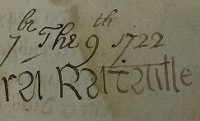
T.F. O'Rahilly
T.F. O'Rahilly,
Prof. Thomas Francis O'Rahilly,
the celebrated Celtic scholar, professor and author,
born 11 Nov 1882, Listowel, Co.Kerry.
See
wikipedia
and
ricorso.
He was educ
St.Michael's College, Listowel.
He was educ
Blackrock College, Dublin,
in 1890s.
He was
there with
Eamon de Valera
and the writer
Padraic O Conaire.
T.F. was one of the first to take
"Celtic"
as an exam subject
[Farragher, 1984].
Eamon de Valera remembered seeing T.F. reading from
An Claidheamh Soluis
to the class:
"to be reading Gaelic from a newspaper - that was something extraordinary indeed in those days"
[Farragher, 1984].
In Public Examinations 1899 he got 1st place in Ireland in Celtic and French,
and full marks in Algebra.
Not living with mother in 1901 census.
He was one of the first students at the
School of Irish Learning
1903.
He was
educ
Royal University,
BA in Irish 1905.
He
worked as civil service clerk, Four Courts,
Dublin.
He
worked in civil service think 1905-19.
He
worked in civil service with the Irish scholar (and leader of the Irish Volunteers)
Eoin MacNeill.
He
corresponded c.1904-15 with his 1st cousin The O'Rahilly
on the family history.
See letters in
[P102].
He
continued Irish studies under
Osborn Bergin at the
School of Irish Learning (must be 1906-08 period).
In 1908 and 1909 he
studied medieval and modern Welsh under
John Glyn Davies
of the
Celtic Department, Liverpool University.
He received MA.
In
1911 census
he is living with mother at 66 Botanic Rd, Glasnevin, Dublin.
He is listed as "civil servant",
"Junior Clerk, High Court of Justice".
In 1911 census
he has reverted to the old surname "O'Rahilly",
like his cousin
The O'Rahilly,
though rest of T.F.'s family still uses "Rahilly".
In 1911-12 he founded and edited Gadelica: a journal of
modern-Irish studies (or Gaedelica).
Editor of Gadelica as at 1913.
He studied Irish manuscripts in RIA, TCD and Maynooth.
He was living Rathmines, Dublin, at mar.
He
mar 17th Oct 1918,
Carrigtwohill RC church, Co.Cork
[GROI]
to Mary Buckley
[Mary Bridget, born 1889], no issue.
She was dau of Michael Buckley
of Rathcormack, Co.Cork.
This is
probably her family
at Park North, Middleton, Co.Cork,
in 1911 census,
though would say born 1896.
At marriage she was living Ballyannon,
Middleton, Co.Cork.
Professor of Irish, Professor of Gaelic Language:
T.F. was
Professor of Irish at TCD
1919-29.
Member of Royal Irish Academy.
He
compiled the Catalogue of Irish manuscripts in the Royal Irish Academy, 1926-58.
Awarded
D.Litt. Celt.
(Honoris causa),
from
NUI 1928.
Research Professor of Gaelic Language, UCC
1929-35.
Research Professor of Gaelic Language, UCD
1935-40.
He gave some assistance to his old schoolfriend
de Valera in drafting of the
1937 Constitution of Ireland.
He was at Nell's funeral, 1939.
In Oct 1940
he was appointed the first
Director of the
School of Celtic Studies
at the
Dublin Institute of Advanced Studies.
He was Director until 1947.
See Dail debate,
6 May, 1947.
"Prof. T.F. O'Rahilly" listed as living 4 Highfield Rd, Rathgar, Dublin
in [Thom's, 1945].
Still there at death 1953.
He
edited
Celtica journal,
vol.1, 1946-50.
He
retired 1947.
Awarded
Litt. D., TCD, 1948.
Appointed Honorary Prof of Irish Language, TCD, Jan 1953.
|
T.F. dies, 1953:
He
died Portobello Nursing Home, Dublin, 16th Nov 1953, age 71 yrs
[GROI].
He was
bur Glasnevin Cemetery.
See
[Boylan's DIB]
and [Dict. Ir. Writers].
Mary's address on her grave record is
still 4 Highfield Rd, Rathgar.
She died 16 Oct 1969, age 80 yrs [grave record].
She was bur Glasnevin Cemetery.
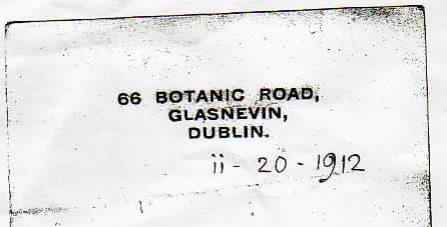
Letter
of
20 Feb 1912,
from T.F. Rahilly at 66 Botanic Rd to his uncle
Theo Curry.
Signed "Frank R." (Frank Rahilly).
See
p.1 and
p.2.
Letter courtesy of Eileen O'Connor.
T.F. O'Rahilly's works on Irish history, language, poetry, and other topics, include:
- "Notes on the Poets of Clare", series of articles in An Claidheamh Soluis between 28 July 1917 and 22 Sept 1917.
- Danfhocail - Irish Epigrams in Verse, Dublin, 1921.
Also here
and here.
- A Miscellany of Irish Proverbs, Dublin, 1922.
- Irish poets, historians, and judges in English documents, 1538-1615 (1922).
- Búrdúin bheaga: pithy Irish quatrains, Dublin, 1925.
- Dánta grádha: an anthology of Irish love poetry (A.D. 1350-1750),
1925, 2nd edn 1926, new edn 1975.
- Measgra dánta: miscellaneous Irish poems, Cork, 1927, repub 1977.
- Duanta Eoghain Ruaidh Mhic an Bhaird
(Poems of
Eoghain Ruaidh Mhic an Bhaird),
Galway, 1930.
[NUIG library] 891.25 McAN.
-
Irish dialects past and present,
Dublin, 1932, repub 1972 by School of Celtic Studies,
ref. E 2.10.
-
The Goidels
and their predecessors, 1936.
- The two Patricks: a lecture on the history of
Christianity, DIAS, 1942.
-
This presented a new theory that
the accounts of St.Patrick confused
two different missionaries to Ireland
-
Palladius of France,
the one sent by the Pope
(early 400s AD),
and
Patrick,
the famous and successful one
(late 400s).
O'Rahilly's version is now largely accepted.
-
See Irish Times,
March 21, 1942.
-
The humourist
Flann O'Brien
wrote in the
Irish Times,
April 10, 1942,
about the new Dublin Institute of Advanced Studies:
"Talking of
this notorious Institute
... a friend has drawn my attention to Professor O'Rahilly's recent address on
"Palladius and Patrick".
I understand also that
Professor Schrödinger
has been proving lately that you cannot establish a first cause. The first fruit of the Institute therefore, has been an effort to show that there are two Saint Patricks and no God."
-
James Plunkett wrote in 1972:
"I can still recall the great scandal of 1942, when a book called The Two Patricks was published by a learned Irish Professor who advanced the theory that there was one Patrick (Palladius Patrick) whose mission lasted from 432-461, and another who arrived in 462 and died about 490. The suggestion caused a national unheaval. If the careers of the two Patricks, through scholarly bungling, had become inextricably entangled, who did what? And worse still - which of them was the patron saint? If you addressed a prayer to one, might it not be delivered by mistake to the other? There was a feeling abroad that any concession to the two Patricks theory would lead unfailingly to a theory of no Patrick at all."
[Hopkin, 1989]
- Early Irish history and mythology, 1946, repub 1976, 1984.
-
This work developed
"O'Rahilly's historical model",
a controversial theory of the
Celtic invasions
in Irish prehistory
in the 1st millennium BC
(written history begins in Ireland in 5th cent AD).
"His ideas, though extremely influential, are no longer universally accepted."
-
In particular, modern DNA studies
suggest
the pre-Celtic native Irish adopted Celtic culture,
rather than there being a large invasion of actual Celtic people from Europe.
That is, in their DNA
the Irish and Scots are not "Celtic".
Nor are the English "Norman" or "Anglo-Saxon" (or even Celtic).
Rather, DNA studies suggest
the English, Irish, Welsh and Scots
are
all mainly of pre-Celtic stock.
References
- Obituary of
T.F. O'Rahilly,
Irish Times, 17th Nov 1953,
p.3
and
p.1.
Sources yet to be consulted
- O'RAHILLY, THOMAS FRANCIS
in
[DIB]
- O RATHILE, Tomas
in [Beathaisneis]
- Rahilly family scrap-books, mentioned in T.F.'s possession in 1905
[P102/172(1)].
- T. F. O'Rahilly Manuscripts,
 MS11,
Special Collections,
Main Library,
Queen's University Belfast.
Don't think has any family papers.
MS11,
Special Collections,
Main Library,
Queen's University Belfast.
Don't think has any family papers.
- Obituary of
T.F. O'Rahilly,
Cork University Record, no.29, Summer 1954.
-
Obituary of
T.F. O'Rahilly,
Eleanor Knott,
Eriu, Vol. XVII,
1955,
[RIA]
C/21/1-2/Knott offprints/17.
- Alannah Hopkin, Living Legend of St. Patrick, 1989.