The English Royal family
As explained
here
and
here,
the oldest section of my site,
and particularly the Royal section,
is
not much more than just an extended Ancestors Chart for myself and my wife,
included only to provide continuity with my later pages.
I do not research
the genealogy of the English Royal family
(and have no plans to ever research it).
I just link to other people's work.
- References:
- Sources yet to be consulted:
All the old Western lines really form
one vast Western family tree.
How far back this tree can be taken is still a matter under investigation.
- "Descent from Adam"
-
For centuries genealogists tried to trace western descents back to the alleged
"first man"
Adam.
However, we know since Darwin's time that Adam did not exist
and humanity's origins
are totally different.
-
Noah
did not exist either.
We know from many branches of science that the Flood never happened.
-
Many early biblical figures may also be legendary.
For example, there is no contemporary evidence for the existence of
Abraham and
Moses.
- List of biblical figures identified in extra-biblical sources
names the first biblical figure unambiguously identified in contemporary sources
as
Omri
(9th century BC).
- Descents from legendary figures obviously make no sense.
But even descents from these 1st millennium BC historic figures make no sense
until western genealogies can first be brought back to classical times.
- "Descent from Antiquity"
-
In terms of real, historic descents, the challenge remains to get a proven
western descent from the
late Roman period
(5th century AD).
- Currently, the earliest that western lines may be traced to
is perhaps the
Irish royal line
in the early 5th century AD.
(A time when the late Roman Empire existed, but Ireland was not part of it.)
-
[Pine, 1969]
says:
"No families, not even the Royal Houses, can make a sound claim to bridge the chasm of the Dark Ages
and establish a proven connection with the period of the later Roman Empire.
Efforts made to give
Charlemagne
a late Roman ancestor are not substantiated."
- Ancient Roman family trees
- Ancient Egyptian family trees
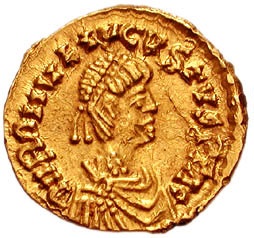
Coin of
Romulus Augustus,
the last
Western Roman Emperor
(deposed 476 AD).
Coin sold at auction
2004.
From
here.
The English Royal line
The Romans left Britain
by 410 AD.
Cerdic, first King of the West Saxons,
who arrived in Britain in 495 AD,
is generally accepted as the historical start of the British Royal line in England.
Ancestries traced for him are regarded as legend.
We begin the English Royal line with the Norman
invaders of England (1066)
and Ireland (1169):
Rollo,
the Viking (born in Scandinavia) who became the first ruler of Normandy.
Sometimes called Duke of Normandy.
He mar or affair with
Poppa of Bayeux
and had issue:
William Longsword.
Sometimes called Duke of Normandy.
He
had affair with Sprota.
Her origin has been debated but remains obscure.
William was assassinated in 942.
He
had issue by Sprota:
Richard I of Normandy,
born 933.
He died 996.
He
had issue (by various mothers):
- Richard II, Duke of Normandy,
mar Judith of Brittany
[dau of Conan I of Rennes
by his wife
Ermengarde-Gerberga of Anjou,
descendant of Charlemagne],
had issue:
- Robert I, Duke of Normandy,
had affair with Herleva
and had issue:
- William the Conqueror.



- Geoffrey, Count of Eu, had issue:
- Gilbert, Count of Brionne, had issue:
- Richard FitzGilbert de Clare.
- William I, Count of Eu,
had issue:
- Robert, Count of Eu, had issue:
- William II, Count of Eu.