Sir Thomas Fitzwilliam, Kt
The outside wall of Donnybrook graveyard, 1999.
Sir Thomas Fitzwilliam, Kt
(see
here),
of Merrion, Baggotrath,
Booterstown
and
Simmonscourt,
born c.1519 (succ aged c.9 yrs),
mar
Genet Finglas,
lived initially at Baggotrath,
but later moved the seat of the family to
Merrion Castle,
seems to have left
Baggotrath
and rented it out by 1547,
MP for Co.Dublin 1559, Vice-Treasurer of Ireland 1559,
Sheriff for Co.Dublin as at 1564,
the Lord Deputy
Sir Henry Sidney
visited him in 1565 after arriving in Ireland and before entering Dublin,
fought against Shane O'Neill 1560 and 1566
(after the latter Sir Henry Sidney knighted him),
the family conformed to Protestantism at the Reformation,
but their conversion was only nominal
and by 1600 they were Catholic again
(although they were always loyal to the crown in Ireland),
Constable of
Wicklow Castle,
at the edge of
the Pale
facing the hostile natives
(whose traditional leaders were the O'Byrnes),
fixed the boundaries of Wicklow county
(as Sir Henry Sidney did with
Clare county in 1565),
died 9th Nov 1592, age c.73 yrs,
had issue:
- Sir Richard Fitzwilliam, Kt,
of Merrion, Co.Dublin,
Constable of Wicklow Castle,
mar Jane Preston
[descendant of Edward I],
succ 1592, rebuilt Dundrum Castle 1590s,
died at Merrion 1595,
bur at Donnybrook church,
erected the Fitzwilliam tomb, which was in the family chapel
attached to the old church,
Jane's will dated at Merrion, Nov 1597,
had issue:
- Sir Thomas Fitzwilliam, 1st Viscount Fitzwilliam,
of Merrion, born 1581.
- Mary Fitzwilliam,
mar 1stly to Matthew Plunkett, 5th Baron Louth and had issue.
- William Fitzwilliam of Dundrum,
mar 1614 to Mary Smyth,
died at Dundrum Castle 16th July 1616,
[Ball, vol.2, 1903] references his will.
- Catherine Fitzwilliam,
mar 2ndly to Christopher Preston, 4th Viscount Gormanston.
The Battle of Glenmalure, 1580
For
centuries
the native Irish of Co.Wicklow had been raiding
the Pale.
After the
Reformation,
the native Irish and some of the "Old English"
(old Anglo-Norman settlers who stayed Catholic)
would sometimes be allied together against the Protestant crown.
One such alliance was during the
Desmond Rebellions
(1569-83)
against
Elizabeth I.
In 1580 at Glenmalure, Co.Wicklow
(nr Glendalough, W inland from Wicklow town,
in heart of Wicklow mountains),
the forces of the Crown
under
Arthur Grey, 14th Baron Grey of Wilton
were defeated by a coalition of native Irish and Pale rebels under
Feach Mac Hugh O'Byrne
and James Eustace, 3rd Viscount Baltinglass.
It was the high point of the rebellion.
For a brief time Dublin itself was threatened.
[O'Byrne] says:
"There was panic in Dublin as the news of the battle filtered back.
This defeat was the worst reverse ever suffered by a royal army in Ireland.
The question on every Elizabethan official's lips was almost certainly whether
Glenmalure's victors would march on Dublin."
The O'Tooles and the O'Byrnes were finally conquered in 1601.
Follow me up to Carlow
The 19th cent song
Follow me up to Carlow

celebrates the Irish rebel victory.
The tune is traditional, but the lyrics
are 19th cent.
"Black Fitzwilliam"
The question is who does "black Fitzwilliam" refer to?
Theories:
- Sir Thomas Fitzwilliam, Kt,
Constable of Wicklow Castle
and long-time enemy of the O'Byrnes.
-
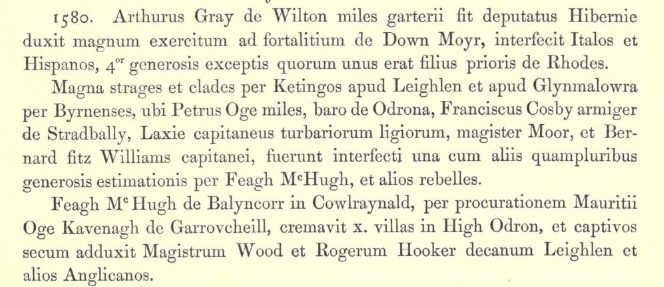
Captain Bernard Fitzwilliam,
an officer leading the English army into Glenmalure,
who was killed by the rebels.
- "Fitz William"
refers to
Arthur Grey, 14th Baron Grey of Wilton,
the son of William Grey, 13th Baron Grey of Wilton.
Lyrics
|
"Lift Mac Cahir Og your face brooding o'er the old disgrace
That black Fitzwilliam stormed your place and drove you to the fern.
Grey said victory was sure, soon the firebrand he'd secure
Until he met at Glenmalure
Feach Mac Hugh O'Byrne.
(Chorus:)
Curse and swear, Lord Kildare, Feach will do what Feach will dare
Now, Fitzwilliam, have a care: fallen is your star, low!
Up with halbert out with sword, on we go for by the Lord
Feach Mac Hugh
has given his word, follow me up to Carlow!
See the swords of Glen Imayle flashing o'er the English Pale
See all the children of the Gael beneath O'Byrne's
banners.
Rooster of the fighting stock, would you let a Saxon cock
Crow out upon an Irish rock, fly up and teach him manners!
From Tassagart to Clonmore flows a stream of Saxon gore
Och, great is Rory Og O'More at sending loons to Hades.
White is sick and Lane is fled, now for black Fitzwilliam's head
We'll send it over, dripping red, to Liza and the ladies."
|