Genealogy research by Mark Humphrys.
Genealogy research by Mark Humphrys.
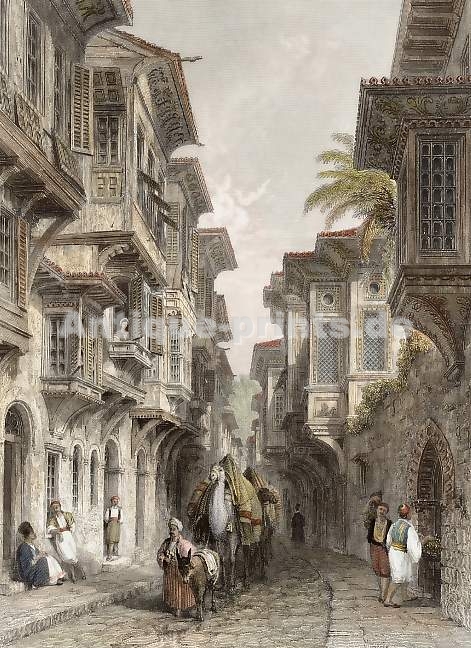
Part of the Ottoman Empire from 1426, Smyrna was for centuries a prosperous trading port to rival Constantinople. It was largely Greek and Christian for centuries under Turkish Islamic rule. The Turks called it "Smyrna of the infidels".
The Western powers established commercial bases there (by agreement with the Ottoman Empire) as early as the 16th century (e.g. the English government-backed Levant Company established 1581), and many western merchants lived there with their families.
For centuries Smyrna was a cosmopolitan place with a large permanent European population. The westerners, from many different countries in Western Europe, tended to marry among themselves, and all the families ended up related.
See the Maltass and Icard and Vassal families, who all moved from Western Europe to the Ottoman Empire by the 18th century.
Augustus Montgomery
must have met Susan Maltass
because he was posted to the area with the Royal Navy:
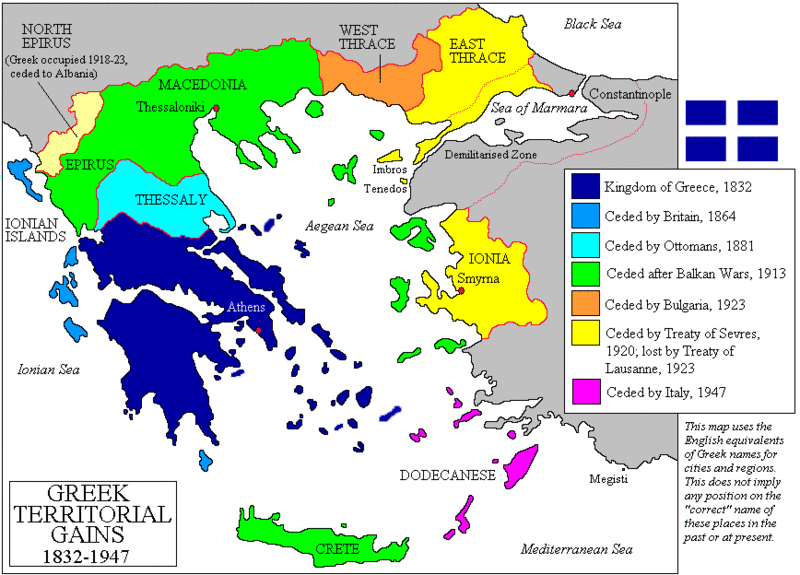
Greece proper became independent of the Ottoman Empire in 1832. Though Smyrna and many other Greek and Christian territories remained under Ottoman rule.
In the 19th century this area became vital to the European balance of power.
Gibbon and de Stentzsch and Herbert were involved in the Crimean War 1853-56.
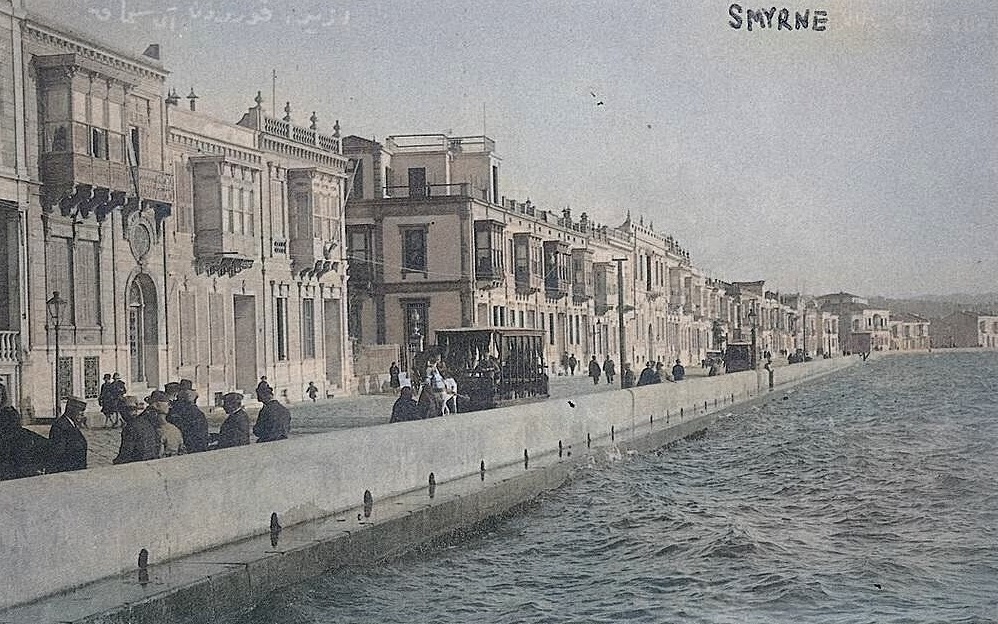
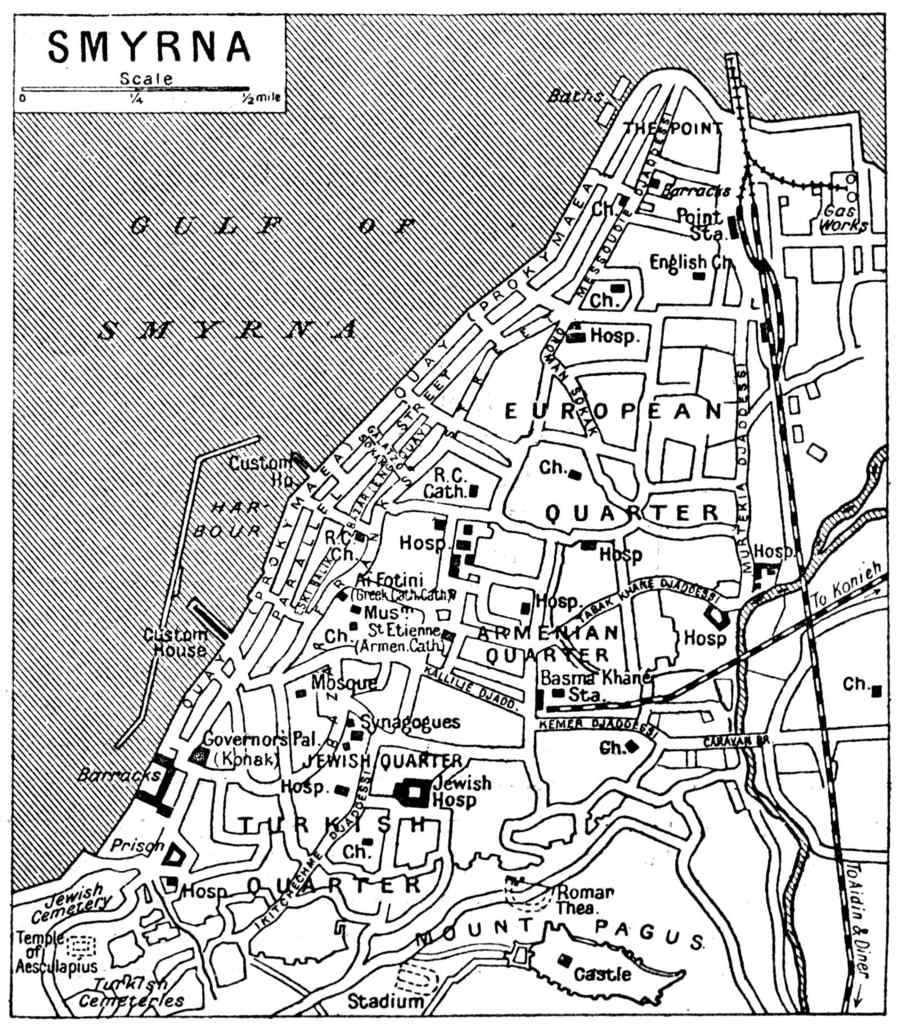
Smyrna Waterfront, before the destruction of 1922.
Posted here.
During WWI, The Ottoman Empire was on the German (Central Powers) side, while Greece was on the Allied side. Smyrna was one of the few places to escape the 1915 Turkish genocide of the Armenians, and the city still retained its ancient cosmopolitan character at the end of WWI.
After being on the losing side in the war, the Ottoman Empire was occupied by the Allies. Greece occupied Smyrna and surrounds in May 1919, and began to expand their territory, immediately starting a new Greek-Turkish war. The Allies supported Greece's expansion into Turkey.
There was a large Greek and Christian population living in the area occupied - and it was these who suffered terribly when the Greek army was routed. The Greek army was defeated by Kemal Ataturk, Turkish nationalist leader and founder of modern Turkey, who captured the Greek hold-out Smyrna in Sept 1922. His troops burnt the Greek and Armenian part of the city and slaughtered the Greek and Armenian population. Rudolph J. Rummel estimates that the Turkish army under Ataturk massacred 100,000 Greek and Armenian Christians at Smyrna. The fall of Smyrna saw the ethnic cleansing of the ancient Greek population of Turkey. (There was also a large ethnic cleansing of Muslims from Greek territory.) The Turkish drive stopped at the sea. (Today, Greece controls as far as the islands just off Turkey's coast.)
Ataturk's revolution was supposed to set up a state that was secular and westernised, in opposition to the old Muslim society. Yet his followers seemed motivated by a more primitive Turkish nationalism, Islamic religious feeling, and a hatred of non-Muslims and non-Turks.
The Maltass relations were split. The Whittall family supported the Greeks. The Wood family and the Giraud family supported the Turks. After the Turkish victory, Europeans that supported the Greeks had to flee. After centuries in Smyrna, the Maltass/Whittall family and relations were split up, and spread all over the world. Many other European merchants, banks and companies, whether they had supported the Greeks or not, pulled out during this period.
For some Europeans, despite what was happening around them, life seems to have gone on much as normal. A number still live there today (including members of the Maltass/Whittall family). But it was the end of Smyrna's long history as a cosmopolitan western city.

The burning of Smyrna
and the massacre of 100,000 Christians
(1922)
by the Turkish army under Ataturk.
See other
videos.
Please donate to support this site.
I have spent a great deal of time and money on this research.
Research involves travel and many expenses.
Some research "things to do"
are not done for years, because I do not have the money to do them.
Please Donate Here
to support the ongoing research and
to keep this website free.