William Henry Gibbon
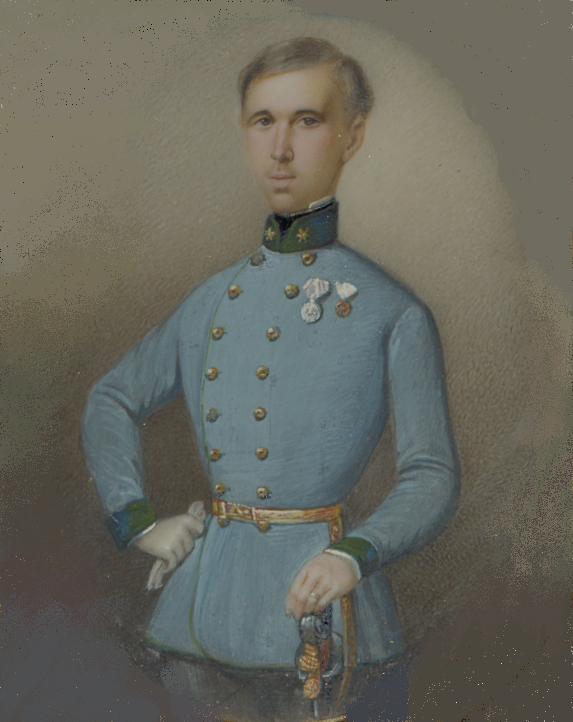
William Henry Gibbon, would be sometime 1848-1857.
Probably in uniform of
Austrian Empire.
Though possibly uniform of
British German Legion.
I showed the image to ChatGPT
and it said Austrian Imperial Army officer, between 1845 and 1855.
But then I specifically asked ChatGPT about the British German Legion,
and it said it could be British German Legion, between 1854 and 1856.
Image courtesy of
Mike Hilligan.
This is probably one of the two portraits of him being critically discussed in
Letter of 21 Apr [think 1857].
William Henry Gibbon,
William,
born 14 Jan 1832.
He was
educ English Grammar School,
Heidelberg,
Germany.
NOT at
University of Heidelberg.
Heidelberg was
not
in the
Austrian Empire,
but he would go on to join the Austrian Army.
His sister
Georgina married 1846 to a German Baron and they
lived Austria.
He received a
note of introduction
from
Lady Pembroke
in Feb 1848 (him age 16),
addressed
to the British Ambassador to Austria.
She
"ventures to give this line of introduction to Mr. William Gibbon, a young man she feels interested in
owing to the circumstance of his mother having been a ward of her husband, the late Lord Pembroke
and the whole family more or less under his guardianship."
Letter says William has intention of entering the Austrian Army.
He was in Heidelberg as at 1848.
Officer in Austrian Empire:
William joined the
Austrian Army
in the war between Austria and
(most of) Italy,
now called the
First Italian War of Independence,
in
1848 (he was only age 16).
The Austrian Empire at this time
included part of northern Italy.
He started as an
Ensign.
Rapidly promoted to
Captain
for gallantry on the battlefield.
He was described as "formerly an Officer in the
Austrian Army"
in will of Cecilia Markham 1866.
[Bentley's Miscellany, 1853]
says that in 1848,
Gibbon
"together with Count Spaur, an Austrian, followed by 30 men only,
stormed a breach at
Rivoli"
[Rivoli Veronese, NE Italy]
"and carried it, driving back a considerable force"
[of Piedmontese]
"who were defending it.
To the young ensign,"
[Gibbon]
"who was instantly promoted for his gallant conduct, was due the credit of having
proposed this daring exploit to Count Spaur.
Mr. Gibbon escaped unhurt, but Count Spaur received many wounds."
After a truce in 1848, war broke out again in 1849.
William distinguished himself again in the
Battle of Novara,
NW Italy,
March 22-23, 1849.
One army letter said about him and a few other officers also praised:
"It is a pity that they are so young that one can not give them a large body
to command, they would do wonders".
After hostilities ended (must be the time in 1849)
he was decorated by the new young
Emperor
Franz Joseph I
(succ December 1848)
in person.
Poem of 1849
references him:
"And Willy, with his curling locks;
Was then a baby in your arms;
Dreaming not then of "War's Alarms";
But since these years have taken flight;
Your hero bold has learned to fight".
His sister
Margaret married 1850 to a Baron in the Austrian army.
William
mar 1stly, 24 Mar 1854, to
Flora Fogolari
[born 26 Oct 1832, Catholic, daughter of an Italian banker].
Flora's
sister had married an Italian Count in 1845.
"Willy" and "Flora" are mentioned before their marriage in
letter of 5 Nov 1853
from Willy's mother.
They were married
in
Venice,
Italy, by a Catholic clergyman.
And again later at Colchester (see below).
Austria sided with Britain
in
Crimean War
1853-1856.
William
joined the
British German Legion
(German nationals raised 1856 to fight for Britain in Crimean War,
part of the British Foreign Legion).
He is listed as Captain
in 6th Regiment of Light Infantry, British German Legion,
as at second mar ceremony Nov 1856 (below).
The Crimean War ended Apr 1856,
before British German Legion
saw action.
The men of the British German Legion
were
based at Colchester
in summer 1856.
William Henry and Flora had a second (English, Protestant) marriage ceremony
at St.Botolph's church
in
Colchester,
25 Nov 1856
[GRO.UK].
They are
both listed as living Wyre St, Colchester.
Goes to South Africa, 1857:
After the Crimean War,
Britain had the problem of what to do with all these foreign nationals it had recruited,
many of whom were now unwelcome in their home countries.
Britain decided to use them to help settle South Africa.
Land was granted by Britain
to members of the British German Legion
in the
Eastern Cape,
South Africa.
An effort was made to get all these young single men married before they went,
so that they might settle in South Africa and not wander again.
Wives and children got free passage.
This might have prompted Gibbon's second marriage ceremony, to make sure he was married under English law.
The men were settled in Eastern Cape 1857,
though they still had some military responsibilities.
William Henry
went to South Africa
(The Cape Colony,
or
"The Cape"),
1857.
He was living at
Grahamstown,
Eastern Cape, South Africa
(see map)
as at 1857.
Settles in Alexandria, 1858:
He and his wife settled in 1858 at
Alexandria,
Eastern Cape,
South Africa
(near the sea,
between
Port Elizabeth
and
Grahamstown,
see
wider map
and closer
satellite view).
He
lived there for rest of his life.
Grave says he arrived at Alexandria 16 March 1858.
They lived at Oak Cottage, Alexandria.
He set up an English-speaking school at the house.
The South African
British-German Legion
finally disbanded 1861.
Letter of 10 Oct 1869
to William's mother
Elizabeth Gibbon
expresses concern about
"your poor daughter in law at the Cape, for whom I am aware you have ever cherished a sincere affection".
This is after the death of Flora's son age 5 in July 1869.
Letter says Flora has taken it hard:
"no wonder her mind was unable to stand the shock."
He is listed as "late Captain, German Legion", living Alexandria, at son Sidney's bapt 1870.
Divorce case:
William and Flora
divorced, after "a long drawn-out affair".
Flora committed adultery in 1871 with an Officer on a ship
on a voyage from
South Africa
to
England.
She signed a confession at Alexandria, 13 Aug 1872.
She says:
-
"I left
Algoa Bay
on 29 Jan 1871"
[her age 38, apparently leaving her new baby and other children behind]
"as a 1st class passenger in the steamer
'Northain'
bound to
Southampton."
- "The vessel touched at
Table Bay
...
After leaving Table Bay
and recovering from sea sickness
I met on board a person styling himself Captain Valler,
an officer belonging to the Union Mail Service."
[The shipping line, the Union Mail Packets Company,
which later merged to form the
Union-Castle Line.]
-
"I occupied a cabin alone ...
About 12 days after leaving Table Bay,
after myself and all the passengers had retired for the night,
on two several occasions
the said Captain Valler entered my cabin,
and on his persuasion I on both occasions committed adultery
with him, and I make this voluntary admission as an
atonement to my husband for the wrong I have done him."
Letter of 22 Mar 1872
to William's brother
says
"I hear your sister in law, Mrs. William, is just on the eve of returning"
[i.e. returning to South Africa from her trip to Europe].
William and his wife
eventually
divorced 12 July 1883.
Their divorce is not found in
UK list of Private Acts (including divorces) 1866-1910.
Geoff Gibbon says that William:
"had a hell of a temper. If the food he got was not to his liking,
he would throw it out of the window - plate and all. No wonder [his] wife left him."
William Henry
is listed as an "Inspector of Roads" at 2nd mar 1883.
He is described as "widower"
but this is wrong.
He
had issue by 1st wife:
- Elizabeth Gibbon,
Elizabeth Montgomery Augusta Leontine Gibbon,
born Grahamstown, South Africa, 22 May 1857 (father age 25).
She
mar at Alexandria, 24 Apr 1882,
to Capt. Alfred W. Ducat
and had issue.
- Emily Gibbon,
Emily Alice Livingston Gibbon,
born Alexandria, South Africa, 20 July 1859.
She mar 26 Oct 1880 to Ernest Newnham [Ernest Edmund].
They lived Jansenville, Eastern Cape, South Africa.
She died Jansenville, 10 Dec 1881, age 22 yrs. NOT 10 Feb.
They had issue:
- Cyril Newnham,
Lewis Cyril Ashby Newnham, born Jansenville, 13 Sept 1881.
- Arthur Gibbon,
Arthur William Fogolari Gibbon, born 5 June 1861, Alexandria.
The expenses book of
Arthur Augustus Gibbon
lists present to him in 1892.
He
died unmarried, 1926, age 65 yrs.
- Alfred Gibbon,
Alfred Louis Henry Gibbon, born 28 July 1863, Alexandria.
He died Uitenhage, South Africa,
16 July 1869, age 5 yrs.
- Jessie Gibbon,
Jessie Mary Flora Gibbon, born 16 Mar 1869, Alexandria.
She died 25 Oct 1877, Alexandria, age 8 yrs.
-
Sidney Gibbon,

Montgomery Sidney Charles Gibbon,
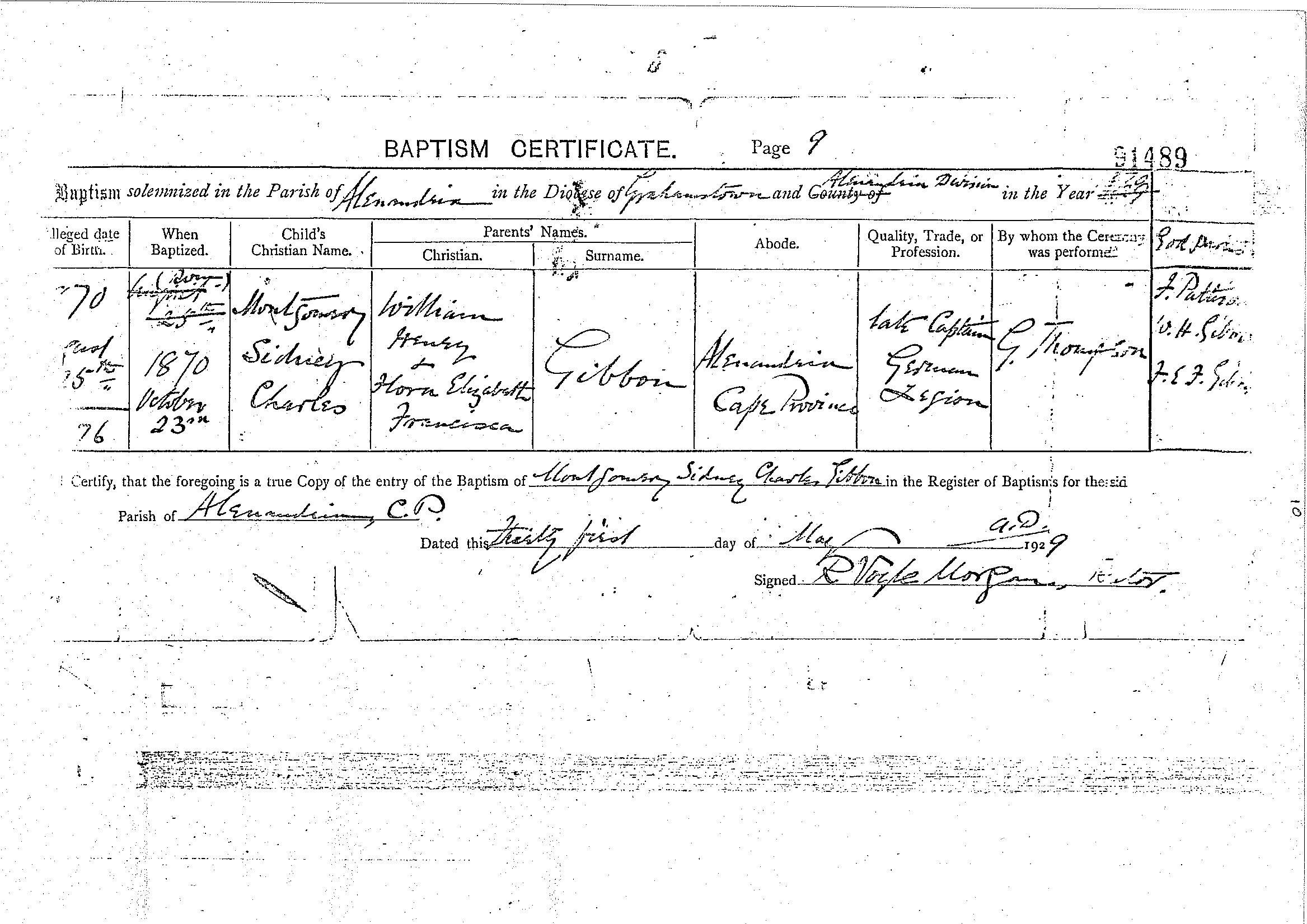
born 25 Aug 1870, Alexandria,
bapt 23 Oct 1870, Alexandria.
See
bapt cert.
"Sidney" on his bapt cert.
Also on his son Sidney's bapt cert.
So he apparently used that spelling,
NOT Sydney.
"Sidney" would be the spelling of his famous close relative
Sidney Herbert, 1st Baron Herbert of Lea,
the Secretary of State for War,
who he was perhaps named after.
William Henry
mar 2ndly, 17 Oct 1883,
to
Elizabeth van Niekerk.
He was age 51, she was age 34.
Both living Alexandria at mar.
They
lived Alexandria.
Elizabeth's
brother had a transport business with ox wagons, and William Henry joined him.
William Henry died at Alexandria, 16 Feb 1894, age 62 yrs.
He was
bur at
Alexandria cemetery, Eastern Cape.
After his brother's death,
Arthur Augustus Gibbon
paid an allowance to Elizabeth
(in Alexandria) until his own death 1907.
Elizabeth died Alexandria, 6 Feb 1930, age 80 yrs.
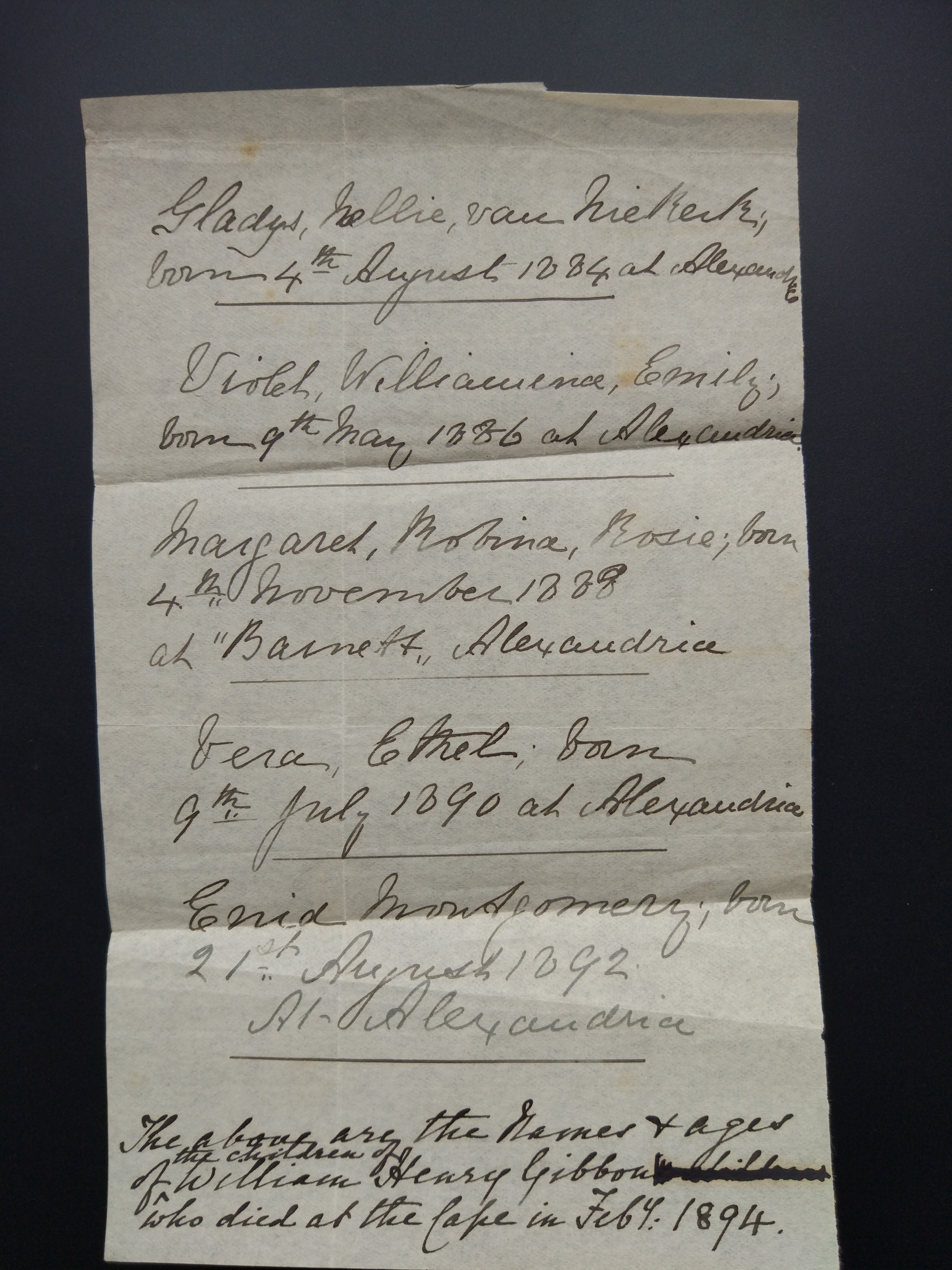
William Henry had issue by 2nd wife:
- Gladys Gibbon,
Gladys Nellie van Niekerk Gibbon,
born Alexandria, 4 Aug 1884.
She died unmarried, Alexandria, 17 Oct 1918, age 34 yrs.
- Violet Gibbon,
Violet Williamina Emily Gibbon, or Williameina,
born Alexandria, 9 May 1886.
She died unmarried, Alexandria, 6 Feb 1904, age 17 yrs.
- Robina Gibbon,
Ruby, "Margaret R. R.",
Margaret Robina Rose Gibbon, think NOT Rosie,
born at Barnett, Alexandria, 4 Nov 1888.
She mar 1 Mar 1920 to
Charles E. Hilligan and had issue.
- Vera Gibbon,
Vera Ethel Gibbon,
born Alexandria, 9 July 1890.
She mar 1stly to --- Moore. No issue.
She mar 2ndly to Jack Chowles. No issue.
She died at Durban,
South Africa.
- Enid Gibbon,
Enid Montgomery Gibbon,
born Alexandria, 21 Aug 1892 (father age 60).
She died unmarried, Alice,
South Africa, 26 May 1916, age 23 yrs.
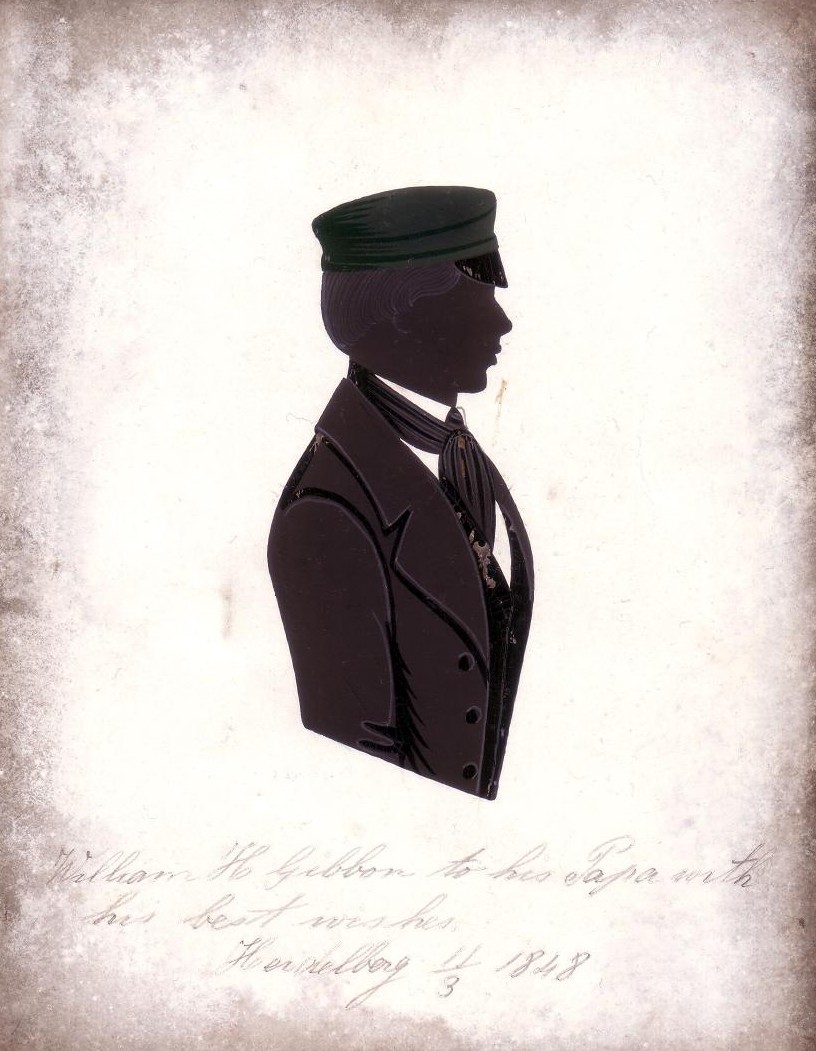
Silhouette of William Henry Gibbon,
Heidelberg,
11 Mar 1848 (age 16).
See
full size.
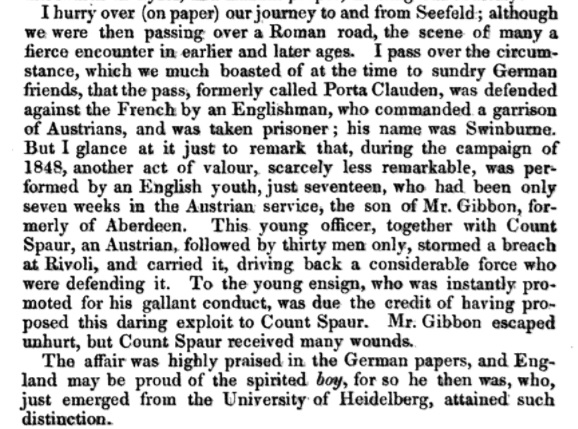
Extract from
[Bentley's Miscellany, 1853]
about William Henry Gibbon's exploits in
First Italian War of Independence in 1848.
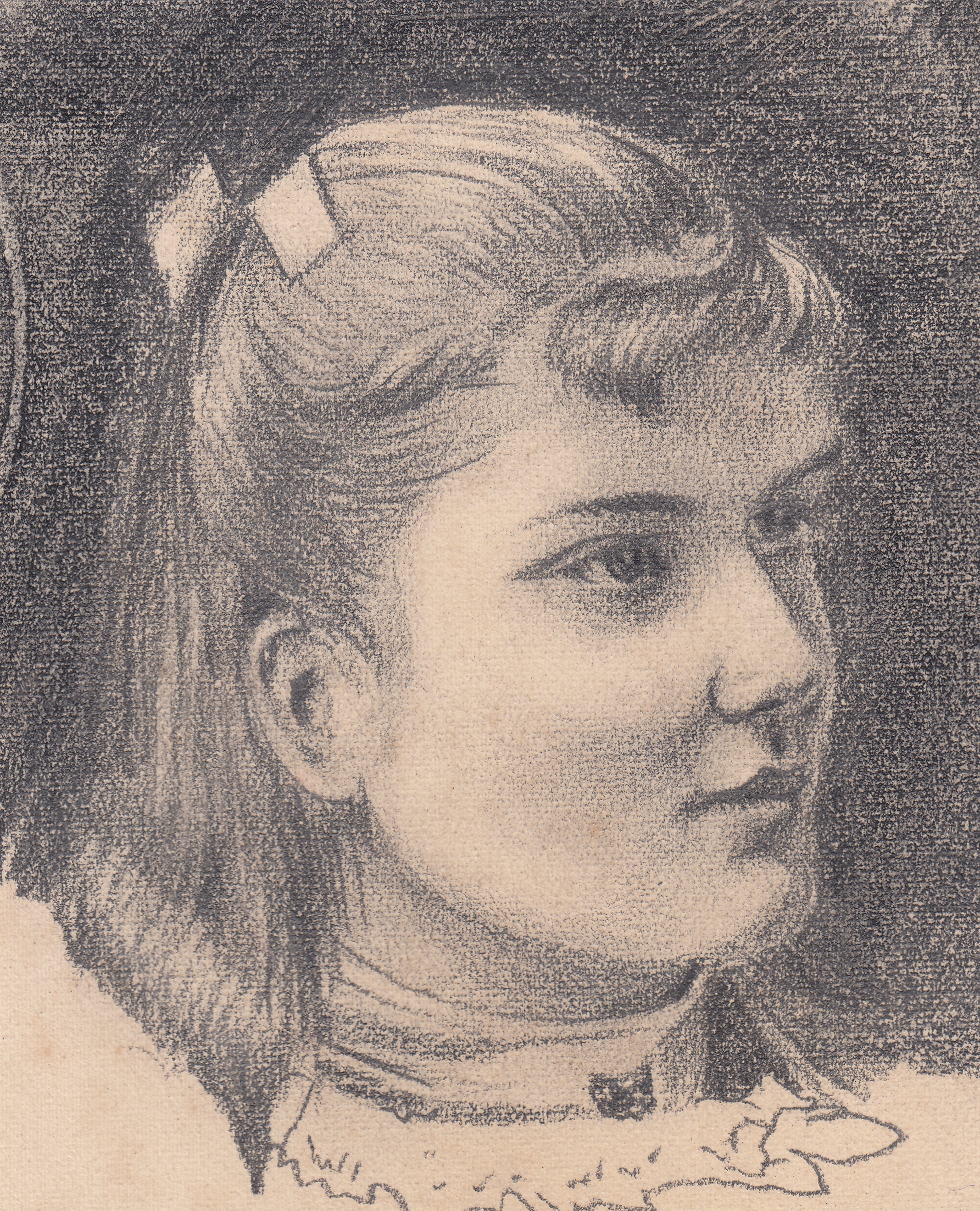
Sketches of a girl
There are two, almost identical, sketches of an unknown girl.
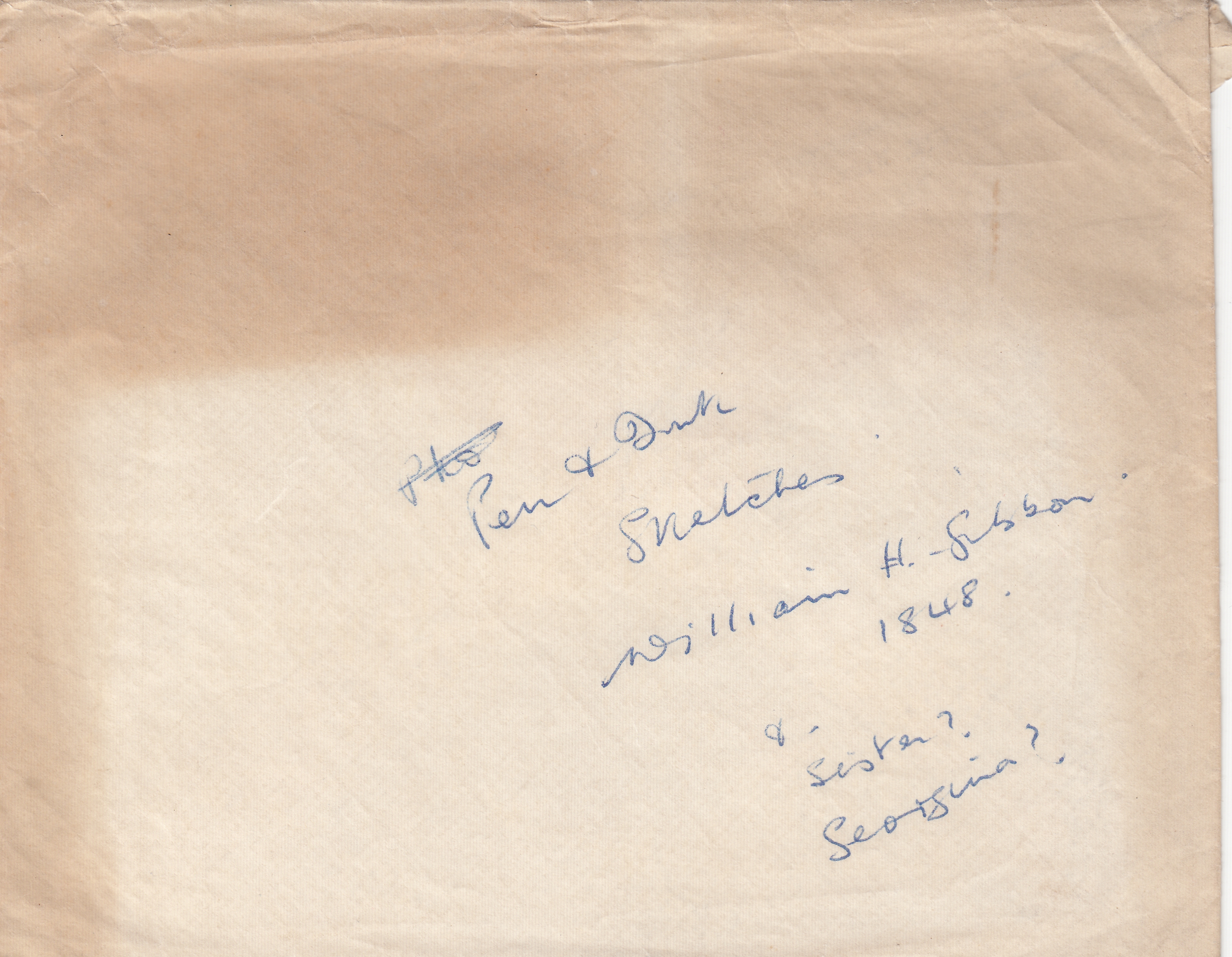
The
envelope
seems to say that the sketches are by William Henry Gibbon in 1848 (when he was age 16).
A note says:
"Sister? Georgina?"
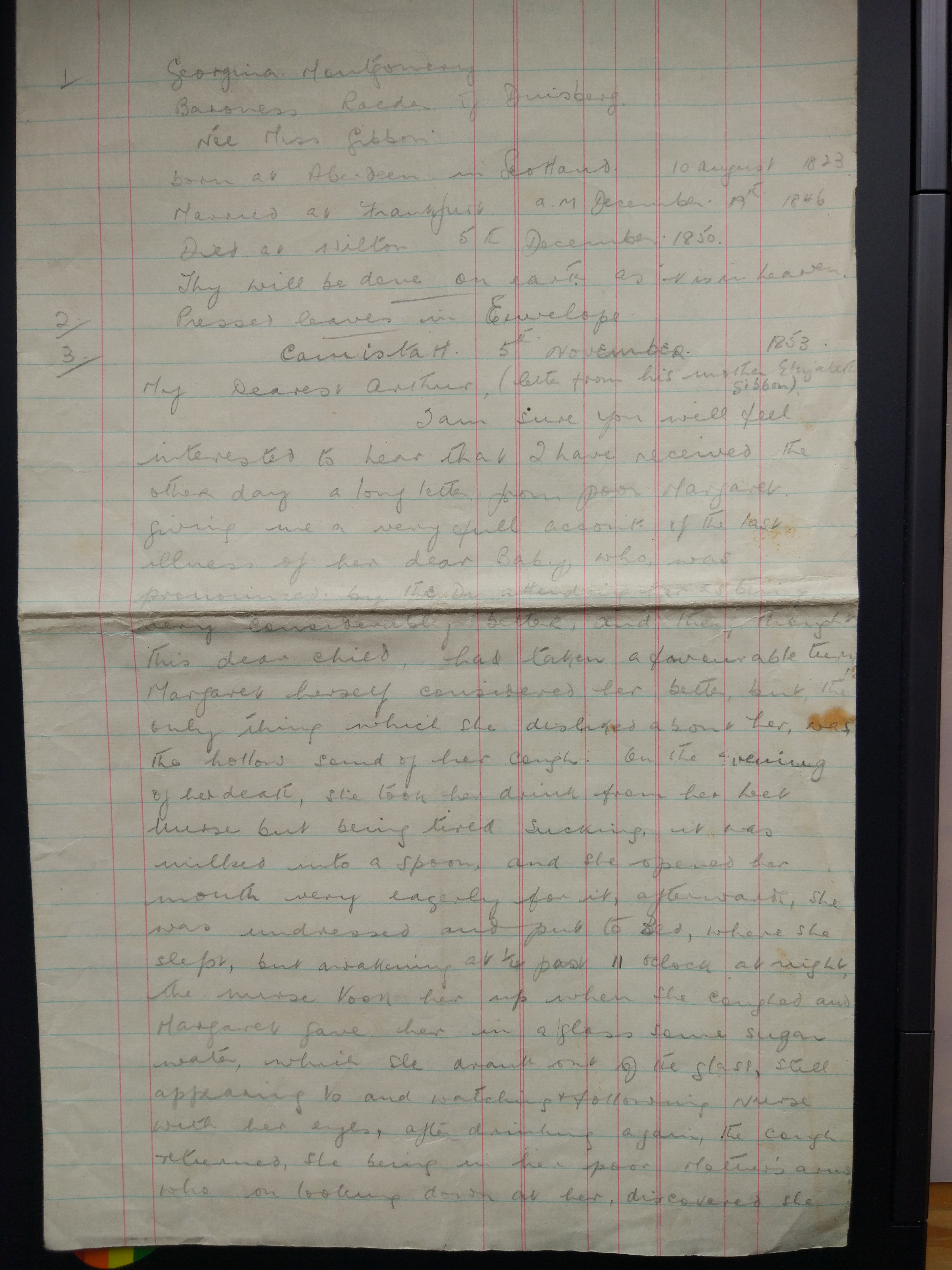
This sheet
may refer to the picture and say it is Georgina.
However, William's sister
Georgina
was married, age 25, in 1848.
This girl looks too young.
And doesn't look like her.
And also too young for his sister
Margaret
(age 30 and married).
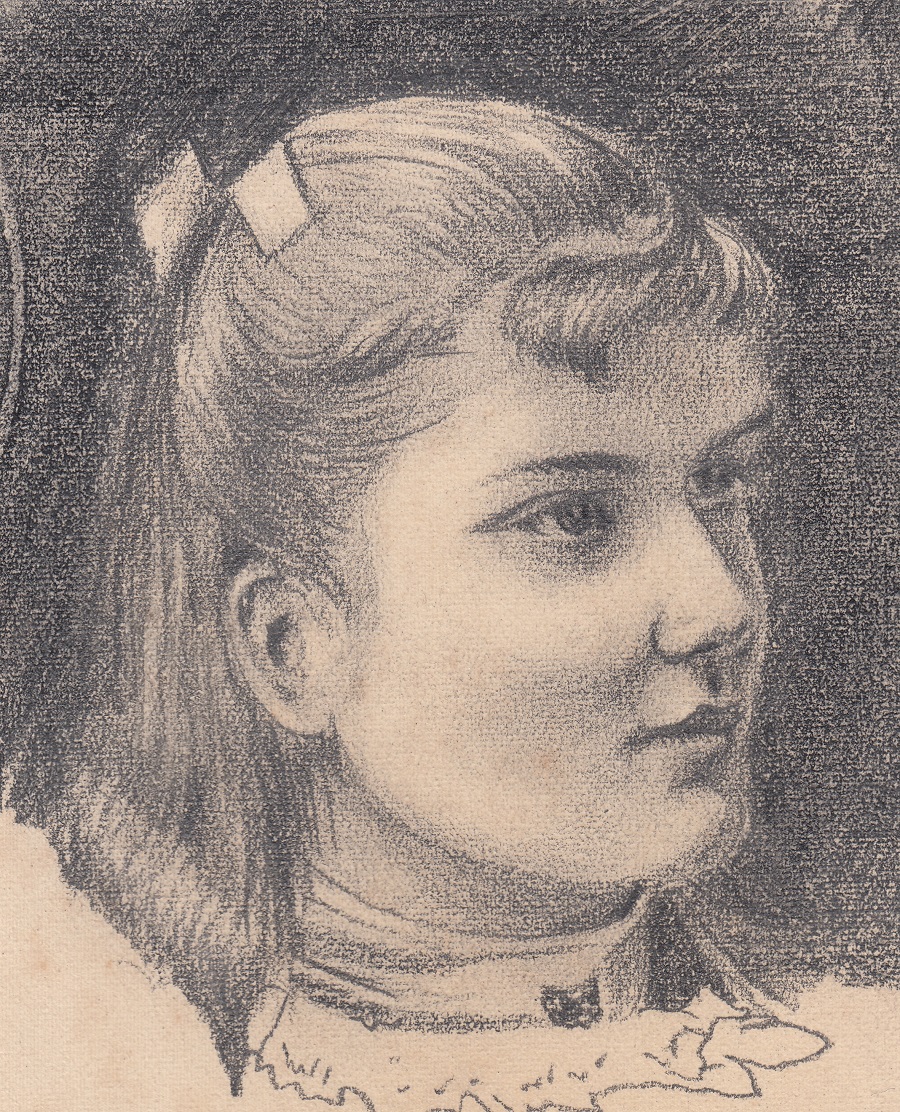
Sketch by William Henry Gibbon, 1848, of an unknown girl.
See
larger
and
full size.
See
second, almost identical picture.
"There is one warning lesson in life which few of us have not received,
and no book that I can call to memory has noted down with an adequate emphasis.
It is this:
"Beware of parting!"
The true sadness is not in the pain of the parting, it is in the "When"
and the "How" you are to meet again with the face about to vanish
from your view!
From the passionate farewell to the woman who has your heart in her keeping,
to the cordial good-by exchanged with pleasant companions at a watering place,
a country house, or the close of a festive day's
blythe
and careless excursion
- a cord, stronger or weaker, is snapped asunder in every parting,
and Time's busy fingers are not practised in re-splicing broken ties.
Meet again you may: will it be in the same way?
- with the same sympathies?
- with the same sentiments?
Will the souls, hurrying on in diverse paths, unite once more,
as if the interval had been a dream? Rarely, rarely!
...
Are you happy in the spot on which you tarry with the persons
whose voices are now melodious to your ear?
- beware of parting; or, if part you must, say not
in insolent defiance of Time and Destiny,
'What matters! - we shall soon meet again.'"
- William Henry Gibbon, 27 June 1886.
References
Sources yet to be consulted
- British German Legion:
-
War Office: Foreign Legions records,
[NA.UK]
WO 15.
- Mercenaries for the Crimea:
the German, Swiss, and Italian Legions in British Service, 1854-1856,
Charles Calvert Bayley, 1977.
- Ten years in South Africa:
only complete and authentic history of the British German Legion
in South Africa and the East Indies,
William Westphal, Chicago, 1892.
- Morning in the heart: A memoir,
Kathleen van der Riet, Port Elizabeth, 2000.
- Memoir of life in the Eastern Cape.
- Pages 174-175
have notes about Oak Cottage and the Gibbons.
-
The
expenses book of
Arthur Augustus Gibbon
lists a wedding present for
"Lizzie Gibbon"
in June 1899
(some years after William Henry's death).
Could this be
Elizabeth van Niekerk?
Except whose marriage?