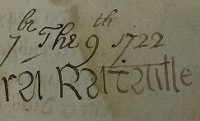
General Robert Hunter
General Robert Hunter,
bapt Oct 1666, Edinburgh.
Governor of New York and New Jersey.
Governor of Jamaica.
See
wikipedia.
Robert
began his military career in 1688 when a guard was formed to protect
the future
Queen Anne
as the rift began with her father James II.
He was
appointed aide-major, 19 Apr 1689, in the regiment of
dragoons
raised by
Henry Erskine, 3rd Lord Cardross,
in support of
William of Orange
in Flanders.
In 1690 he became
Captain
in Colonel John Hill's
regiment of foot.
On 28 Feb 1694 he was
transferred to the Royal Scots Dragoons
with rank of Captain.
On 28 May 1695 he
was appointed Major
of brigade in Flanders.
Appointed Major of
Charles Ross' dragoons
(5th Royal Irish Dragoons)
on 23 Apr 1698
[Lustig, 1983]
or 13 Apr 1698
[Seaver, 1929].
Promoted to brevet
Lieutenant Colonel
on 1 Jan 1703.
Distinguished himself as a soldier under
Marlborough.
He fought with Marlborough at
Blenheim in 1704.
He served under Lord John Hay,
commander of the Scots Greys,
and after his death in Aug 1706
he married his widow.
He was a poet, playwright and amateur scientist.
He was a friend of the writers and politicians
Richard Steele,
Joseph Addison,
William Congreve
and
Jonathan Swift.
He
mar
Elizabeth Orby
[born 1686,
descendant of Edward III].
They married in 1707
[Lustig, 1983].
She was
widow of Hunter's commander Lord John Hay,
and a wealthy heiress.
Through her he inherited estates at
Croyland Abbey, Lincolnshire,
and at
Chertsey, Surrey.
His family took the name "Orby Hunter".
Lieutenant Governor of Virginia, 1707 (captured at sea, never served):
He was
appointed Lieutenant Governor of Virginia
in 1707.
The Governorship of Virginia had been given to
George Hamilton, 1st Earl of Orkney
[one of Marlborough's generals]
in 1705.
Orkney appointed his friend Hunter as lieutenant to govern on his behalf.
Hunter sailed to Virginia on 20 May 1707,
but was captured en route by the French.
He was
taken to France as prisoner.
Had a
very civilized captivity.
Even received letters.
Letters survive written by
Swift,
early 1709,
to Hunter in captivity in Paris, which
"rallied him pleasantly on his social successes there"
[DNB].
Swift falsely suggested that Hunter was the author of the
"Letter Concerning Enthusiasm"
[dated Sept 1707, pub anonymously 1708].
In fact it was written
by the
3rd Earl of Shaftesbury.
Hunter was
released in a prisoner swap for the French
Bishop of Quebec in 1709.
He
became Captain General.
Governor of New York and New Jersey, 1710-1719:
Hunter suggested that the
Palatines
(Protestant refugees from persecution by Catholics
in Germany)
be settled in the British colonies.
He
petitioned the London Board of Trade to that effect.
The Board made a report
to
Queen Anne, 5 Dec 1709,
proposing a settlement
in the
Province of New York:
"May It Please
Your Majesty: In obedience to your Majesty's commands,
signified to us by the Right Hon'ble the
Earl of Sunderland, we have considered the proposals made to us by
Colonel Hunter,
for settling 3,000 Palatines at New York and Employing them in the
Production of Naval Stores".
The plan was
approved on 7 Jan 1710.
He is described as
"
Brigadier Robert Hunter".
He sailed from
Plymouth, 10 Apr 1710,
bringing with him nearly 3,000 Palatines
in a convoy of ships.
See
list of ships.
The ship he was on, the
Lowestoffe,
arrived at New York,
14 June 1710.
He was appointed
Governor of New York
and
New Jersey
the same day,
14 June 1710.
His wife
Elizabeth joined him in America in
1711, arriving at Philadelphia in July 1711.
Their children apparently were born and grew up for a while in America.
He organised the Palatines to work
in the forests of New York producing
tar
for
the English Navy.
See
letter from him
from New York, 24 July 1710.
He is
described as:
"one of the few
popular Royal Governors in American history".
But he had many problems with the Palatines,
who became the pioneer settlers of
Schoharie County, New York.
He is
described as:
"a man of wit and humor".
Also
described as:
"a Whig and friendly to Marlborough".
He was a friend in America of
Lewis Morris
and
James Alexander.
He authored (with Lewis Morris) a satiric farce
Androborus (1714).
This was
the first play to have been written and printed in British
America.
Elizabeth died in
Perth Amboy,
New Jersey, Thur 9 Aug 1716, age 30 yrs.
She was
bur in the Chapel in Fort George, Manhattan, New York City.
See
[The Boston News-Letter, report dated from New York, Mon 13 Aug 1716].
They had issue (see below).
Hunter also had an affair c.1716 with Betty Holland [a New York seamstress] and had natural issue:
- Elizabeth Hunter,
natural dau,
born 1716 to 1719,
fl 1733.
He returned home 1719,
with rank of
Brigadier General.
In 1720 he became comptroller of the customs
at the
Custom House,
London (the 1715 building that burnt down in 1814).
He swapped
jobs with
William Burnet,
who became Governor of New York.
He served as comptroller
under the First Lord of the Treasury, the
3rd Earl of Sunderland,
and later, from 1721, under
Walpole.
He
inherited
Burton Pedwardine, Lincolnshire,
after
his wife's father died in 1724.
He became a member of the
Spalding Gentlemen's Society
9 March 1726.
This is the
oldest surviving local antiquarian society of England,
founded 1710, in
Spalding, Lincolnshire
(just N of Croyland).
Isaac Newton
(died 1728) was a member.
Governor of Jamaica 1727-1734:
He was
appointed
Governor of Jamaica
in 1727.
He was asked
to re-assert
British control of
Jamaica
against the
Maroons
(free and escaped slaves).
He
gained rank of
Major General
20 June 1729.
He was frustrated
by Jamaica's mountainous terrain, which the Maroon leaders used to their advantage
in guerrilla warfare.
He set up a sugar plantation c.1730 which he called
"Hunterston"
in
Portland Parish,
NE Jamaica.
He sent
slaves
to work the plantation.
His will dated 5 Jan 1733 [new style year].
He
died Jamaica, 31 Mar 1734, age 67 yrs, shortly before the reinforcements he so
often requested finally arrived in Jamaica.
He was bur 1 Apr 1734, churchyard of the
Anglican church, Spanish Town, Jamaica.
The church survives
but Hunter's
grave does not survive.
He is
described
at death 1734 as
lord of the manor of Croyland.
His
will proved with codicil in
Prerogative Court of Canterbury, 4 Nov 1734.
He is listed as of Burton Pedwardine, Lincolnshire,
and Captain General and Commander in Chief of Jamaica.
Robert and his wife Elizabeth (married 1707, died 1716)
had issue:
- Charles Orby Hunter,
elder son, born est c.1709.
Must be named after his granduncle
Sir Charles Orby, 2nd Baronet
(who was alive and the current Baronet at this point).
He
went to Jamaica with father 1727.
He died as a young man in Jamaica, 1732
[Lustig, 1983], age est c.23 yrs.
- Henrietta Hunter,
eldest dau.
Though father's will implies she is born post-1712.
She did not go to Jamaica in 1727.
Stayed in England with sister Mrs. Sloper.
Her father left her £5,000 in his will 1733.
Her then under age 21 and unmarried.
[Green, 1879]
says she was unmarried in 1737.
- Catherine Orby Hunter,
or Katherine or Katharine,
"Kitty",
born 28 Aug 1712, 2nd dau
[Sloper tree].
[Green, 1879]
says 2nd dau.
Could be after her great-grandmother
Catharine Guernier (died 1706).
Her father gave her £6,000 at mar.
She mar 13 Nov 1727 [him age 18, her age 15]
to William Sloper
[born 28 Apr 1709]
and had issue.
Marriage location given as
"Fleet"
(think this means a
Fleet Marriage).
She and her husband separated sometime between 1734 and 1737.
He lived with another woman in a famous scandal.
-
Thomas Orby Hunter,


younger son,
born c.1714.
He must be born in America, probably in New York.
See his ancestors
by Leo van de Pas.
Must be named after his grandfather
Sir Thomas Orby, 3rd Baronet
(who was not yet Baronet at this point).
His
mother died 1716.
- Charlotte Hunter,
youngest dau, born pre-1716.
Must be after her grandmother
Charlotte Gerard.
She
did not go to Jamaica in 1727.
Stayed in England with sister Mrs. Sloper.
Her father left her £5,000 in his will 1733.
Her then under age 21 and unmarried.
[Green, 1879]
says she was unmarried in 1737.
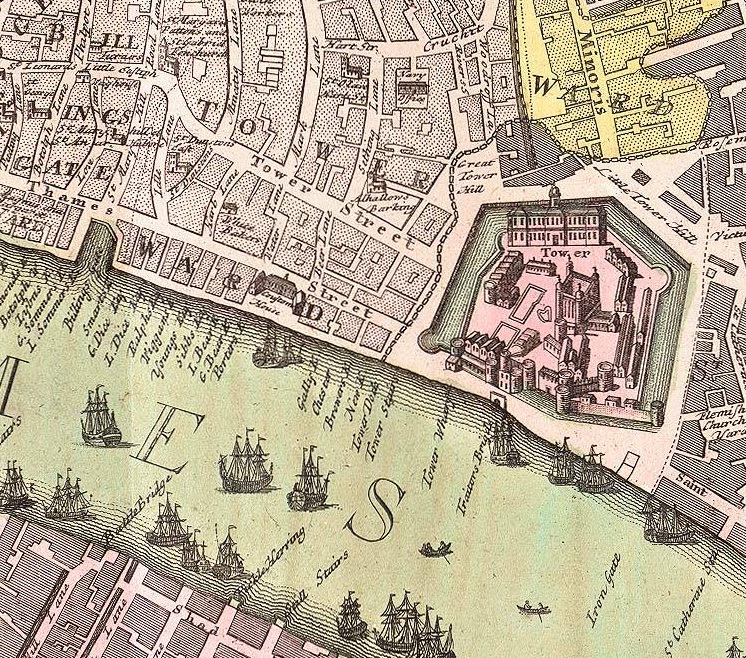
The
Custom House,
London (the 1715 building that burnt down in 1814).
On the river near the Tower of London.
From
Homann Heirs' map of London, 1736.
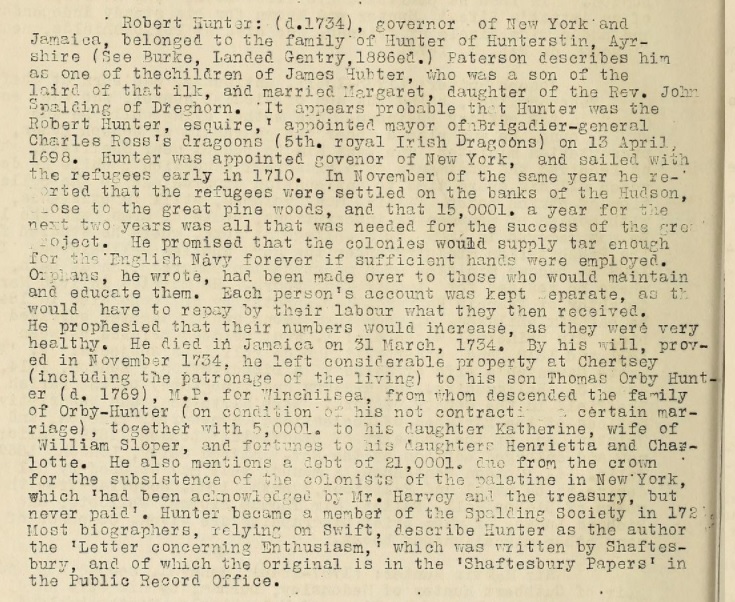
Biography of General Robert Hunter in [Seaver, 1929].
Text was formerly here.
The
10th Earl of Pembroke
had an affair in 1762
with General Robert Hunter's granddaughter
Kitty Hunter.
There were claims she was a "stable girl"
or "an actress",
but the status of her father and grandfather shows this is nonsense.
She was a society lady of fashion, from a political and military family.
And
quite likely the reason she met the 10th Earl
was because their families already knew each other,
or at least moved in the same circles.
Here are the most obvious connections:
And some other connections:
Governors of Jamaica in fiction
Both of the following are ludicrous but good fun:
- The movie
Swashbuckler (1976)
depicts a fictional Governor of Jamaica
in 1718.
- The
Pirates of the Caribbean
series of movies
(2003 to date)
feature
a fictional Governor of Jamaica,
Weatherby Swann,
and his daughter Elizabeth Swann.
- Weatherby Swann
is widowed (like Robert Hunter).
-
In so far as any logical
timeline
can be established, Swann was Governor of Jamaica in the 1720s.
In real life, Robert Hunter was Governor of Jamaica 1727-1734.
Tribute to Governor Swann in
Pirates of the Caribbean.
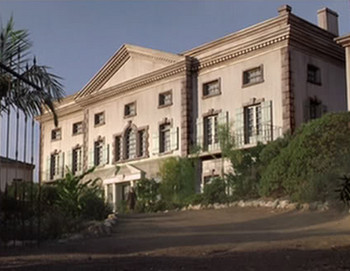
Governor Swann's Mansion
in Pirates of the Caribbean.
George Orby Hunter
George Orby Hunter is unidentified.
Presumably he descends from General Robert Hunter and Elizabeth Orby.
See
discussion
about who he might be.
- George Orby Hunter,
born 1773 (according to age at death).
Though if he was an Ensign in 1783 he must be born earlier, maybe c.1765.
Colonel
in English infantry.
He
translated the works of
Byron (died 1824)
into French.
Lived 6 Grande Rue,
Dieppe, France
(see map).
He died at his house in Dieppe, 26 Apr 1843, age 70 yrs.
Translation completed by
Pascal Ramé and
published Paris, 1845.
See biography in
[DNB]
(which is unable to identify his parentage).
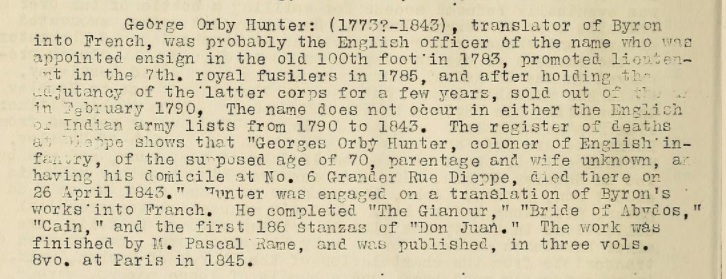
Biography of George Orby Hunter in
[Seaver, 1929].
Text was formerly
here.
Elizabeth Orby Hunter
Elizabeth Orby Hunter is unidentified.
This is her married name.
Presumably her husband descends from General Robert Hunter and Elizabeth Orby.
- Elizabeth Orby Hunter,
born 1756.
Described at death as widow,
of Upper Seymour Street, London.
She was bur 12 June 1813, St Marylebone, Westminster, age 57 yrs.
See index
and index.
See her will
(and here).
Her will was proved June 1813,
leaving a vast amount of money
for the care of her parrot. Also:
"and if any one that I have left legacies to attempt bringing in any bills or charges against me,
I will and desire that they forfeit whatever I may have left them, for so doing, as I owe nothing to any one.
Many owe to me both gratitude and money, but none have paid me either."
References
Sources yet to be consulted
-
Robert Hunter in [DNB].
See here.
- Will of Robert Hunter.
PROB 11/668/26
in [NA.UK].
- Letters from Swift to Hunter in 1709.
Swift, Works, xv, 326, 337.
- Minute-Books of The Spalding Gentlemen's Society, 1712-1755,
published by the Lincoln Record Society, 1981.
-
The Governors of New Jersey 1664-1974: Biographical Essays,
New Jersey Historical Commission, 1982.
Paul A. Stellhorn and Michael J. Birkner, Editors.
- Biography of General Robert Hunter:

- New York:
-
"Robert Hunter and the Settlement of the Palatines, 1710-1719",
C.B. Todd,
in
Memorial History of New York, Vol.2,
J.G. Wilson,
New York, 1892.
-
The History of the Province of New York,
William Smith, 1757.
- Manuscripts related to
General Robert Hunter:
- Reviews of
[Lustig, 1983]:
- Review
by Robert C. Ritchie,
The American Historical Review, 1984, American Historical Association.
- Review
by Jessica Kross,
The Journal of American History, 1984, Organization of American Historians.
- Review
by Sung Bok Kim,
The William and Mary Quarterly, 1986,
Omohundro Institute of Early American History and Culture.
- Review
by Colin Bonwick,
The English Historical Review, 1986, Oxford University Press.
Links