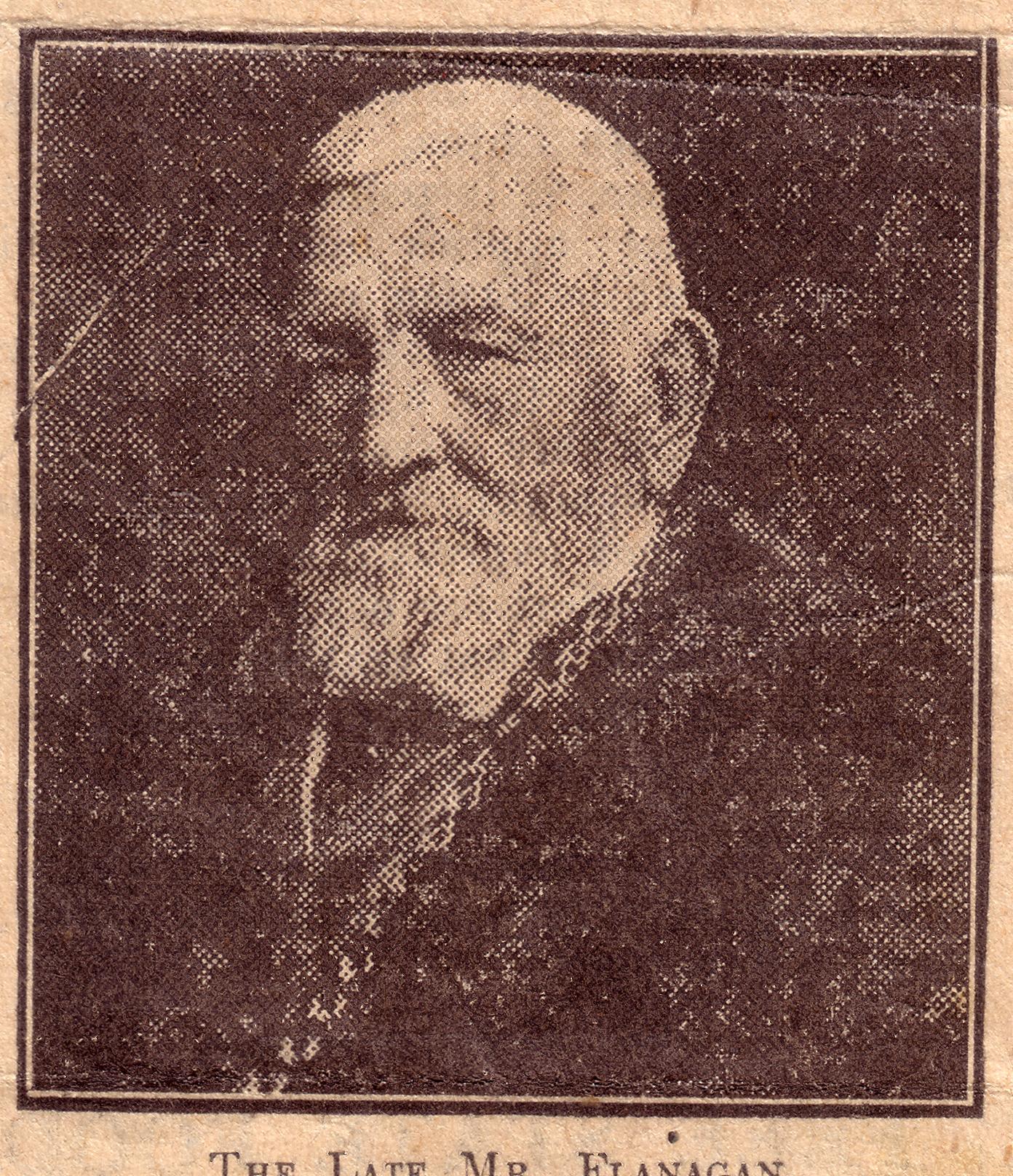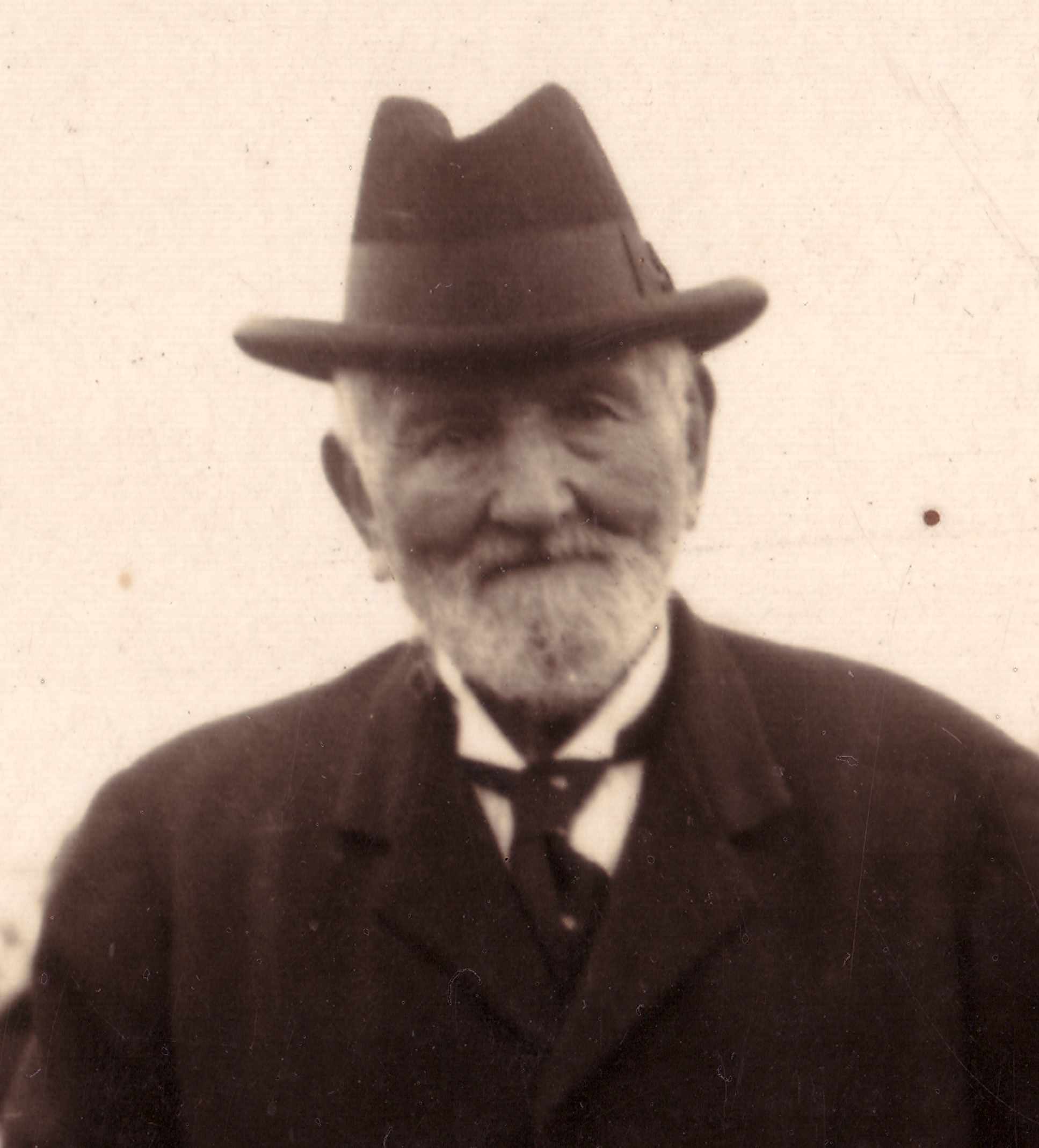
Alderman Michael Flanagan,
Michael
grew up on family farm,
Greenhills, Tallaght,
Co.Dublin.
He
was taken by his father to see Daniel O'Connell
speak c.1840.
He remembered The Famine (1845-50).
[Frank Flanagan] said:
"My father told me of the Famine,
and the terrible times the unfortunate people went through".
He would be "Michael Flanagan" who sp bapt of his nephew Patrick Malone 1853.
He grew vegetables, starting on his father's small holding at
Greenhills, Tallaght.
There is a story in the family
of
Marie Ryan (née Hughes)
of Jamestown House, Inchicore,
that she
"walked out with" the Alderman when she was a widow.
This story is according to her descendant
James Molloy.
The dates are unclear, but it seems more likely
she was a young widow (around the 1860s)
rather than when they were both widowed in old age.
"Michael Flanagan" sp the bapt of his niece
Mary Ellen Doyle
1865.
He
wit his sister's mar, 6 Aug 1866
and got married himself days later.
He is listed as "gardener" (would be market gardener)
at mar 1866
[GROI].
He is
living Kilmainham at mar 1866
(possibly already living Royal Hospital, Kilmainham).
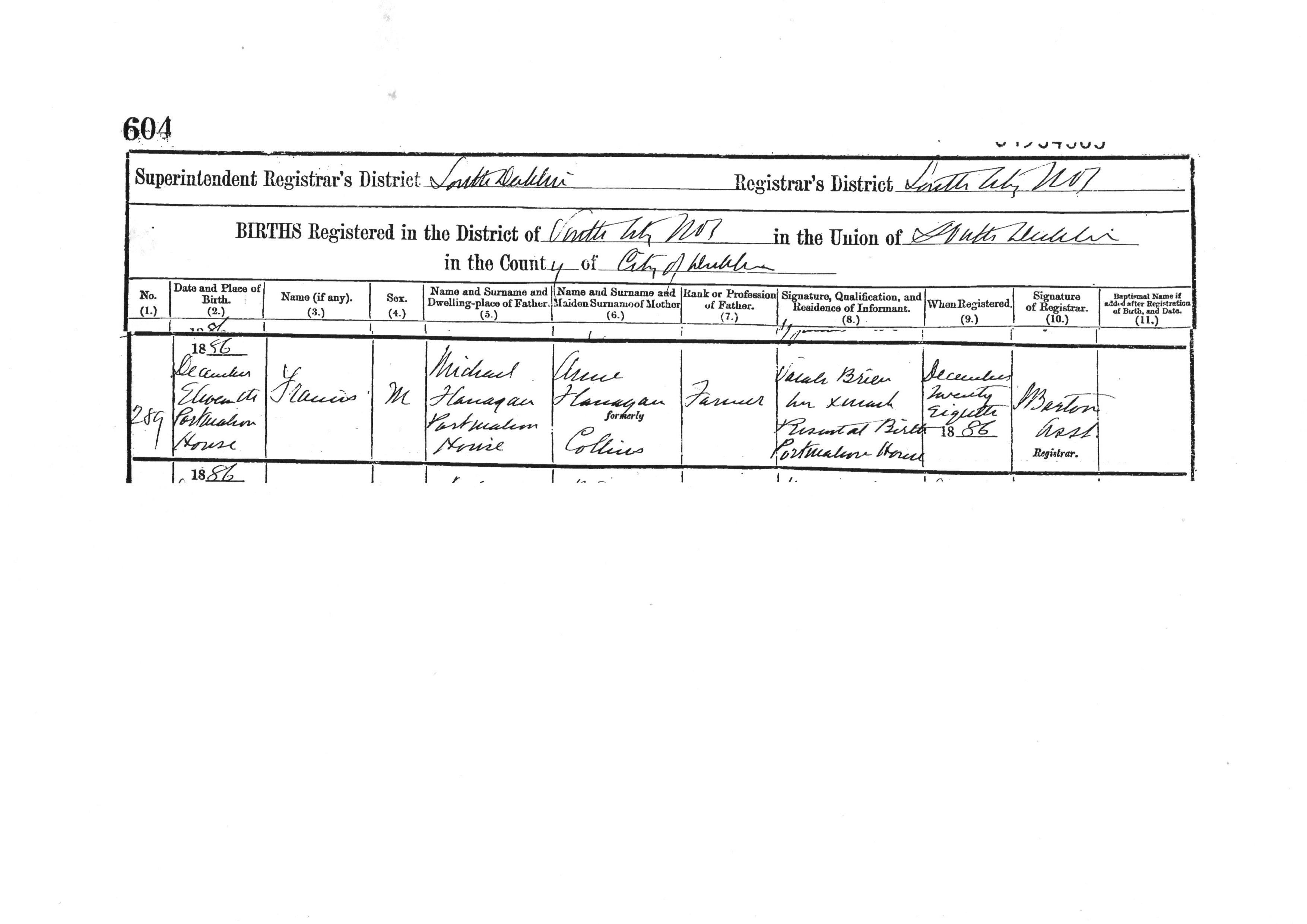
He
mar 19 Aug 1866
to Anne Collins
[bapt 27 Nov 1842].
|
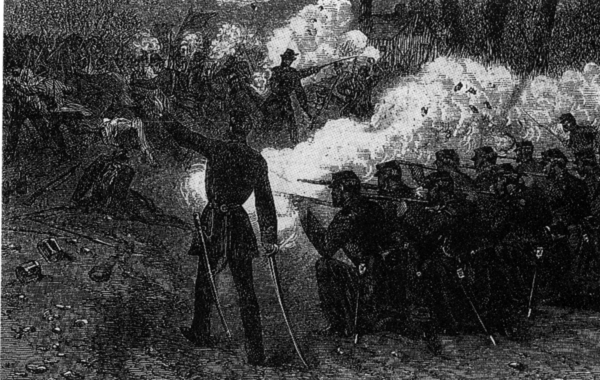
Fenian Rising 1867:
Michael was a nationalist. "He knew all the great Irish leaders from James Stephens to John Redmond." [Frank Flanagan's memoirs]. He was a supporter of the abortive Fenian Rising, 5th Mar 1867. [Frank Flanagan's memoirs] say Tallaght: "was the place in which the abortive 1867 Fenian rising took place. The morning of the rising my father entertained Lucas, the leader, and his men to breakfast" [presumably at Greenhills, Tallaght, rather than at Royal Hospital, Kilmainham]. However, I can't find any "Lucas" among names of leaders of the rising in Tallaght. The rising was a disaster, as, in the "Battle of Tallaght", a tiny force of around 15 armed Irish Constabulary at Tallaght village police barracks held off hundreds of poorly-led rebels advancing on incoming roads. The police force was renamed the "Royal Irish Constabulary" in Sept 1867 in tribute to its success against the Fenians. |
Michael and Anne lived for a short time
in the Garden Lodge
at the Royal Hospital, Kilmainham, Dublin.
Liam Cosgrave
said Michael just rented the Garden Lodge
for a time after marriage,
that he wasn't actually the gardener of the
Royal Hospital.
They are listed there at The Bird's birth, Apr 1867.
Michael
is
listed as a
"pensioner". This could be confusion with all the actual pensioners living there.
Or maybe Michael did actually serve in the military?
The Garden Lodge seems quite a good house to rent.
Though of course the fact that he had money by this time
is shown by the fact that he soon moves to Portmahon House.
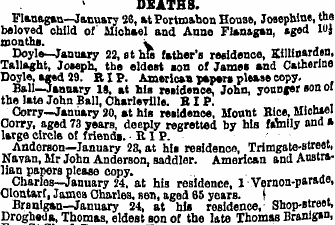
Michael and Anne
moved to Portmahon House, Rialto, Co.Dublin.
He purchased Portmahon House on 4 Apr 1867
[Deed of 1867].
Though still at Royal Hospital when dau born July 1868.
He is listed as "farmer".
He is
listed at Portmahon House in
[Thom's] from 1870 to 1932.
Listed as "gardener", living Portmahon House,
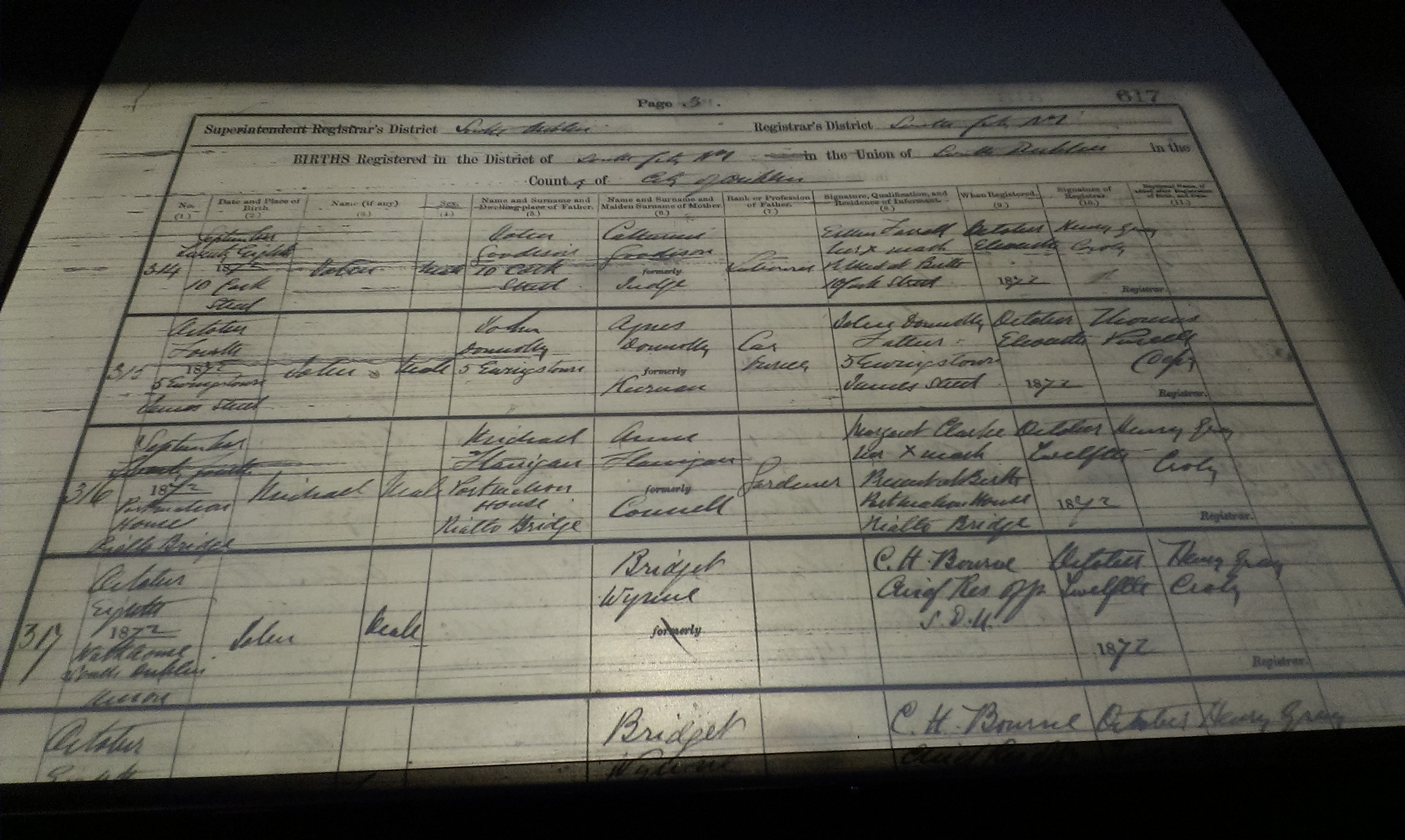
at son's births 1870 and 1872.
"Michael Flanagan" sp the bapt of his niece
Elizabeth Doyle
1870.
Listed as Michael Flanagan, farmer, of Portmahon House, in
[Deed, 1871].
Listed as "farmer and kitchen gardener", of Portmahon House, in
[Deed, 1873].
Listed as "market gardener", living Portmahon House,
as at [Deed of 1873].
Listed as "market gardener", living Portmahon House,
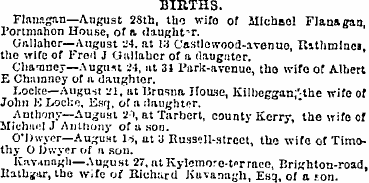
at Larry's birth 1874
[GROI].
He
built up market gardening business.
He and his brother William
inherited
Greenhills, Tallaght
after their father's death in 1874.
"Michael Flanagan"
sp the bapt of his wife's cousin's child Cecilia Toole 1876.
The only land Michael is listed as owning in
[Owners of Land, 1876]
is 6 acres at Greenhills and Crumlin.
Later he had acquired so much land in the area
that apparently Dublin Corporation stopped him
from buying any more.
[Liam Cosgrave]
said:
"his farming was mainly
tillage and vegetables,
at which work he employed large numbers of men and women.
The ploughing was, of course, done by horses
and the vegetables
were sown and cultivated by men and women."
There is a story about
the night of the Phoenix Park murders 1882.
The Alderman was driving out to Tallaght,
passed a sidecar with a group of men in it.
Found out later it was the assassins.
He noticed them because little traffic in those days.
The Alderman did not know them,
and did NOT help them.
|
Dublin Corporation councillor, PLG, Alderman, JP:
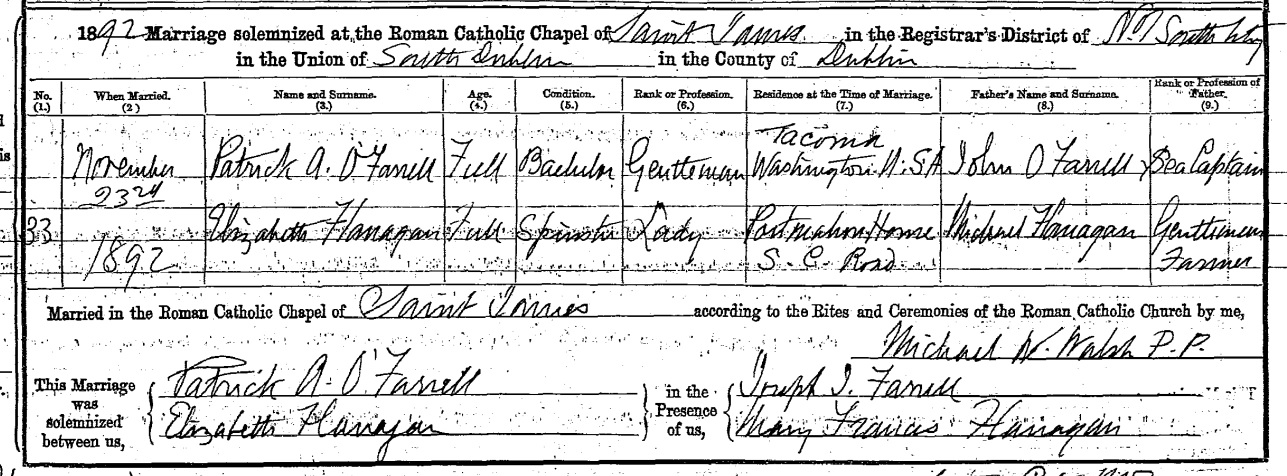
He was a prominent member of the Irish Parliamentary Party (the Nationalist Party, re-founded 1882 under Parnell). He was a Nationalist Party local councillor on Dublin Corporation (for Usher's Quay ward) from 1884 to 1919. He set the record for the longest tenure as councillor on Dublin Corporation [O'Brien, 1982, p.93]. [Thom's, 1884] lists him as Councillor for Usher's Quay ward for Dublin Corporation. [Thom's, 1884] also lists him as Poor Law Guardian for Palmerstown district for the South Dublin Union. His younger brother William Flanagan was also a guardian for South Dublin Union. Thomas Cosgrave is listed as the other guardian for Palmerstown district. Cosgrave's son would later marry Michael's daughter. Michael is listed as a "T.C." (Town Councillor) and "P.L.G." (Poor Law Guardian) in [Thom's] from 1884 on. Listed as "TC" (Town Councillor) at Laurence Dunne funeral, 1886. After his brother William died 1886 he inherited Greenhills, Tallaght. The Parnell divorce scandal broke in 1890. [Frank Flanagan's memoirs] say: "My father knew Parnell and, although a very strict practising Catholic, he never wavered in his devotion to Parnell." He was a friend of Andrew J. Kettle (a founder of the Land League). He became an Alderman of Dublin. Listed as Alderman in Deed, 5 Feb 1892. At dau's mar Nov 1892 he is listed as "gentleman farmer". Listed as Alderman and Justice of the Peace at his brother's death 1894. Listed as J.P. at Larry's mar 1895. Michael Flanagan, farmer, Greenhills, is listed under Tallaght in [Thom's] at least 1896 to 1960 (obviously many later entries are stale, the estate was then owned by Frank, it seems he left his father's name on it).
Story about him declining Lord Mayoralty and Baronetcy:
|
See entry
in 1901 census
at Portmahon House.
He is listed as Alderman,
Justice of the Peace, farmer.
Portmahon House has 13 rooms,
8 windows in front of house.
There are 32 out-buildings -
consisting of 6 stables, 3 coach houses, 1 harness room,
1 cow house, 1 calf house, 1 dairy, 1 piggery, 1 fowl house, 1 boiling house,
6 barns, 1 turf house, 1 potato house, 1 workshop,
4 sheds, 1 store, 1 forge and 1 laundry.
He is
listed as Alderman,
Justice of the Peace,
in [Deed of 1902].
[Obituary of Nora Flanagan, 1957]
says
the hounds of
the South County Dublin Harriers
were kennelled at "Portmahon Lodge" around 1909.
Think this is error for Portmahon House.
W.T. Cosgrave
(son of
Thomas Cosgrave)
became Sinn Fein councillor for Usher's Quay ward in 1909.
(W.T. would later marry Michael's daughter.)
|
Anne dies, 1910:
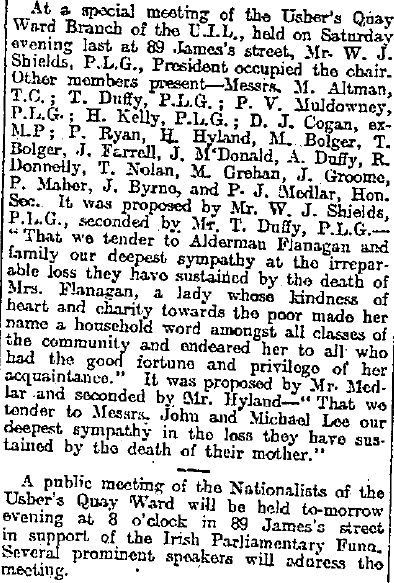
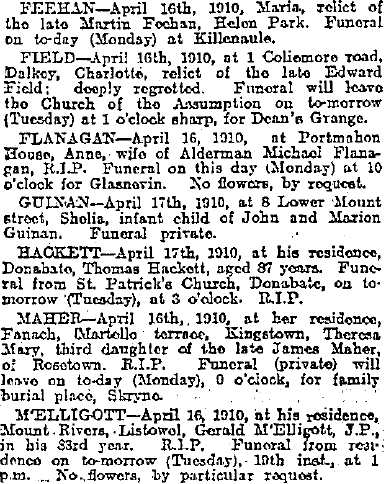
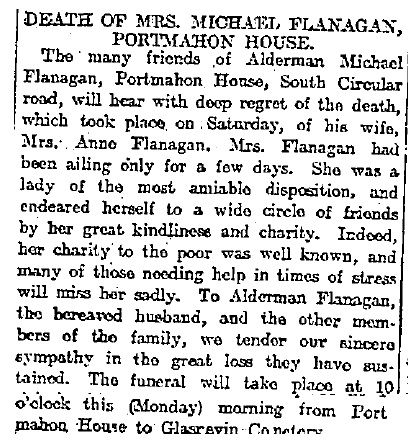
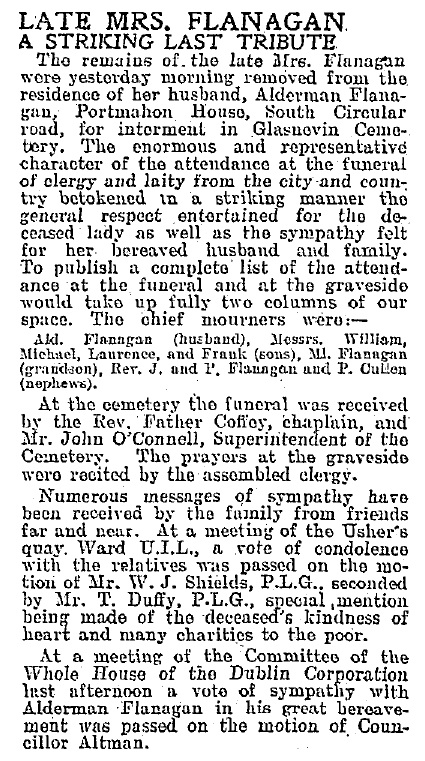
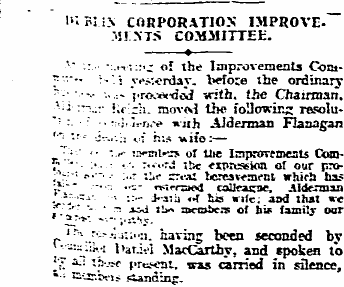
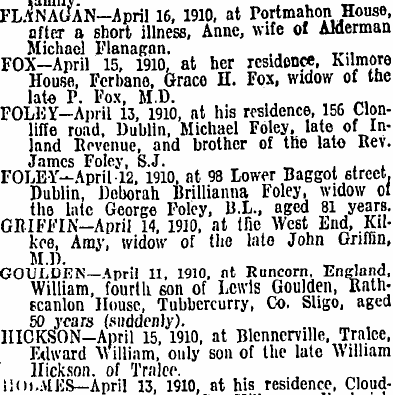
Anne died Sat 16 Apr 1910, at Portmahon House, age 67 yrs, after an illness of only a few days. See death cert from here. Registered in May and they get the date of death wrong. The United Irish League passed a vote of condolence on Sat evening, 16 Apr. See item in Freemans Journal, April 19, 1910. See death notice and report in Freemans Journal, April 18, 1910. Funeral Mon 18 Apr, bur Glasnevin Cemetery. Huge attendance at the funeral, including W.T. Cosgrave and John Stanislaus Joyce and Daniel John Hishon and the Lord Mayor and many city councillors. See funeral list, Freemans Journal, April 19, 1910. See funeral report in Irish Independent, Apr 19, 1910. Dublin Corporation passed resolution of sympathy for "Alderman Flanagan", 19 Apr 1910. See item in Irish Times, April 20, 1910. See death notice in Irish Times, 23 Apr 1910. |
The Alderman is
listed
in 1911 census
as
living Portmahon House.
He is "agriculturalist",
He and his children live with 2 servants.
The house has 6 rooms,
3 windows at front of house.
There are a total of 20 out-offices and farm buildings
(consisting of 4 stables, 2 coach houses, 1 harness room, 2 cow houses,
1 calf house, 1 potato house, 6 sheds, 2 stores and 1 forge).
He
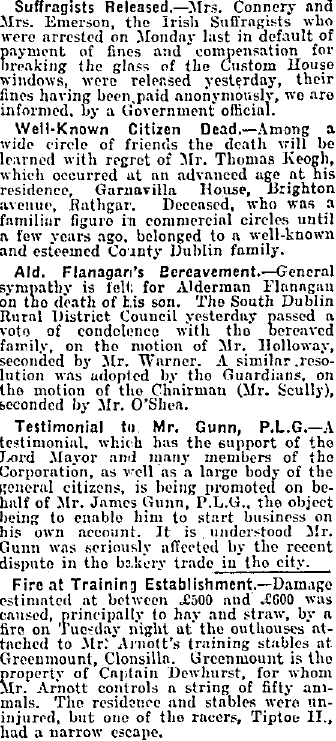
sold vegetables to Covent Garden, London, 1912/13.
"He was most successful, and as well as supplying the Dublin market
with vegetables, he exported to Liverpool and I think possibly the
Continent before and during
WWI."
[Liam Cosgrave].
He
exported hay to Glasgow, cabbages to Scotland.
The massive
Flanagan estate of SW Co.Dublin
probably reached its peak around 1914.
Liam Cosgrave
says his father W.T. told a story of visiting Portmahon some time before he married the Alderman's daughter in
1919.
The Bird
was attacking Sinn Fein,
not really to annoy W.T.
but rather to annoy his own father.
Eventually the Alderman said to The Bird:
"Are you sober enough to know you're drunk?"
Retirement, 1919:
[Thom's, 1919]
for
Usher's Quay ward
lists
Michael Flanagan
as Alderman,
W.T. Cosgrave
as Councillor,
and two other Councillors.
Lived to see many great-grandchildren (1919 on), the grandchildren of
Elizabeth and
Larry.
He
finally
retired from Dublin
Corporation 1919, age 86 yrs.
He was succeeded as Alderman by his son-in-law
W.T. Cosgrave
who became an Alderman after the Jan 1920 local election.
See him and the unmarried sons listed
at Portmahon
in 1926 census.
He is "farmer and market gardener" and "employer".
[Frank Flanagan's memoirs]
said:
"no matter how busy he was, he went to 12.00 mass daily until his last illness".
Liam Cosgrave
remembers going to 12 mass
in Adam and Eve's
on Merchants Quay
in the trap with his grandfather the Alderman,
late 1920s.
Poor fellas would be hanging round outside.
The Alderman would throw them six pence.
Liam remembers the Alderman using a
trap
in the 1920s.
He was not interested in getting an automobile.
His son Frank eventually bought him his first car.
Liam said the Alderman had a strong voice.
When there was a game of cards on
"you could hear him in the next parish".
Liam recalls visiting Portmahon House in the 1920s, with the Alderman upstairs confined to bed,
and his unmarried sons Michael (died 1929)
and Frank living there.
There is a letter of 1980 by his great-grand-niece
Marie Boyce (born 1923)
recalling visiting Portmahon House
as a child:
"There was a very old gentleman on a couch who looked very much like George Bernard Shaw.
My mother said he was Uncle Mike".
His will
is dated
14 Mar 1930.
He says he is "farm produce merchant".
Liam Cosgrave
says the Alderman left a provision in his will that if there was
any contest, they would forfeit - ensured no rows.
He lived to see great-grandchildren.
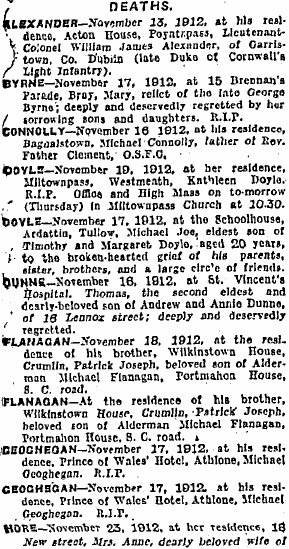
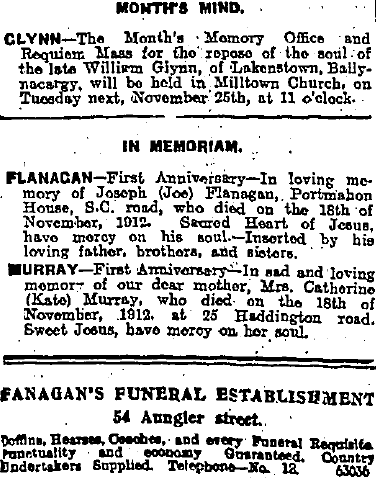
He outlived 7 of his 11 children.
Death, 1931:
He
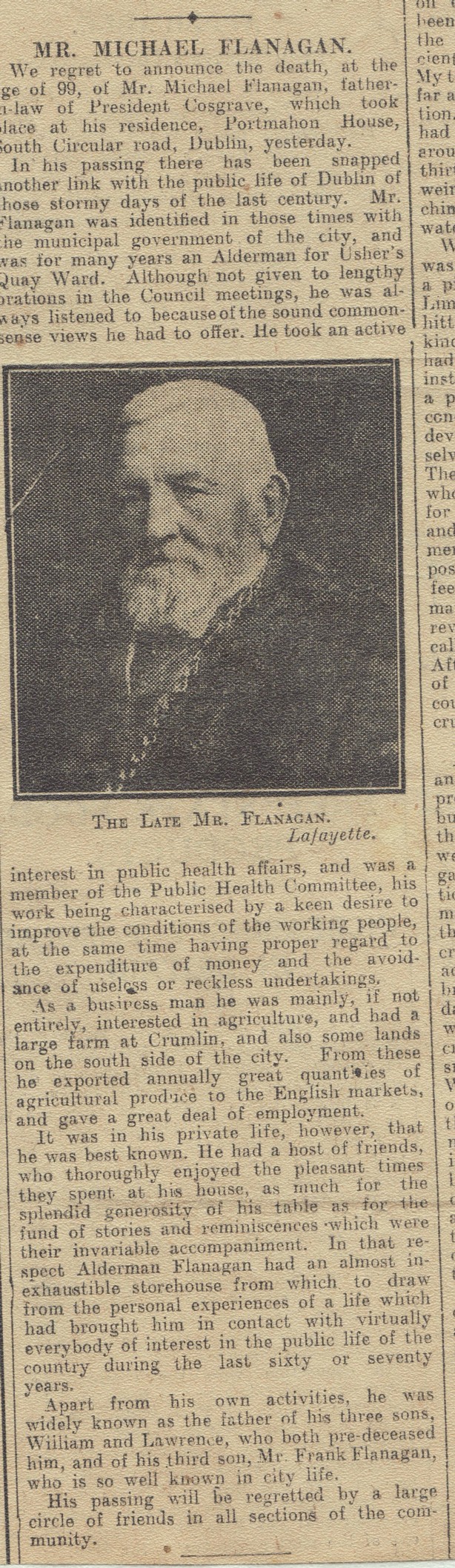
died Portmahon House, 16th Oct 1931, age 98 yrs.
See obituary
in Irish Times,
October 17, 1931.
Funeral 19 Oct,
bur Glasnevin Cemetery.
Mass celebrated by Fr. John Flanagan,
also presiding was
Michael Fogarty, Bishop of Killaloe.
Present at the funeral were the Alderman's son-in-law, the President of the Irish Free State
W.T. Cosgrave,
and
his entire
cabinet,
and a long list of politicians and clergy,
including
Eoin MacNeill and
John A. Costello and
Sean Mac Eoin (later Minister for Defence)
and
Batt O'Connor and
Sir Thomas Esmonde and
The Ceann Comhairle and
The Chief Justice and
The President of the High Court
and
The Lord Mayor.
See funeral report
and photo
in
Irish Times, October 20, 1931.
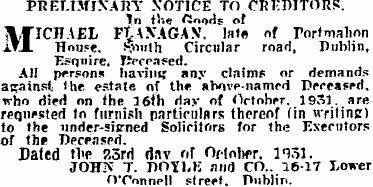
See
notice to creditors
in
Irish Times,
October 28, 1931.
His will
proved 13 Nov 1931.
Personal assets £18,600,
land £6,500.
This totals about £5m in
today's money.
But also many debts.
Michael and Anne had issue:


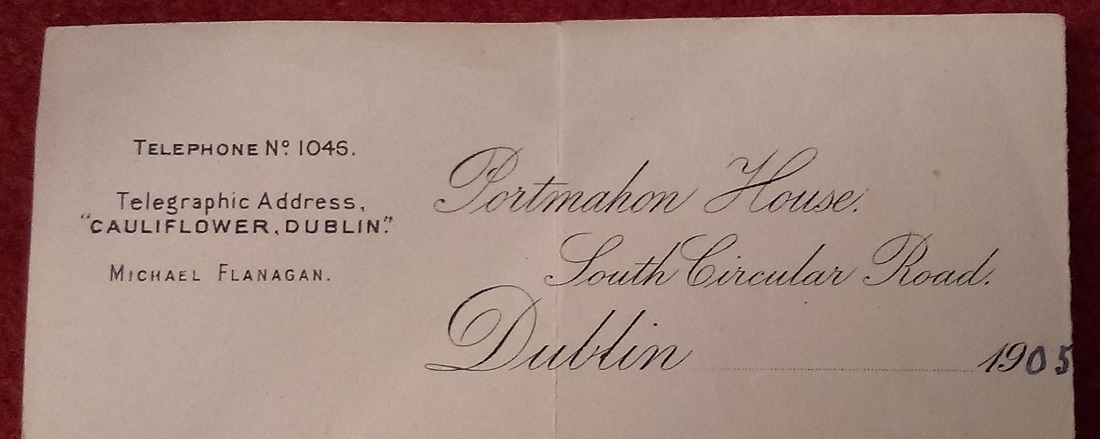
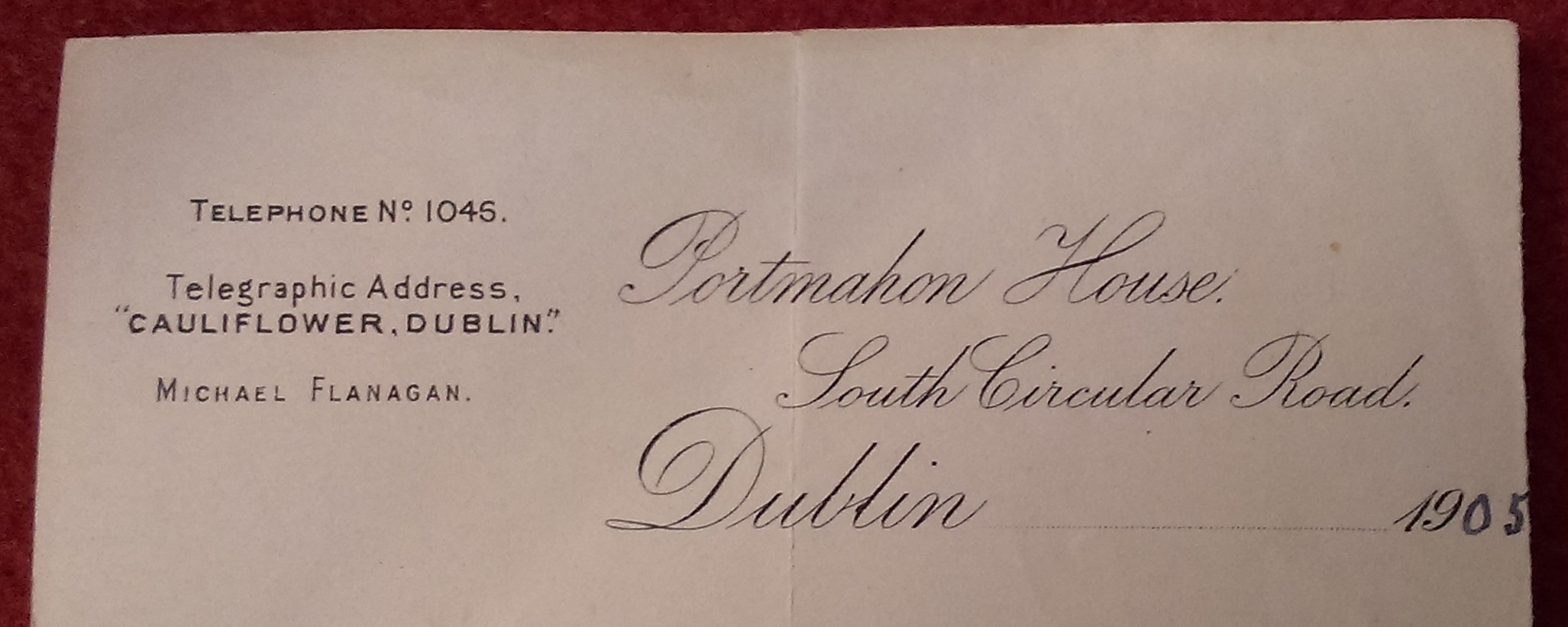
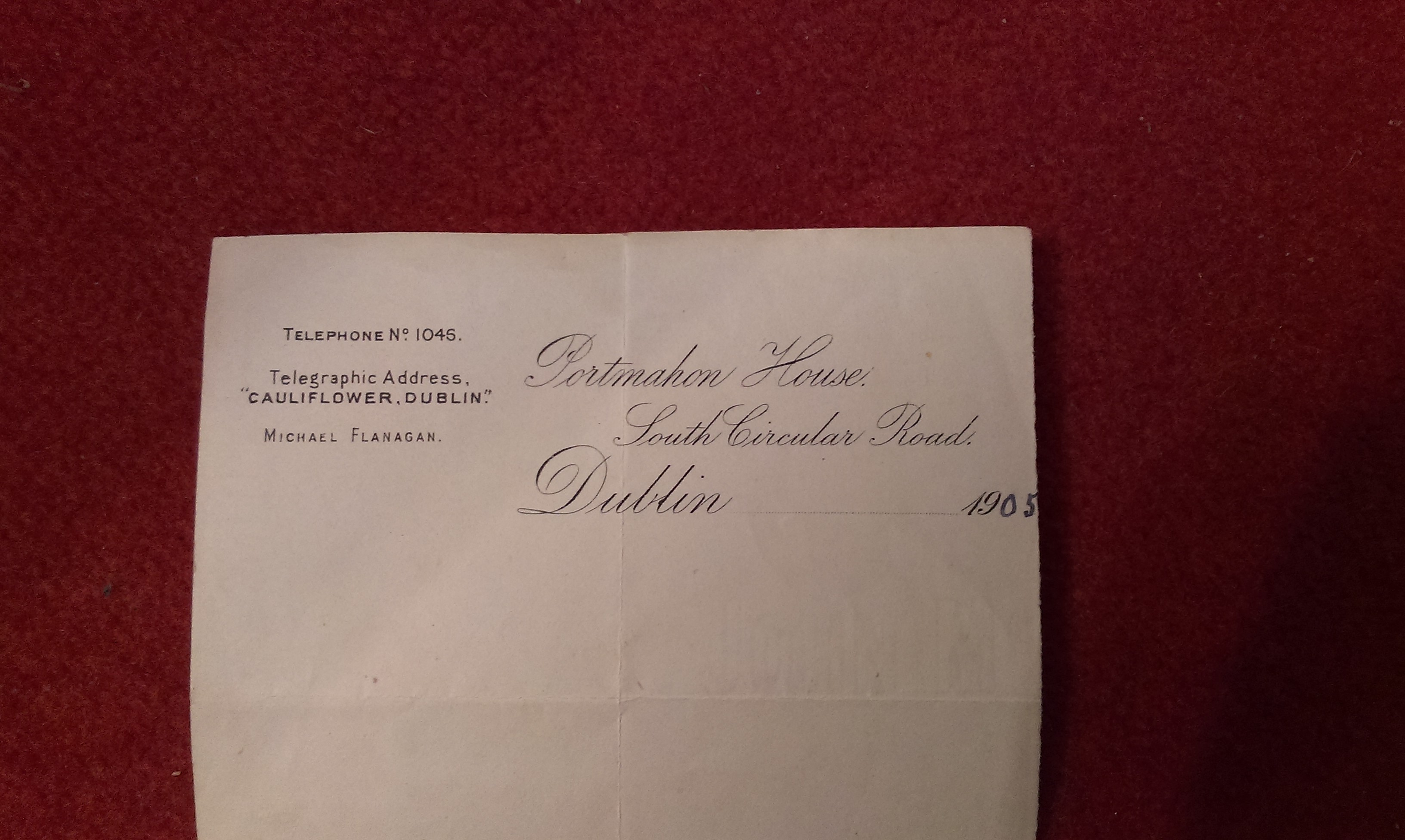
Alderman Michael Flanagan's notepaper from Portmahon House, 1905.
Note he had a
telephone.
Note also the amusing telegraph address.
See larger
and full size.
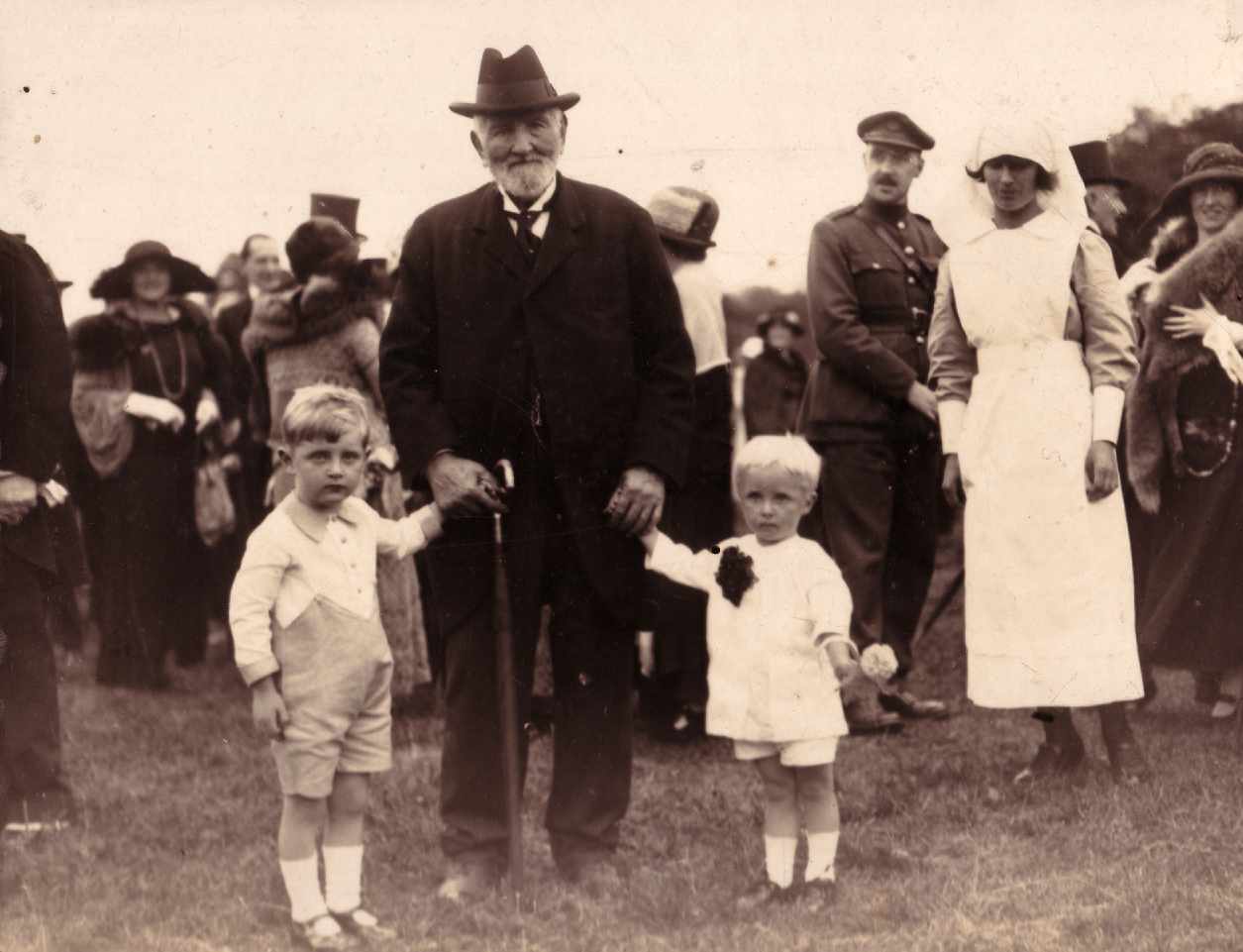
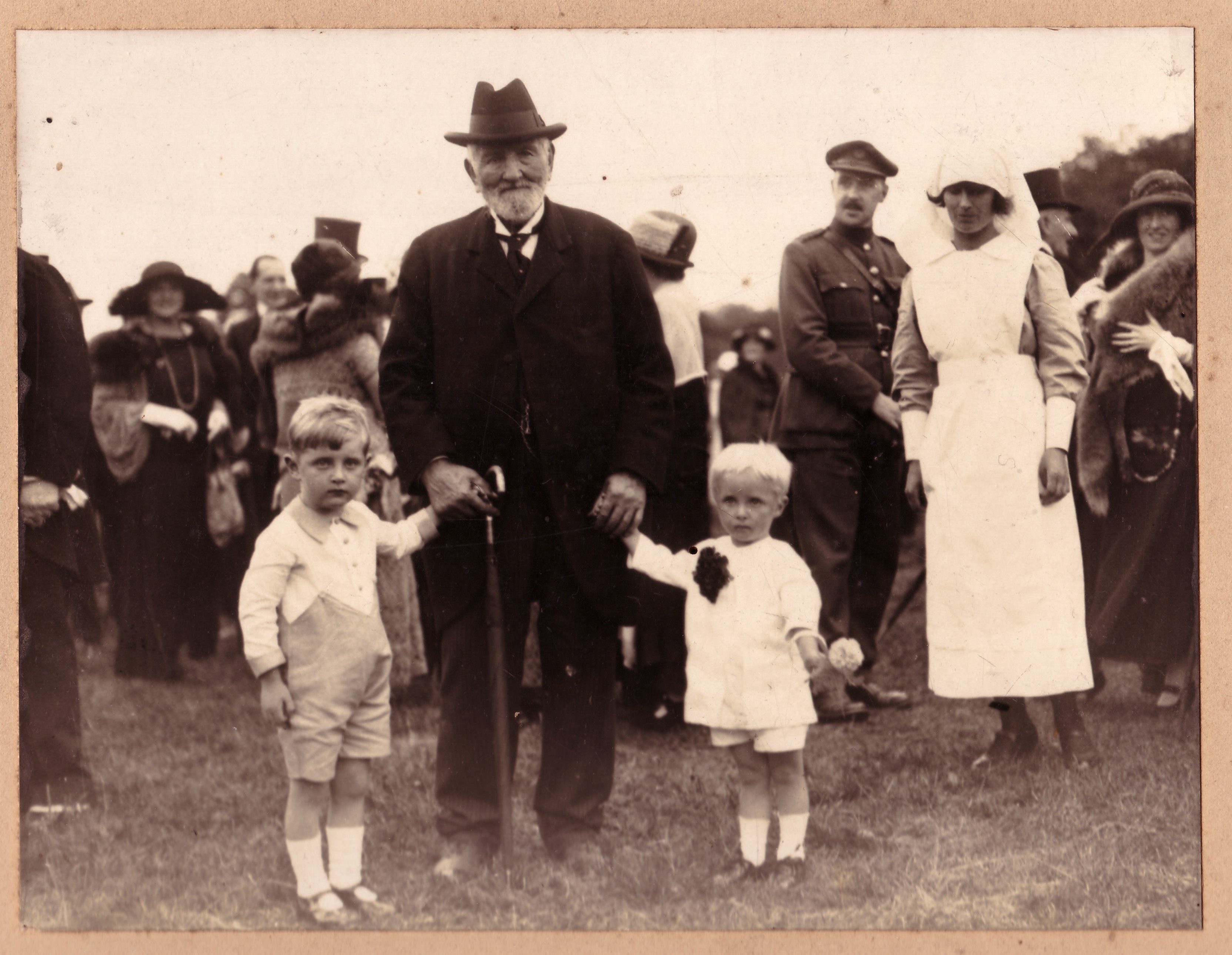
Alderman Michael Flanagan
with his grandchildren
Liam Cosgrave (left, born 1920)
and
Míceál Cosgrave (right, born 1922).
Garden party at the Cosgrave house,
Beechpark, 1925.
The officer on RHS is
Free State General J.J. O'Connell,
who was kidnapped by the republicans
at the start of the Civil War,
June 1922
(later released unhurt).
See larger
and full size.
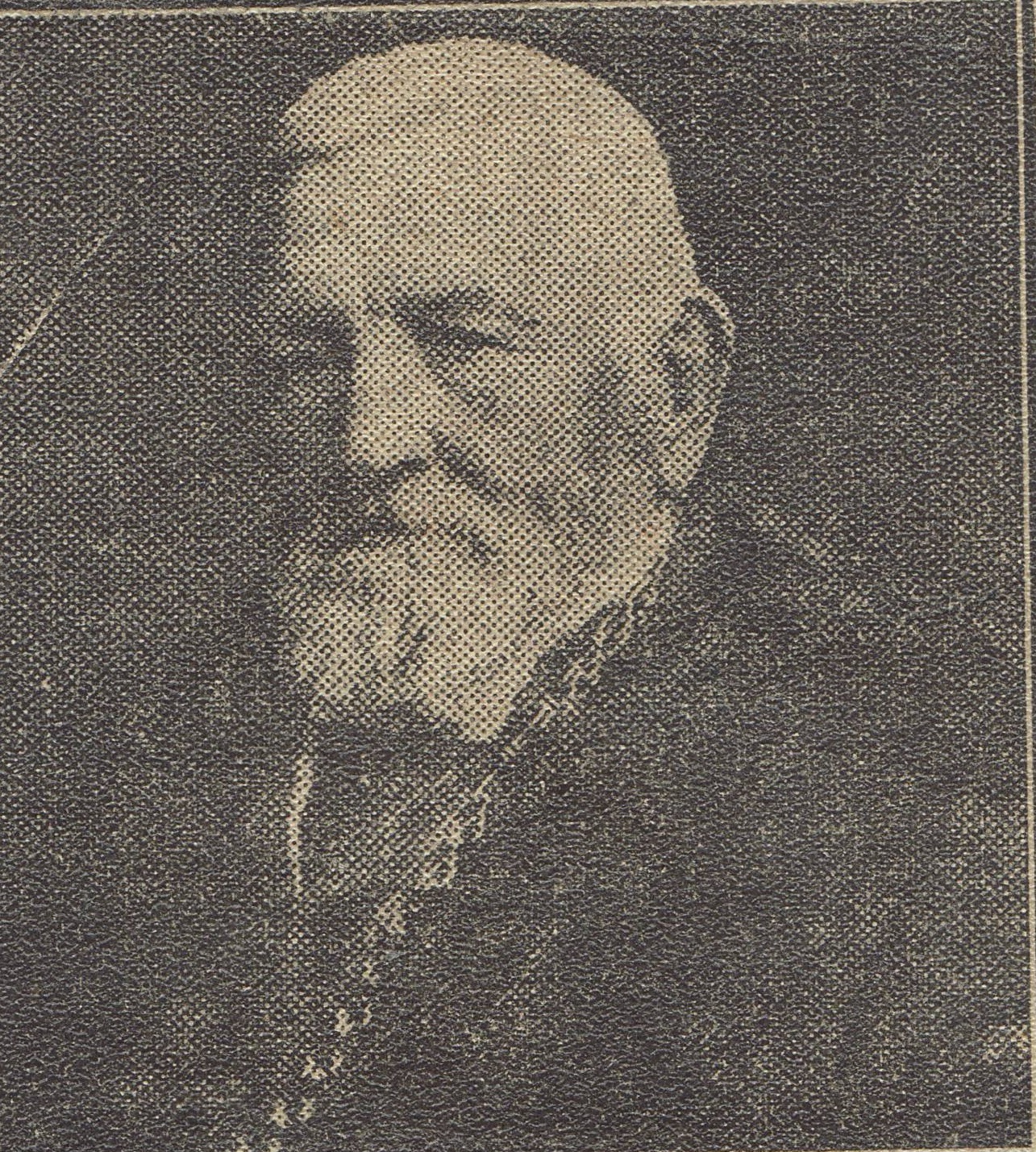
Alderman Michael Flanagan.
From obituary, Irish Times, October 17, 1931.
See wider
and full size.
See other scan.
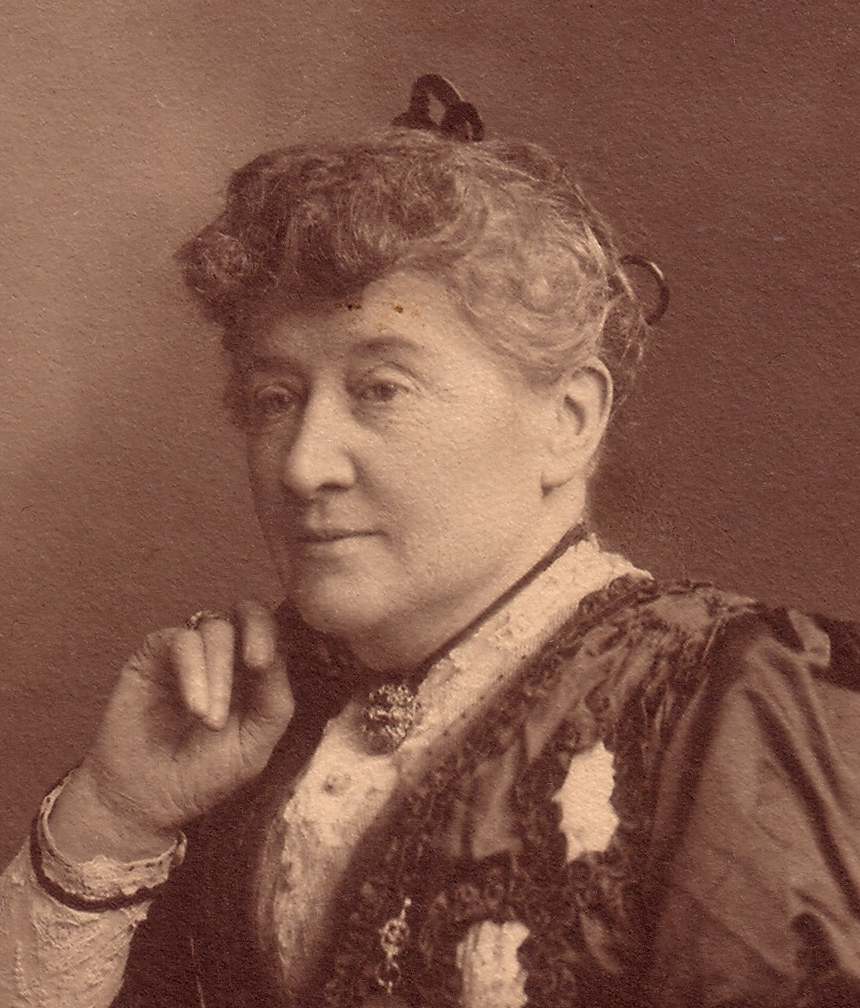
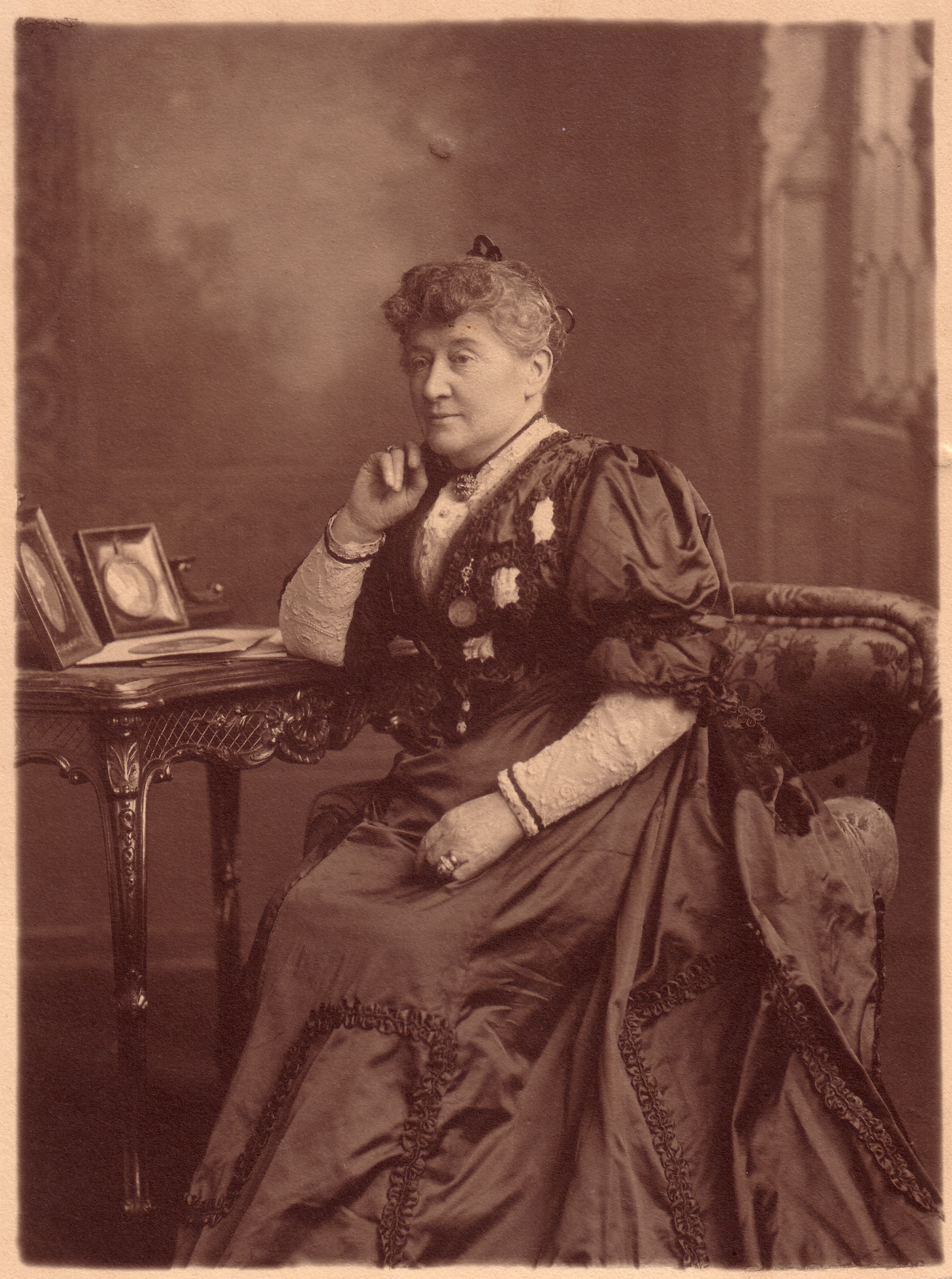
AI animation of Anne Collins in
photo perhaps c.1895.
Please donate to support this site.
I have spent a great deal of time and money on this research.
Research involves travel and many expenses.
Some research "things to do"
are not done for years, because I do not have the money to do them.
Please Donate Here
to support the ongoing research and
to keep this website free.
![[Obituary of Nora Flanagan, 1957]](Newspapers/obit.1.a.jpg)