Frank Flanagan,
Went for priesthood:
He initially went for the priesthood.
He
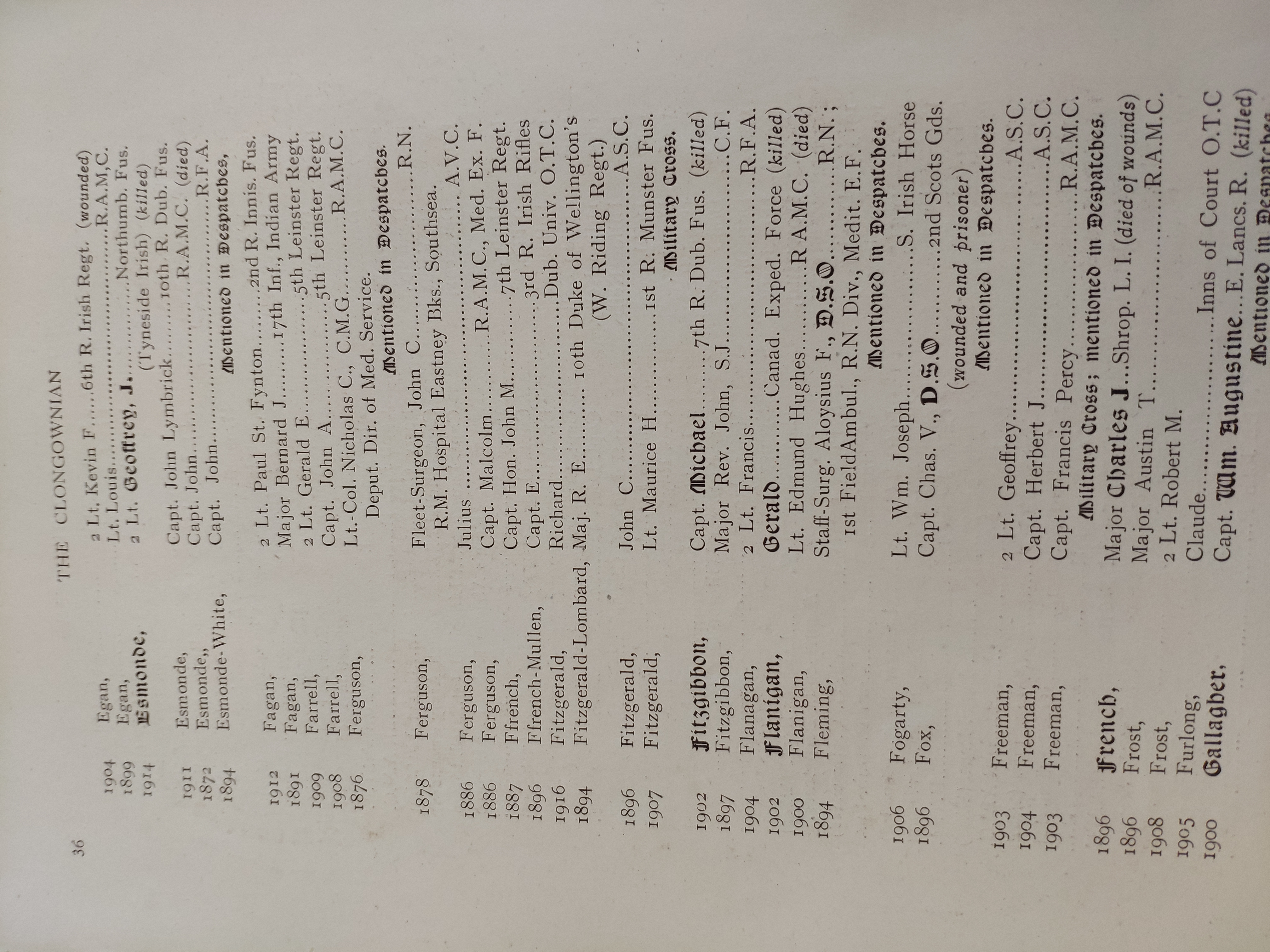
joined the Jesuits
7 Sept 1904 (age 17).
He
was planning to become a priest on the missions.
He
stayed for 3 years.
Eventually decided wasn't suited, left apparently 1907.
His parents
gave an inscribed
monstrance
to the Jesuits.
He
didn't go to university.
He recalled:
"I had no incentive to work. Father told me I need not
take up a profession, as he had sufficient land and property
to ensure my future."
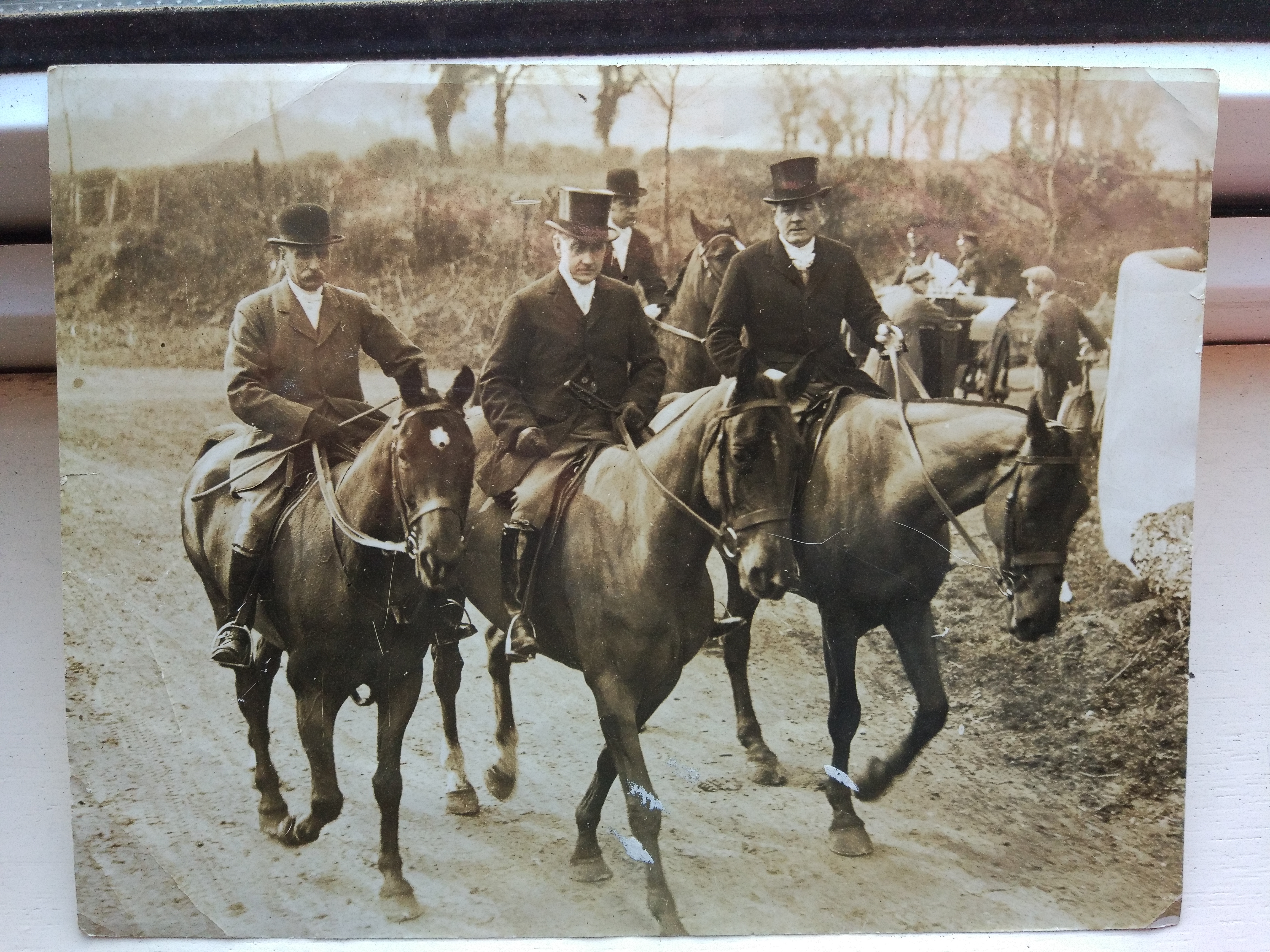
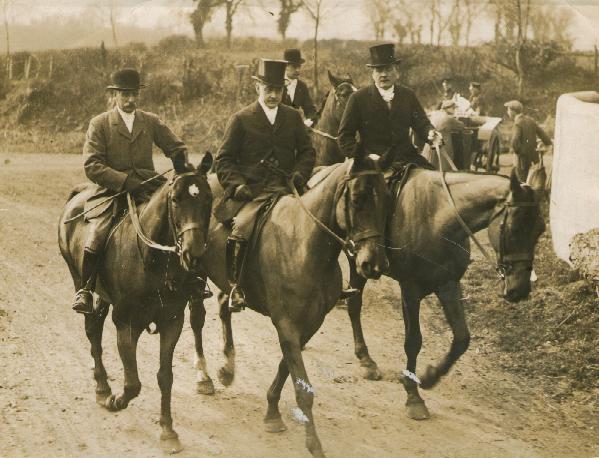
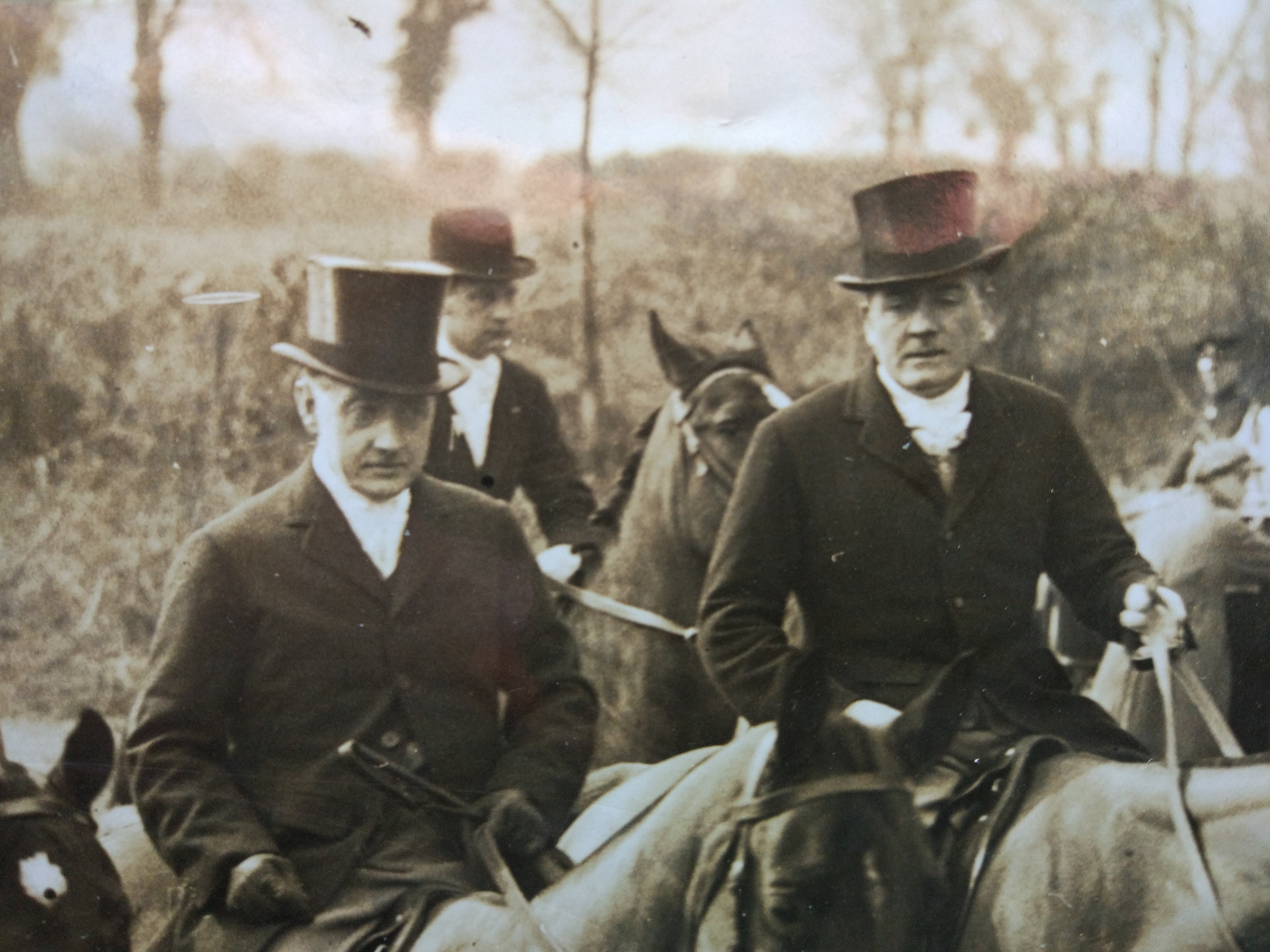
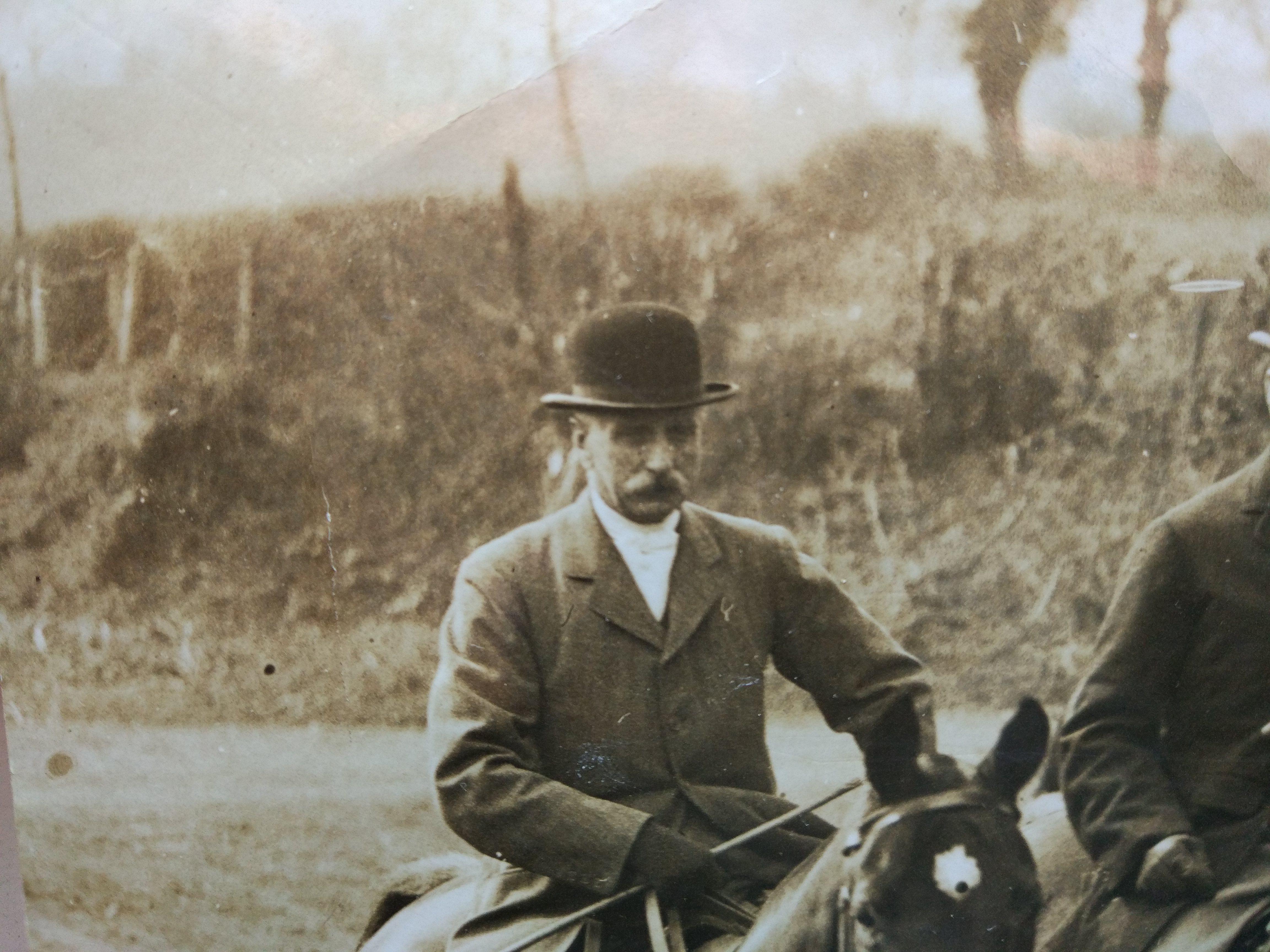
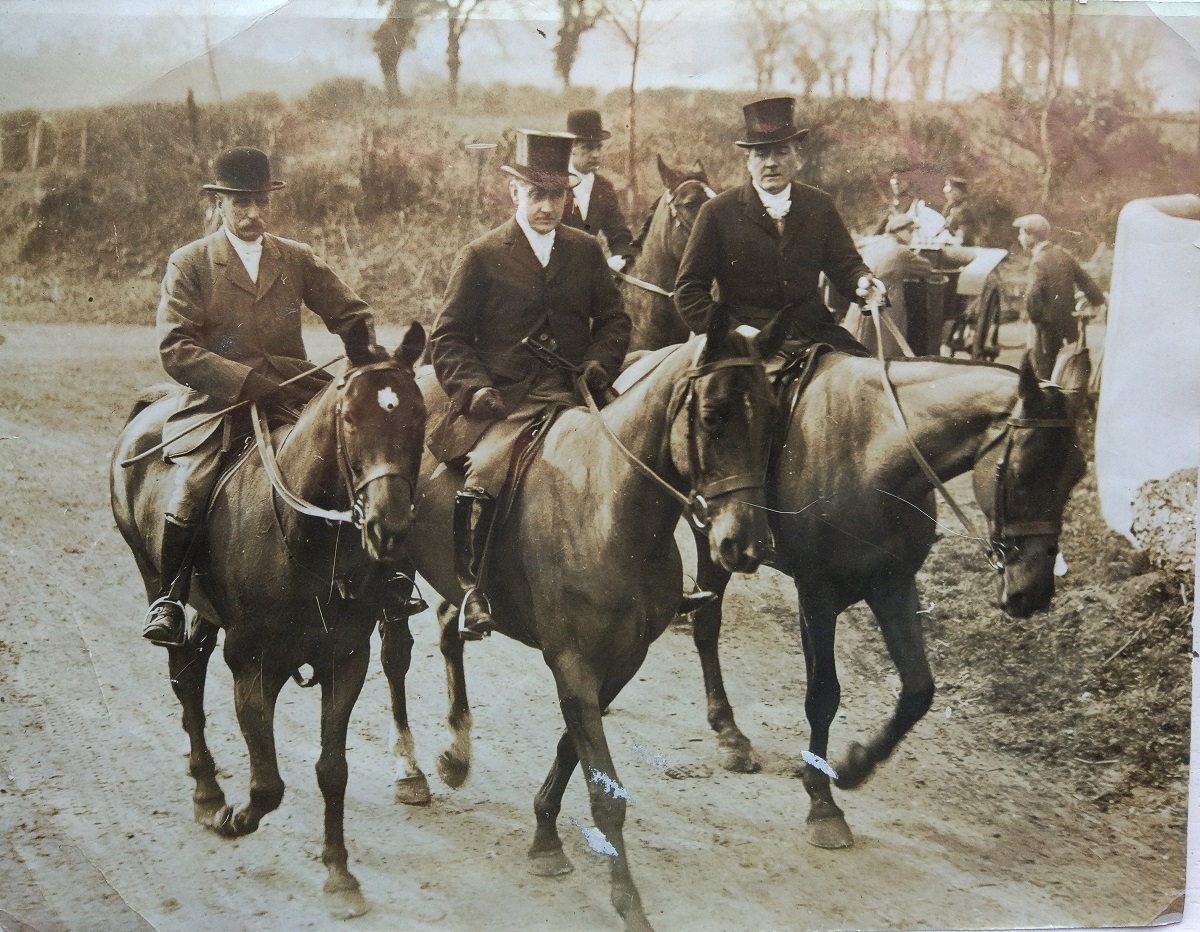
He hunted with his brother The Bird
around SW Co.Dublin (then open country, now all built over).
Founder member of
South County Dublin Harriers
1906.
Also hunted with the Ward Hounds,
and generally lived the high life on his father's money:
"riding around his
many farms on horseback to supervise his workers
and hunting twice a week did not help me to realise
that life meant more than idling
my life away".
Friend of Gogarty:
He was a friend of
the writer, conversationalist and Dublin character
Oliver St.John Gogarty.
Gogarty was said to be a cousin of Frank's friend
Fonso Carton,
but apparently this is not true.
When Frank left the Jesuits in apparently 1907, Gogarty is said to have put a notice in the social column of the
Irish Times saying:
"The Pope has gone to
Avignon"
(i.e. "The Pope" has left Rome and is pursuing a new path).
Through Gogarty, Frank met
Joyce,
but he was not a fan of Joyce or his writings.
Note that Joyce's father was at Frank's mother's funeral 1910.
Frank stayed friends with Gogarty all his life.
He would have stayed with Gogarty
- not at the
Martello Tower,
where Gogarty lived only for a brief time in 1904 -
but rather at Renvyle in Connemara.
After leaving the Jesuits he went to America.
He was in the US around 1907-08.
There is a picture of
Thomas Addis Emmet,
"regards to F.C. Flanagan", 24th Dec 1907.
He met US President
Theodore Roosevelt,
"who kindly gave me a signed photo",
dated 20th Jan 1908.
He stayed friends with his son
Kermit Roosevelt.
A postcard May 1908 shows him living at
Portmahon House.
His mother died 1910.
He worked as an insurance broker for a while,
listed as such in Census 1911.
In
[Census, 2 April 1911]
he seems to be listed twice:
|
Nationalism:
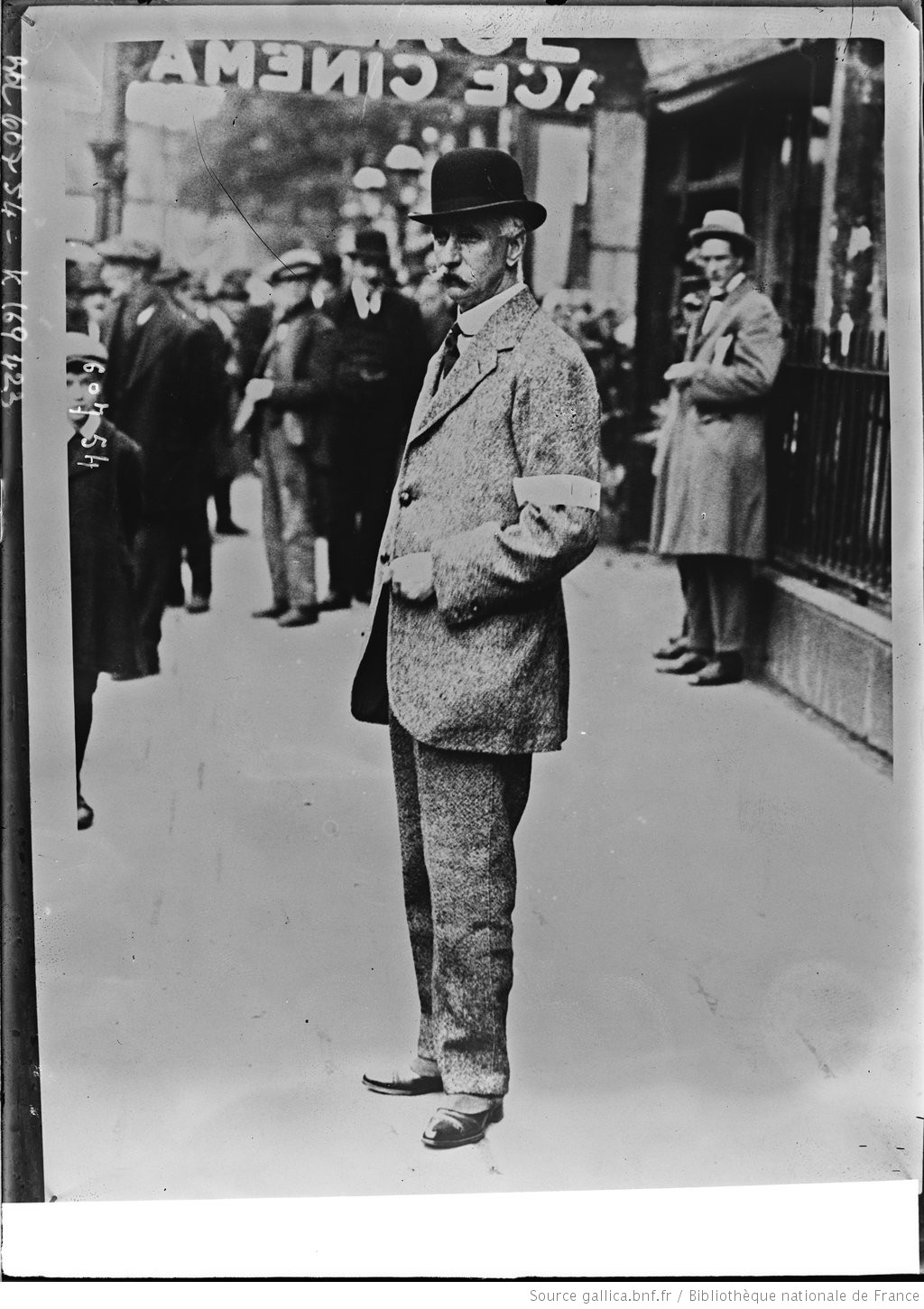
Like his father, he was in Irish Parliamentary Party / Nationalist Party. He was a Captain in the Redmond wing of the Irish Volunteers. He helped create a brief diversion to distract British troops during the Howth gun-running, 26 July 1914. Bulmer Hobson recalled: "They went off in all directions and a scene of great activity ensued, which was further enlivened by the arrival of a gentleman, locally known as 'The Pope Flanagan', on horseback. Mr.Flanagan, at my request, galloped his horse off at a furious pace and added to the noise." [Hobson, 1964]. Frank was good friends with T.P. O'Connor (Nationalist MP). Also a friend of the nationalist politician Tom Kettle (their fathers were friends). [Frank's memoirs] recall that "Life was pleasant in Dublin before 1914 and if one had a bit of money there was not much need to work. Tom and I played billiards very often in the mornings", and would then go for a few early drinks in a hotel bar, or in the pubs on the Dublin docks. |
|
Fought in British Army in WWI:
He followed the John Redmond volunteers to fight in WWI. He was officer in British Army, Nov 1914 to Nov 1919. See Frank Flanagan's WWI service. |
Bachelor life:
Frank was
living Portmahon House
in 1920s,
with his father and brother
Michael.
Liam Cosgrave
recalled the three of them there.
Like all his family, he was pro-Treaty
and against De Valera.
His memoirs
blame De Valera
for the Civil War,
and admire W.T. Cosgrave
for successfully founding the Free State.
He was friends with the
opera singer
Margaret Burke Sheridan
around 1923.
He may have been interested in her
but it didn't go anywhere.
They were friendly later in life.
(She died in 1958.)
The Flanagan estate was 489 acres in 1924
[Hannan].
"Frank Flanagan" was at
George Dempsey's
funeral 1924.
He was a very sociable person, and his memoirs are full of a list of
interesting friends that he visited, dined with, and drank with.
Apart from those mentioned above,
he was also friends with
the writers
Brinsley MacNamara
and
Liam O'Flaherty,
and
the journalist
Thomas Kenny of Galway.
He also lists as friends
the British journalist
Hannen Swaffer,
and the
US Democratic politician
Jim Farley.
He is listed with father and Michael at Portmahon House
in 1926 census.
He is "Company Promoter".
Before marriage, he possibly left Portmahon House
and lived for a time at Rialto Lodge, one of the Flanagan properties near the canal.
Papers linked to
draft deed of 1929
have a letter of 16 July 1929
addressed to Frank at Rialto Lodge.
Deed is also drafted with "Frank Flanagan .. of Rialto Lodge".
He was the only son left alive when his father
died at Portmahon House in Oct 1931.
Frank was age 44, a bachelor.
He
inherited Portmahon House and all the
Flanagan lands
[Alderman's will] and eventually sold them off.
The Flanagan estate was 344 acres in 1931
[Hannan].
Deed, 29 Aug 1932
lists him as of Portmahon House.
He set up his married home in the old Flanagan family property
Walkinstown House.
He is listed at Walkinstown House in
[Thom's] from 1933 to 1960
(indicates he moved in there before marriage).
Note that his sister
Lizzie O'Farrell
was living in Portmahon House as at Dec 1933, when her husband died there.
She moved into Portmahon House around or after the Alderman's death.
So Frank set up home in one of the other Flanagan properties.
[French, 1997, p.81-82]
tells a story of "The Pope" Flanagan
riding into Crumlin with some friends
to go to
Mooney's pub in Crumlin.
A local character called "Whack" minded his horse,
and after a few hours drinking he tipped him a
half-crown.
He
enjoyed drinking a lot when a bachelor,
but eventually stopped
and became a
Pioneer
before he even met his wife, and for the rest of his life
never drank.
He more or less stopped hunting when he married.
He continued to smoke.
He
met his future wife Nora think July-Oct 1932, when she was working
in Co.Wicklow.
Frank was out for a drive round Co.Wicklow
with a friend.
His friend said let's call in to a young doctor
friend of mine where we'll get afternoon tea.
Agreement of 3 Mar 1933
still describes him as of Portmahon House.
He is
listed as "farmer" at marriage, July 1933.
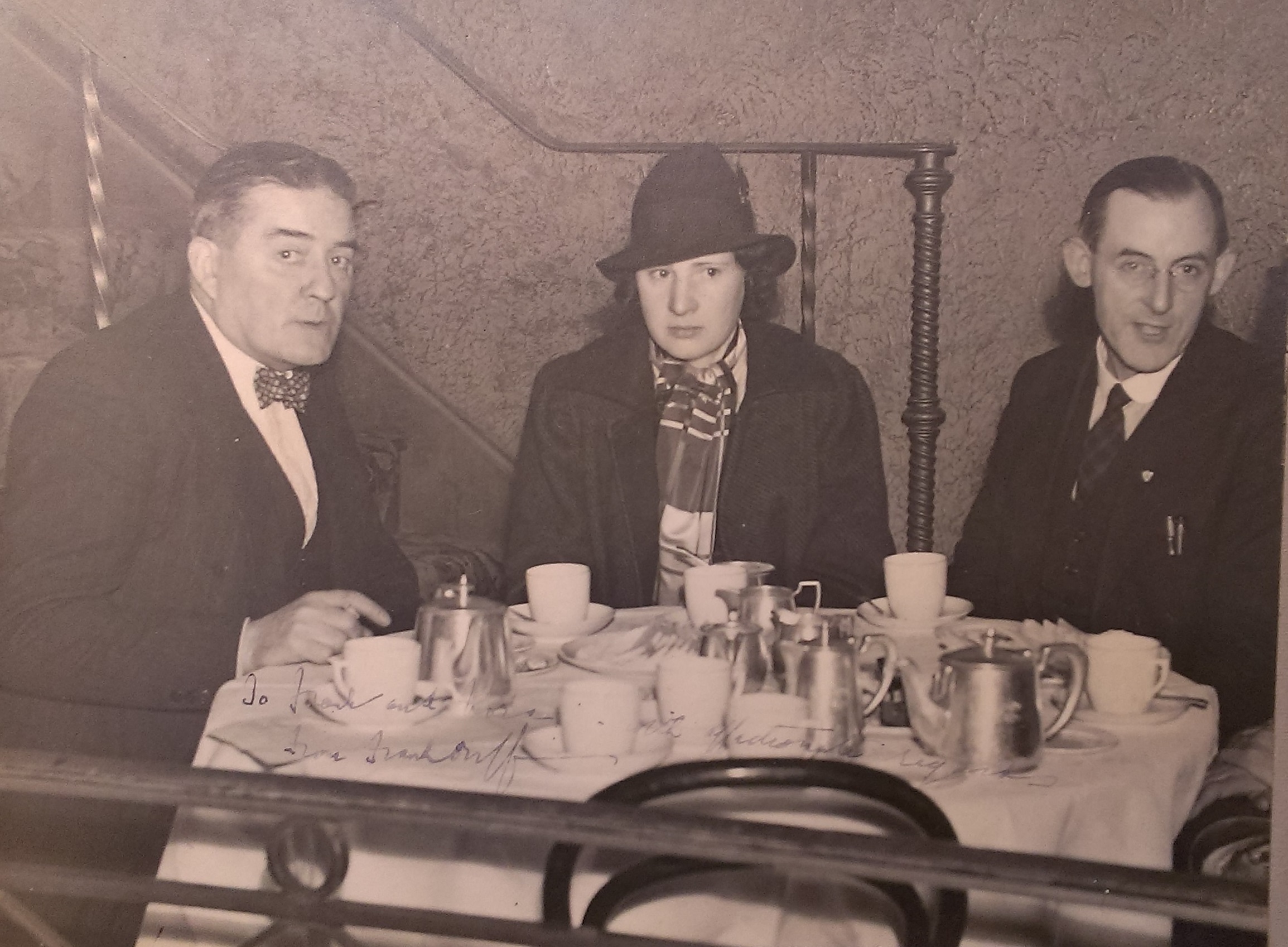
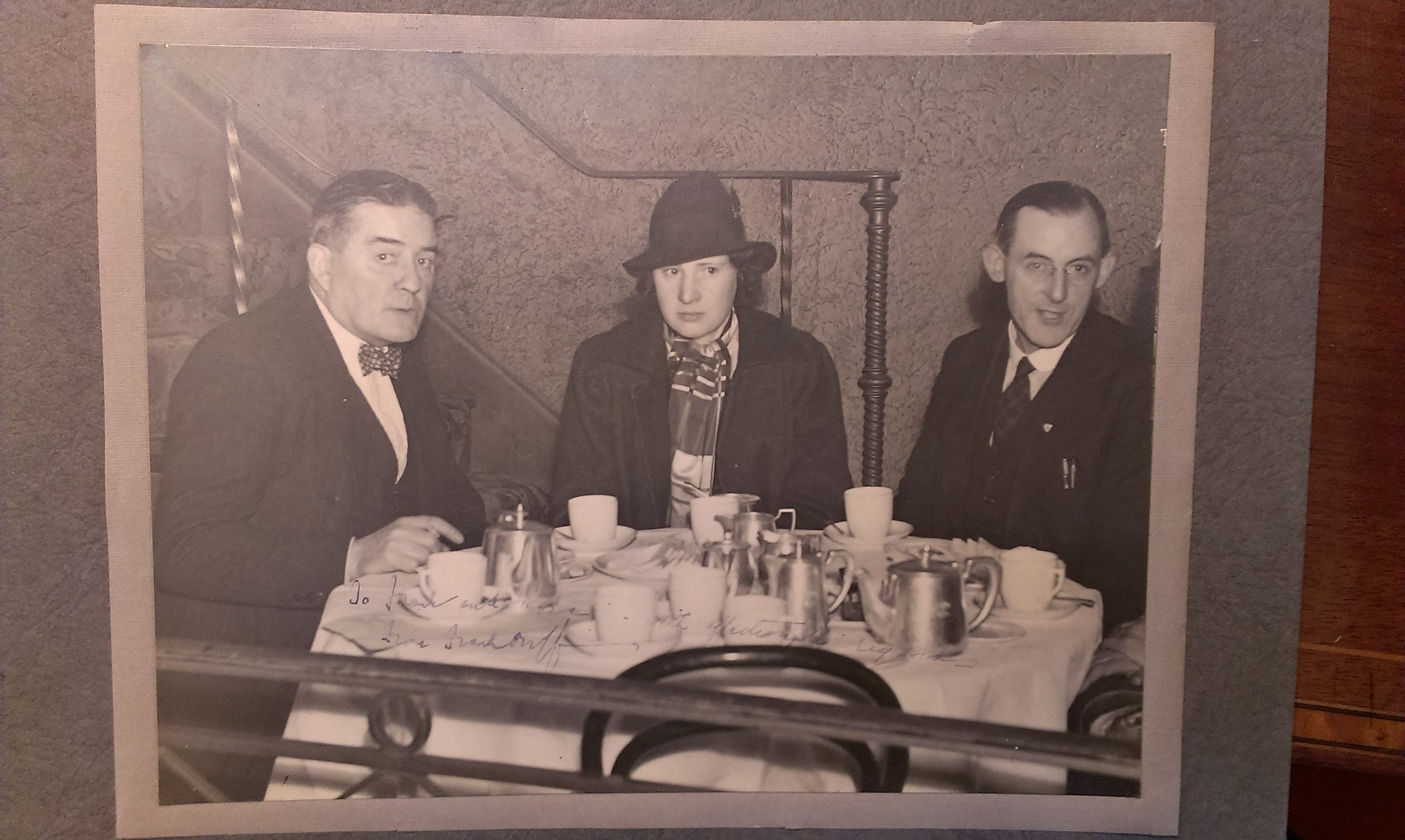
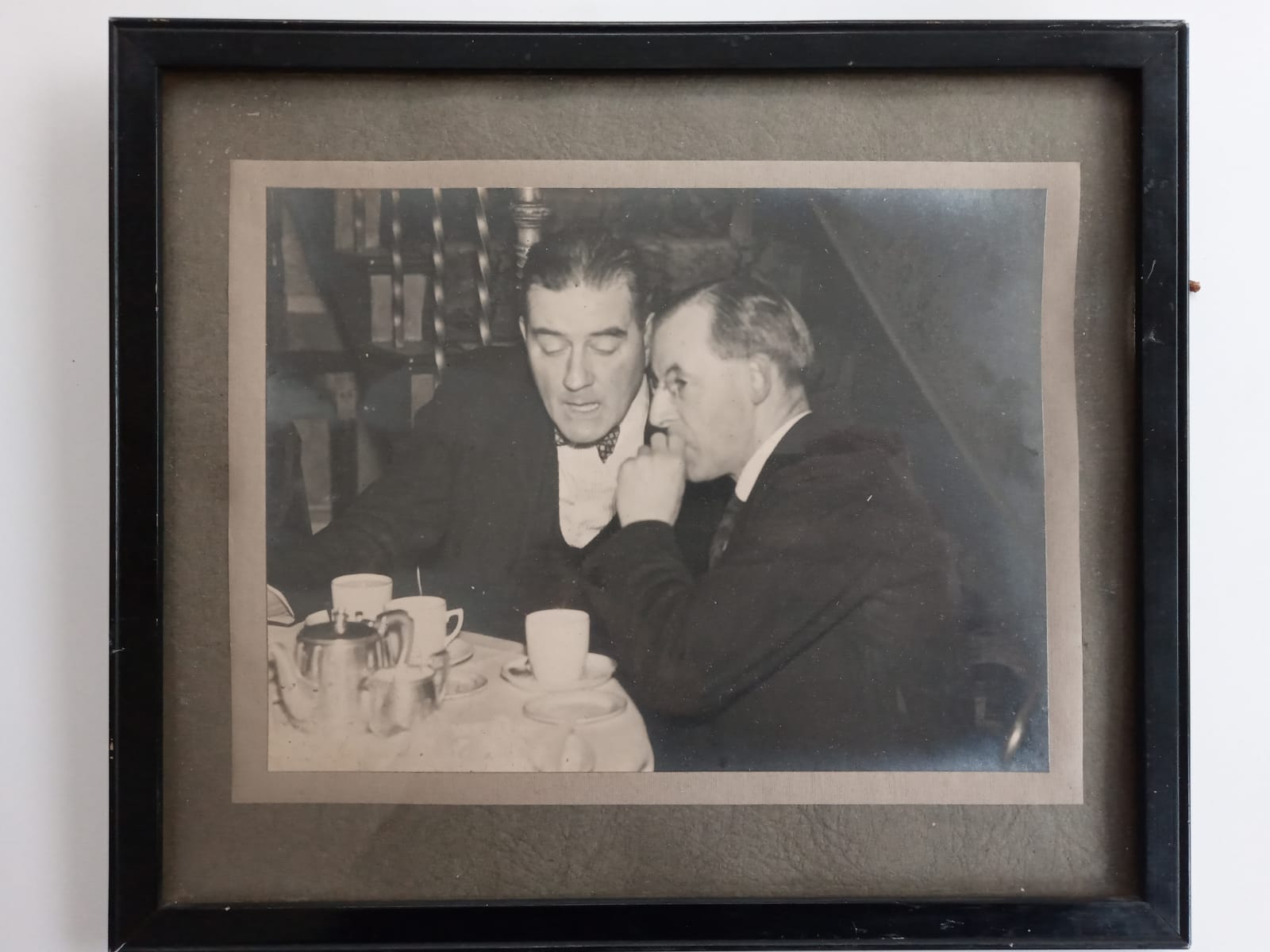
He was a
friend of
Frank Duff
(founder of
Legion of Mary).
He was a
friend of the painter
Jack Yeats.
Frank
bought some of his paintings very cheap when he was unknown.
But unfortunately Nora didn't like them and they were sent back.
Deirdre Flanagan
said her parents still sometimes rode horses to church in Crumlin in the 1940s.
By this time no one rode horses in Dublin centre,
but some still rode in the suburbs.
The Flanagan lands of SW Co.Dublin
were disposed of
in Frank's lifetime as the suburbs expanded
into what was countryside.
Some he sold commercially to developers.
Some were subject to Compulsory purchase orders.
It was not the best area of Dublin,
but the lands were still probably worth a lot more than they were let go for.
Frank's daughter Deirdre described him as very easy going about money, not materialistic.
The Flanagan estate was 207 acres in 1939
[Hannan].
The Flanagan estate was 97 acres in 1949
[Hannan].
Drimnagh Castle
became vacant 1954.
The school was apparently built on Frank's land,
though he didn't own the castle itself.
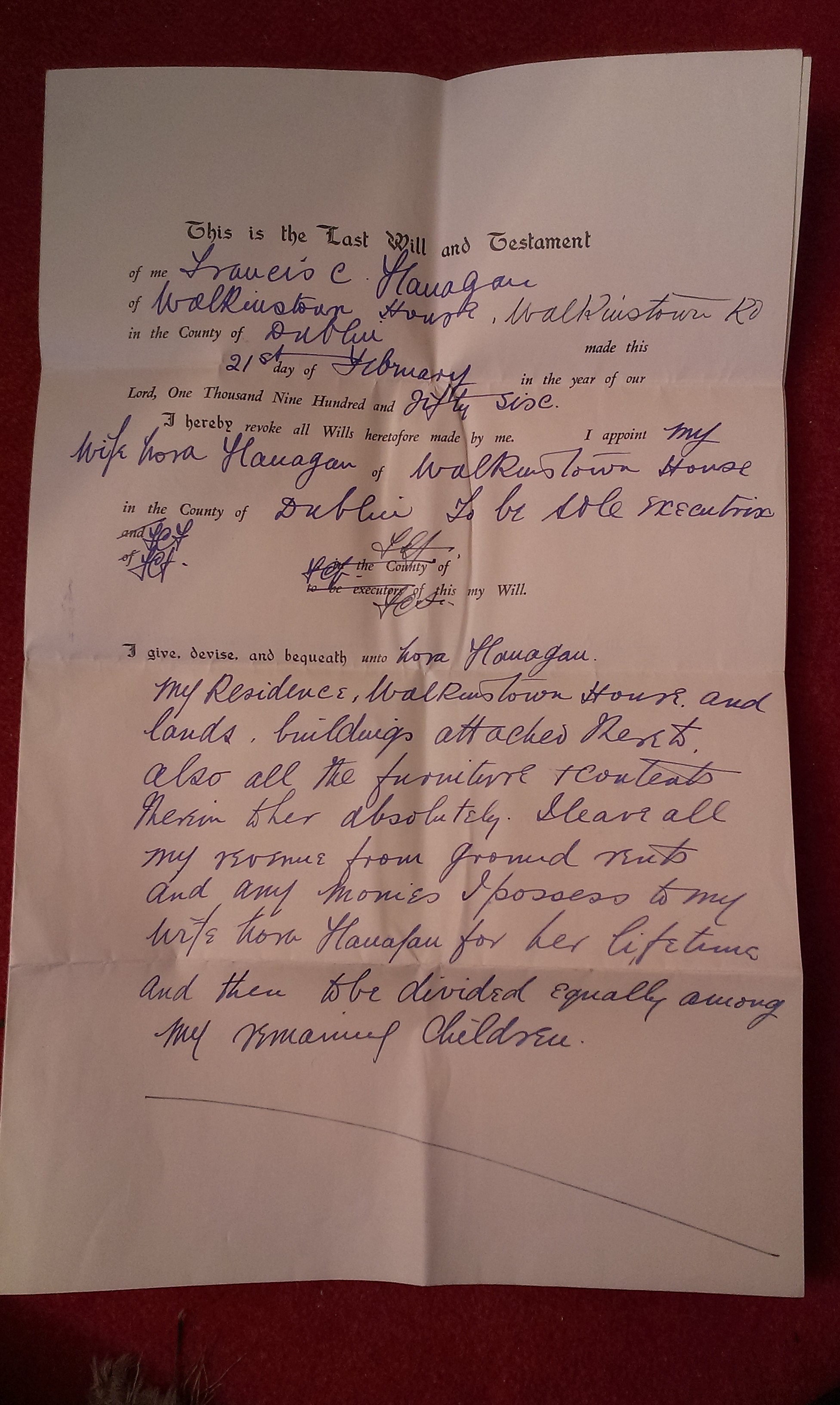
Frank's will
dated 21 Feb 1956.
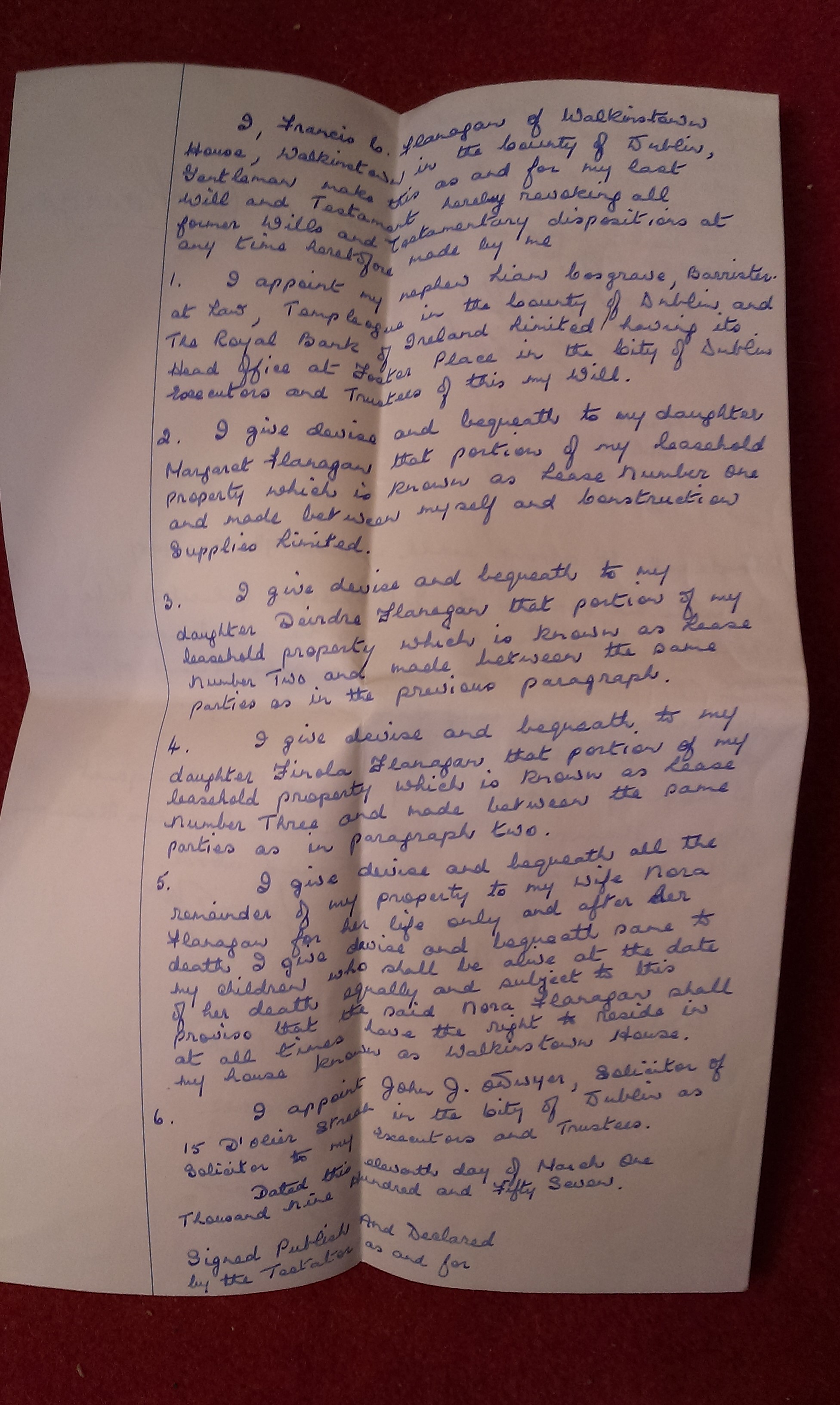
New will
dated 11 Mar 1957.
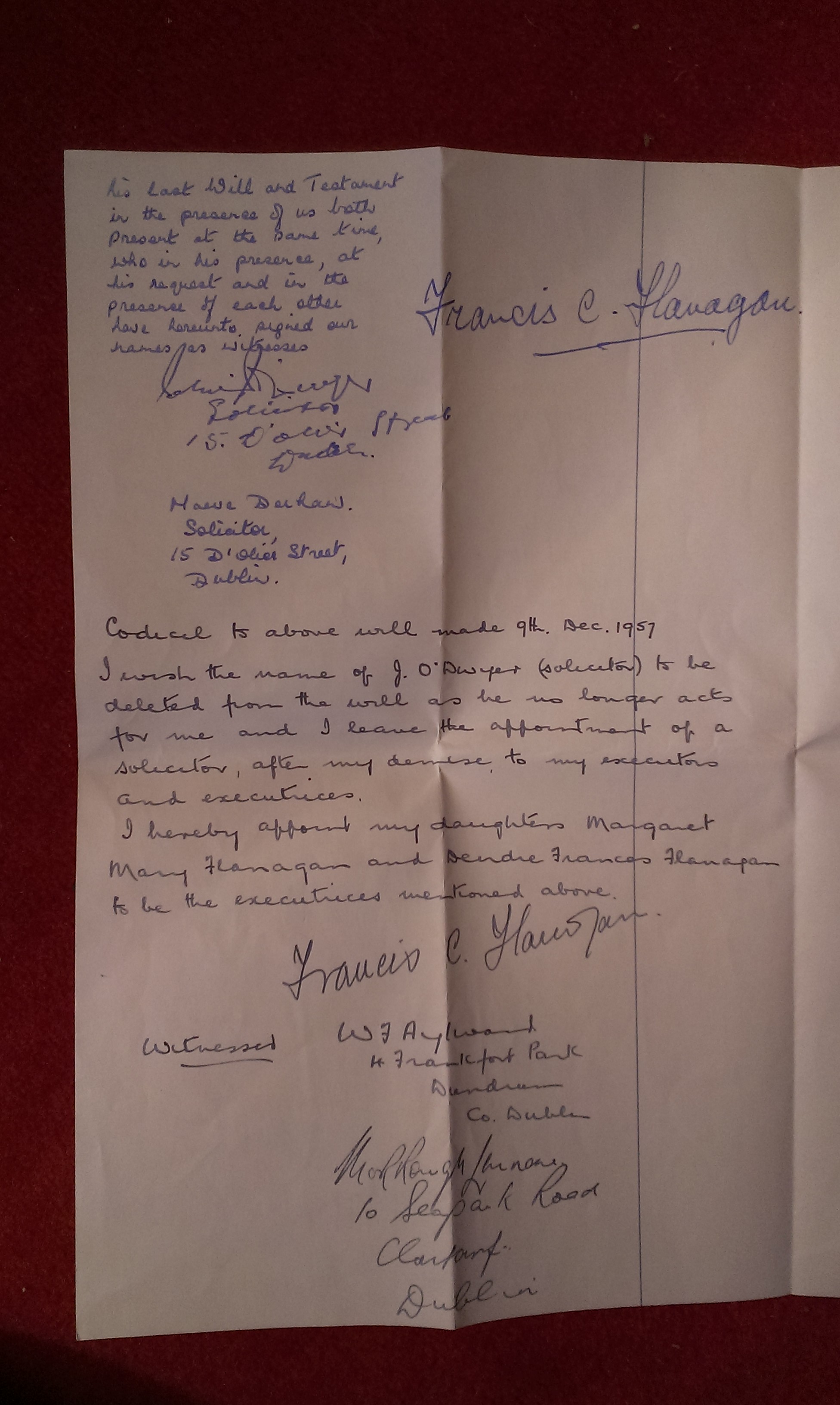
Codicil 9 Dec 1957.
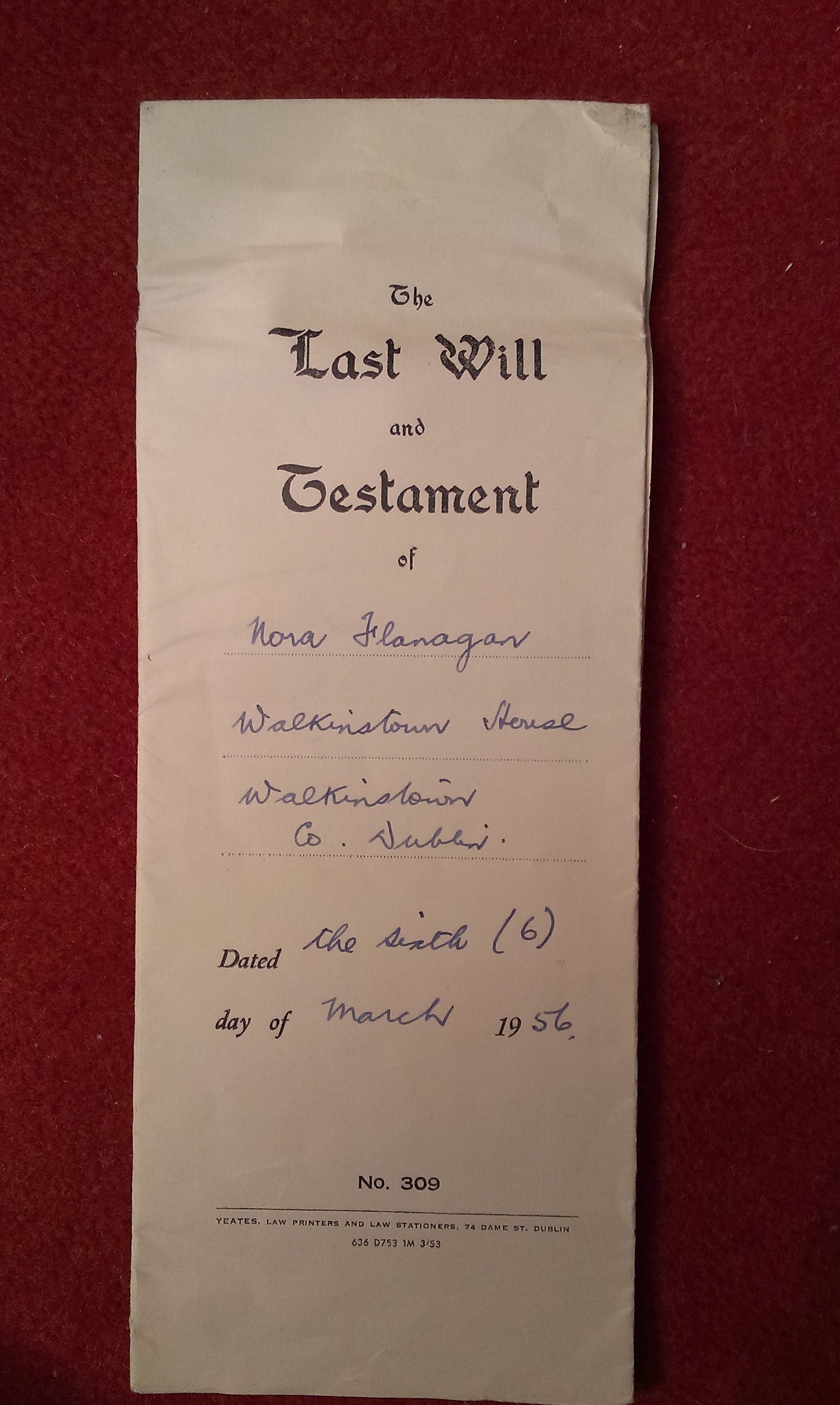
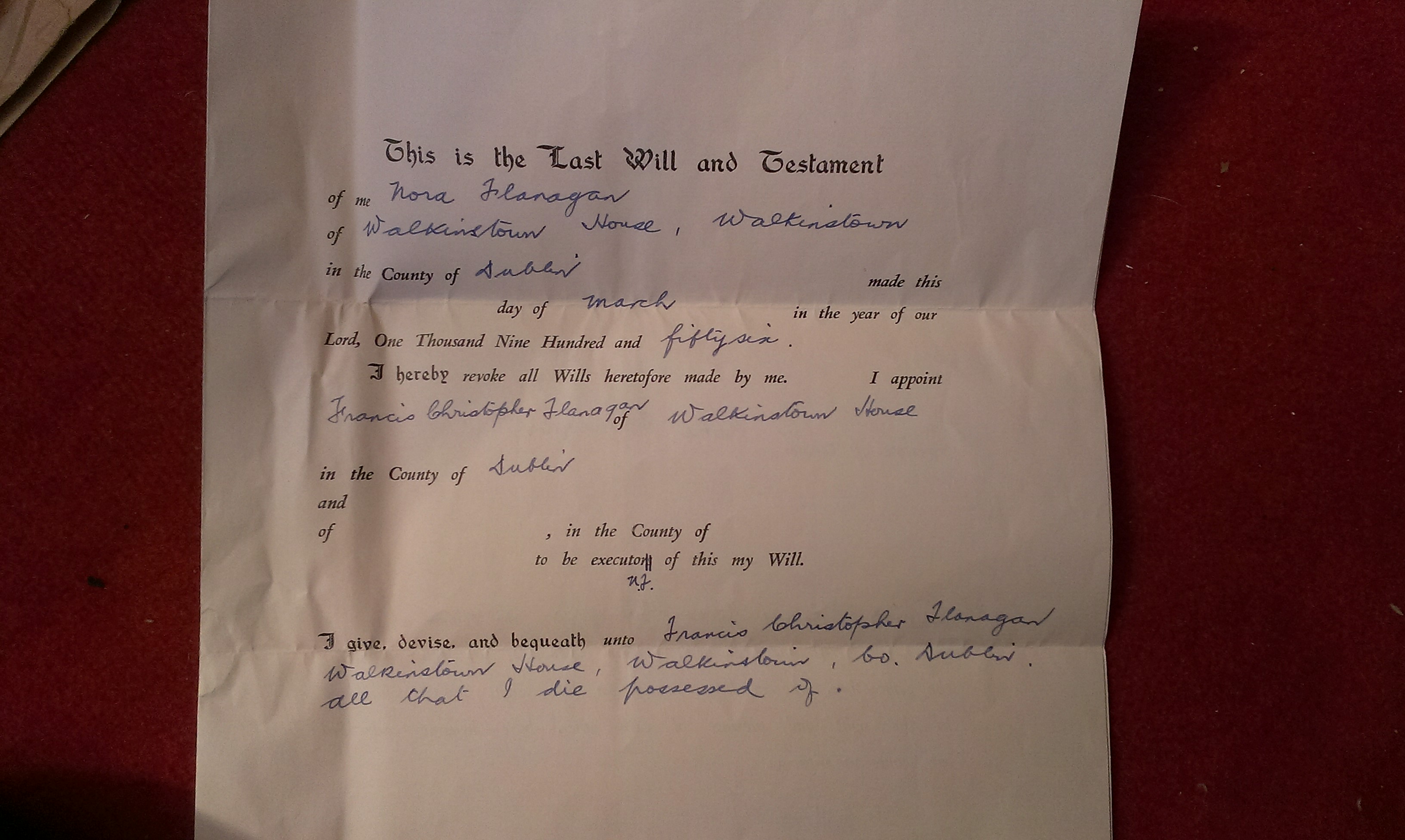
Nora's will
dated 6 Mar 1956.
New will
dated 15 Nov 1957.
Nora dies, 1957:
Nora suffered long struggle with breast cancer,
fought very hard against it.
She was in hospital in early 1957 for a time.
I have a letter from Nora in hospital, Feb 1957,
to "Peg" at home, full of confidence that she will be
back to normal soon.
She did come home.
But later in 1957 she became unwell again. Peggy minded her at home.
Then not long before she died, she went back into hospital,
into St.Vincent's private nursing home,
96 Lr Leeson St, Dublin.
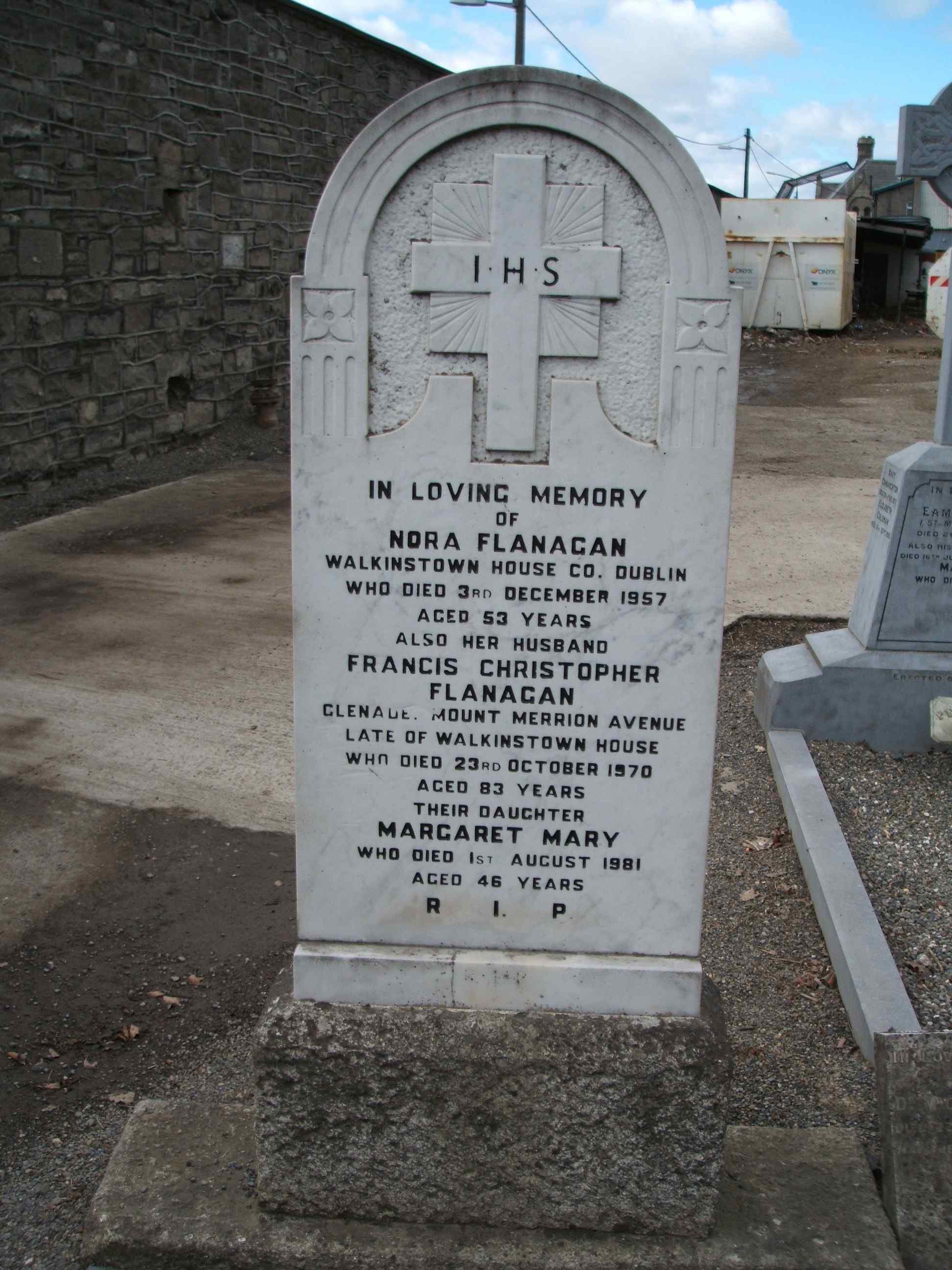
She died in St.Vincent's,
3 Dec 1957, age 54 yrs.
See
death cert.
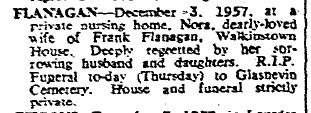
See
death notice in
Irish Times, December 5, 1957.
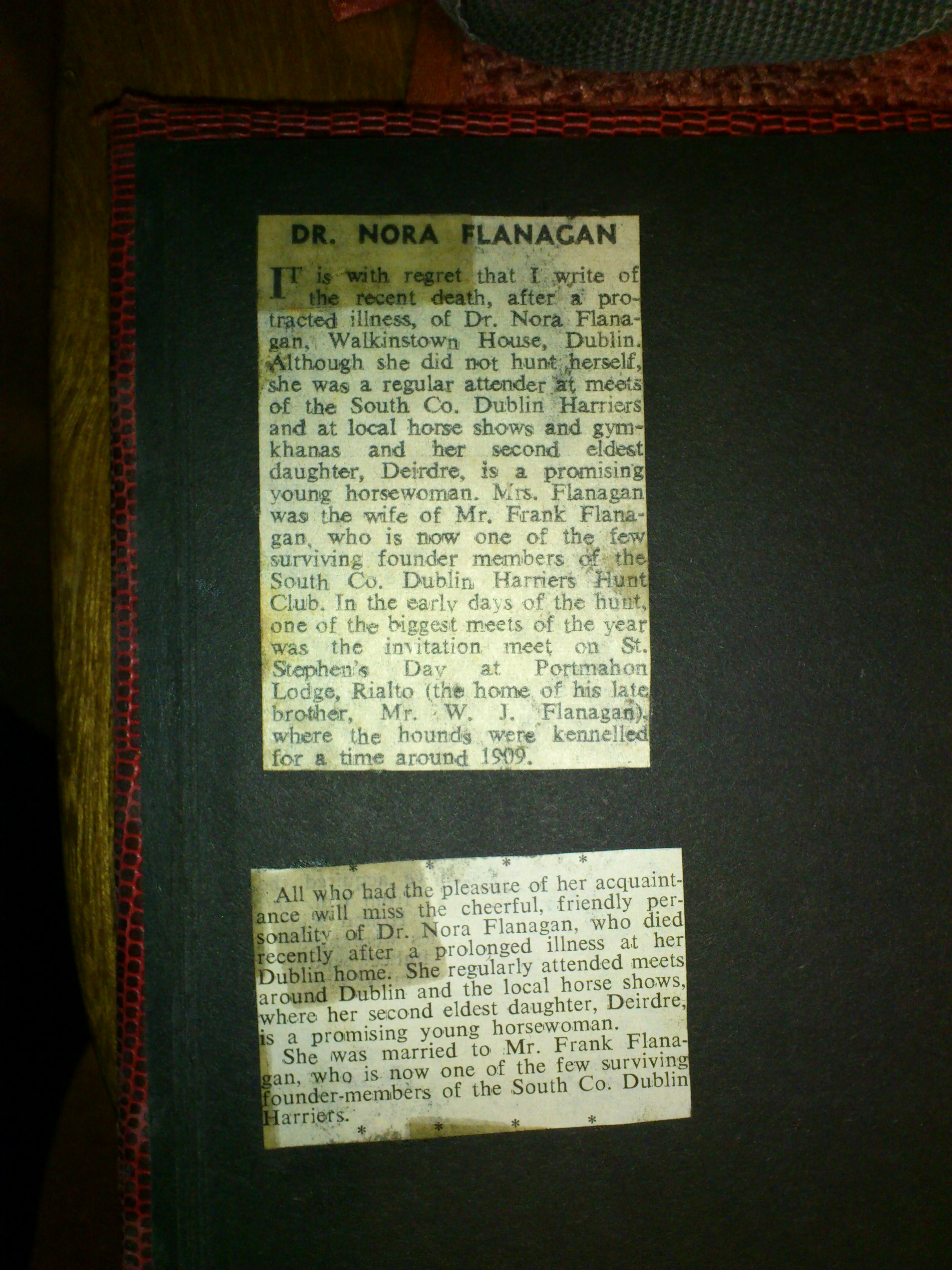
See two obituaries
in unknown newspapers.
Abstracted in
[Norton, 1991].
Funeral 5 Dec 1957.
She was
bur Glasnevin Cemetery.
Probate 7 May 1958.
Frank sold
Walkinstown House in
1959.
Still living there as at
8 July 1959 postcard.
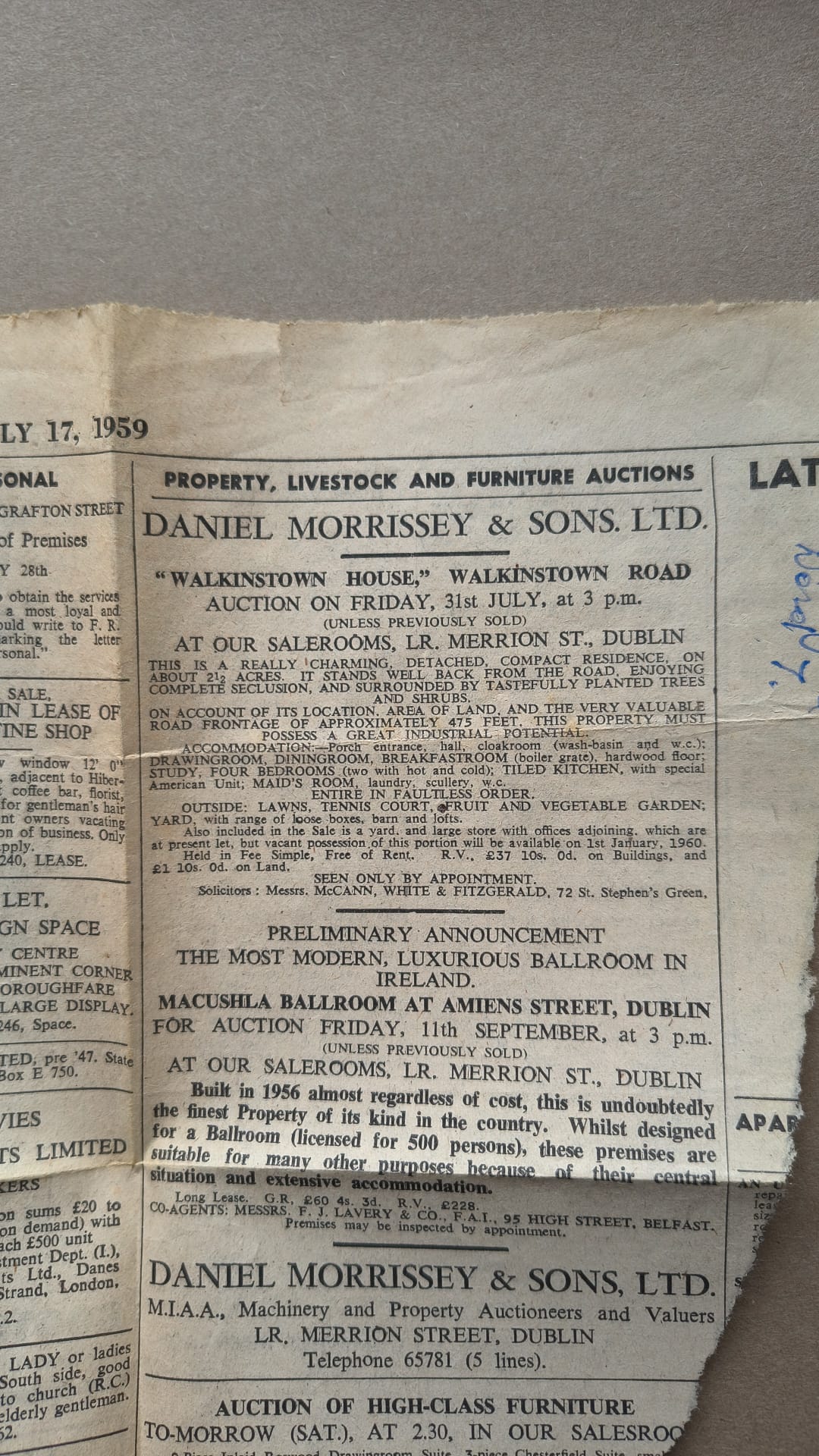
See
notice
in Irish Times, 17 July 1959, which
says it will be sold at auction 31 July 1959.
A newspaper
item of 26 Oct 1959
says Frank has just sold and will shortly move out of the area.
He is definitely gone
by mid 1960.
He moved to "Glenade",
65 Mount Merrion Ave, Mount Merrion / Blackrock, Co.Dublin.
Living there as at May 1960 postcard.
He is still listed at Walkinstown House in
[Thom's, 1960].
Listed at Glenade in
[Thom's, 1962-63].
Frank wrote new will dated 11 Jan 1966.
Left "Glenade" to Peggy.
Frank was called "Poppy" by his grand-children
(NOT by his children).
He smoked all his life. Smoked a pipe in later years. Yet still lived to a good age.
Frank dies, 1970:
He
died
Fri 23 Oct 1970, "Glenade", age 83 yrs.
It was a good death. Finola recounts it as follows.
He went to mass in Donnybrook.
Came home, had a cup of tea and his favourite chocolate cake, sat in his armchair.
Suddenly got a pain. It was a heart attack.
Peggy said: "Daddy will I call Finola?"
(Deirdre was in Galway.)
He replied: "Ah don't disturb Finola."
Anyway, Peggy called Finola, the doctor and a priest.
By the time people got there, Frank had died.
Frank Duff said: "That is how I would like to go".
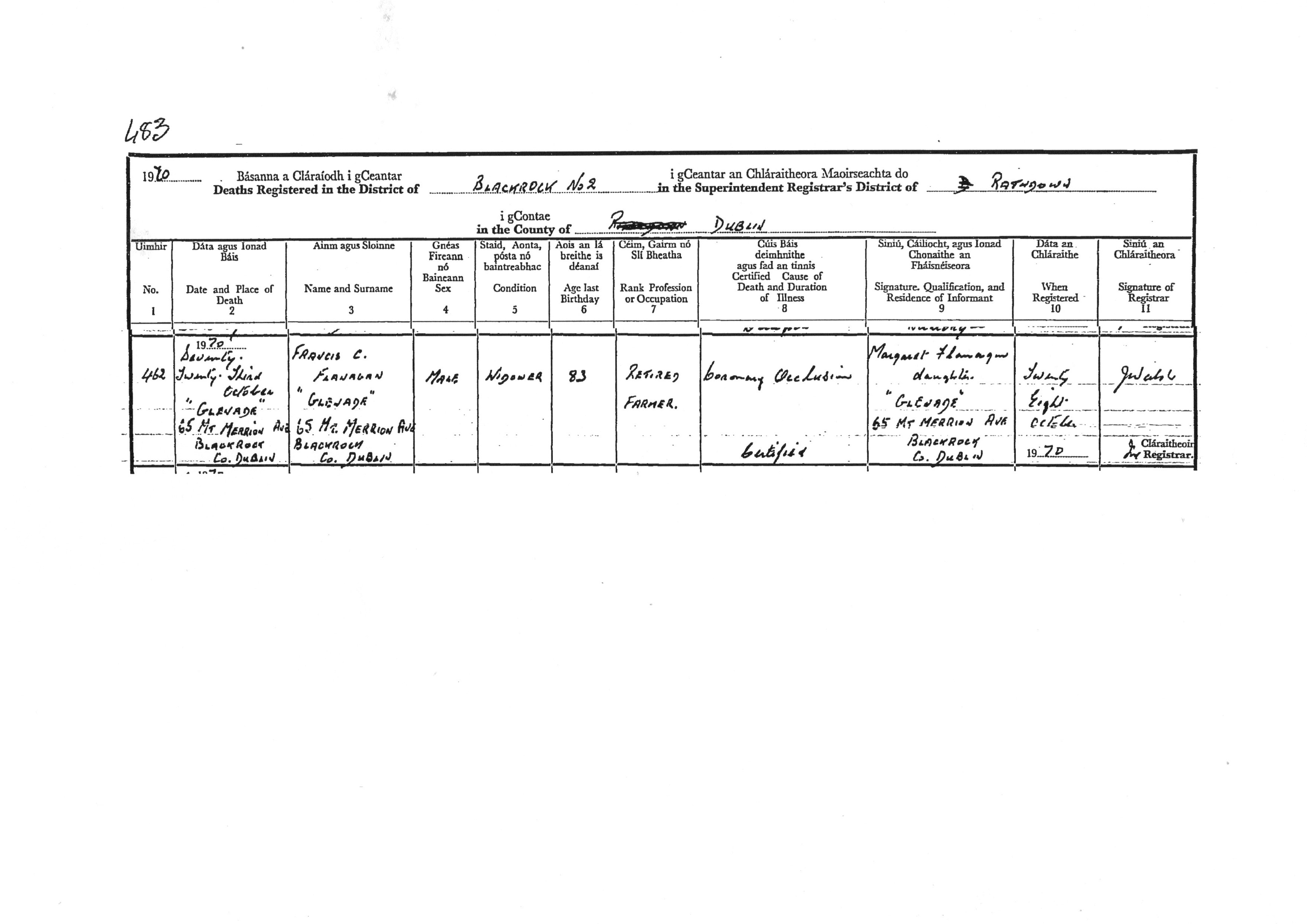
See
death cert
from
[GROI].
He is "retired farmer".
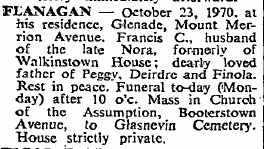
See
death notice,
Irish Times,
October 26, 1970.
Funeral Mon 26 Oct 1970,
Booterstown church.
He was
bur Glasnevin Cemetery.
Probate 1 Sept 1971.
Frank and Nora had issue:

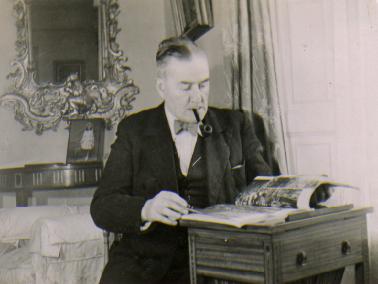
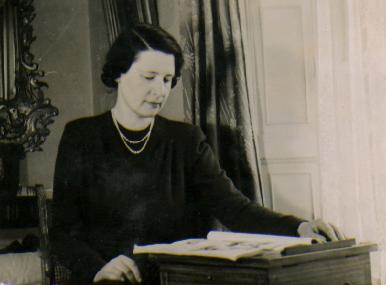
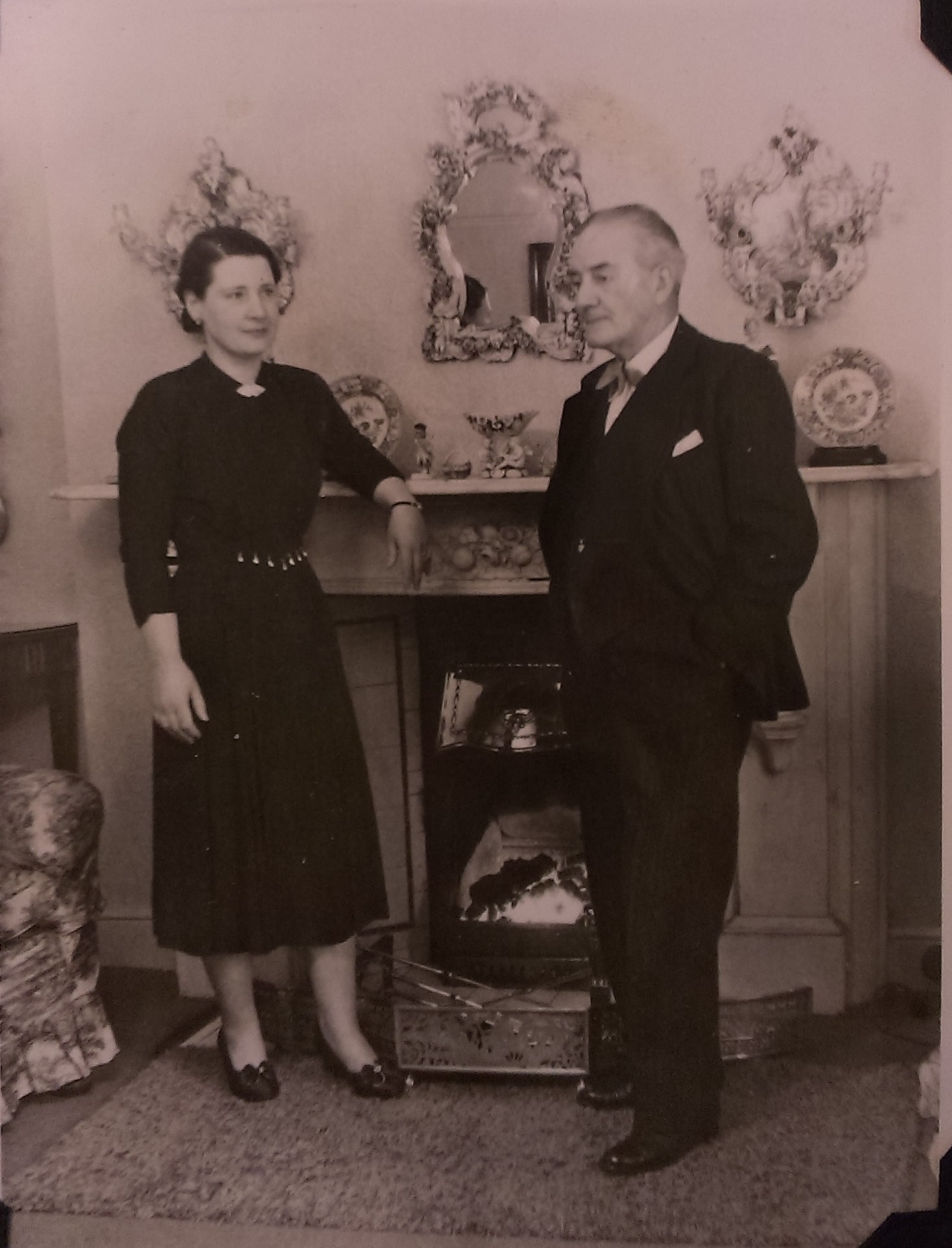
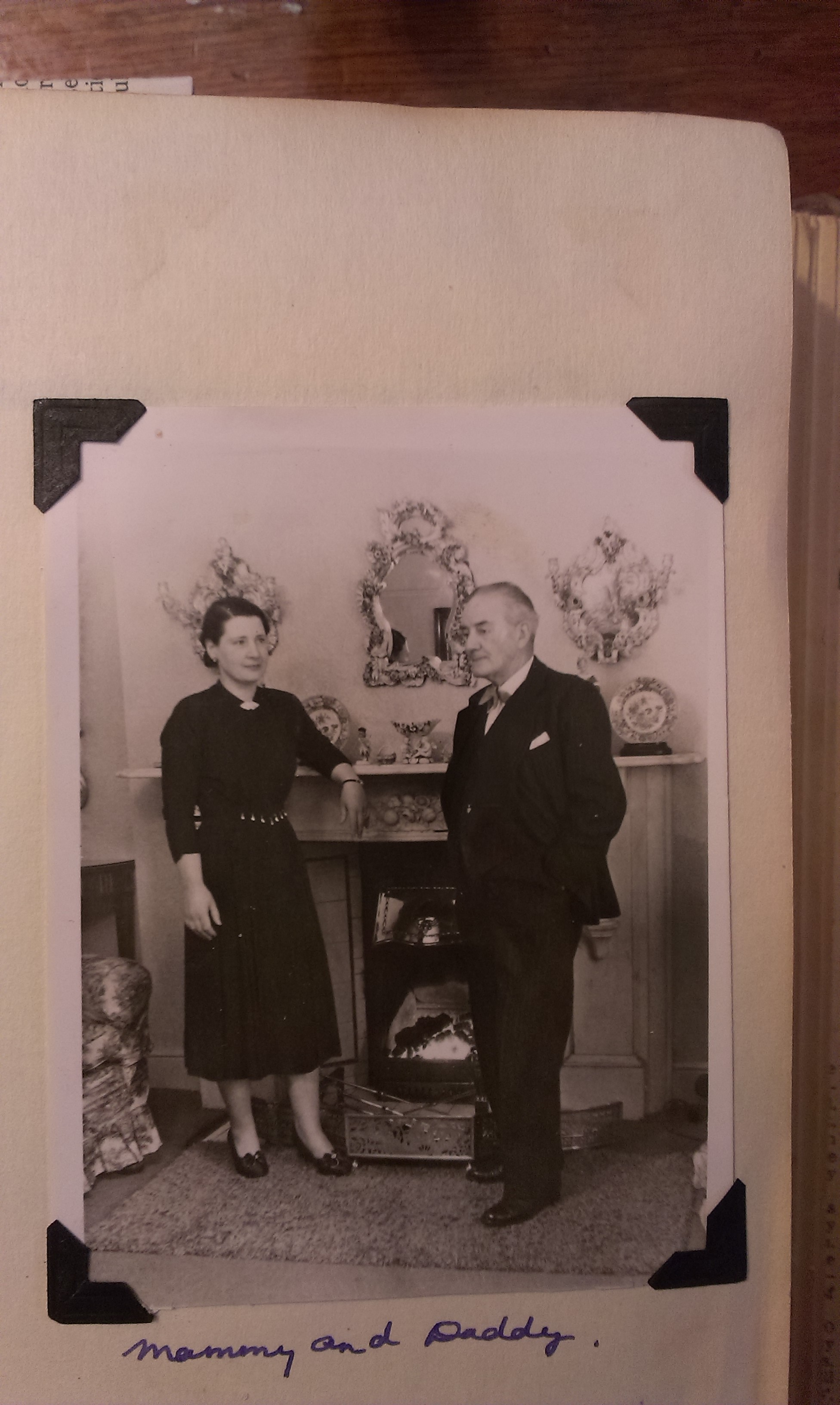
Frank Flanagan and Nora Stack,
in the drawing room, Walkinstown House,
both pictures 14 Mar 1948.
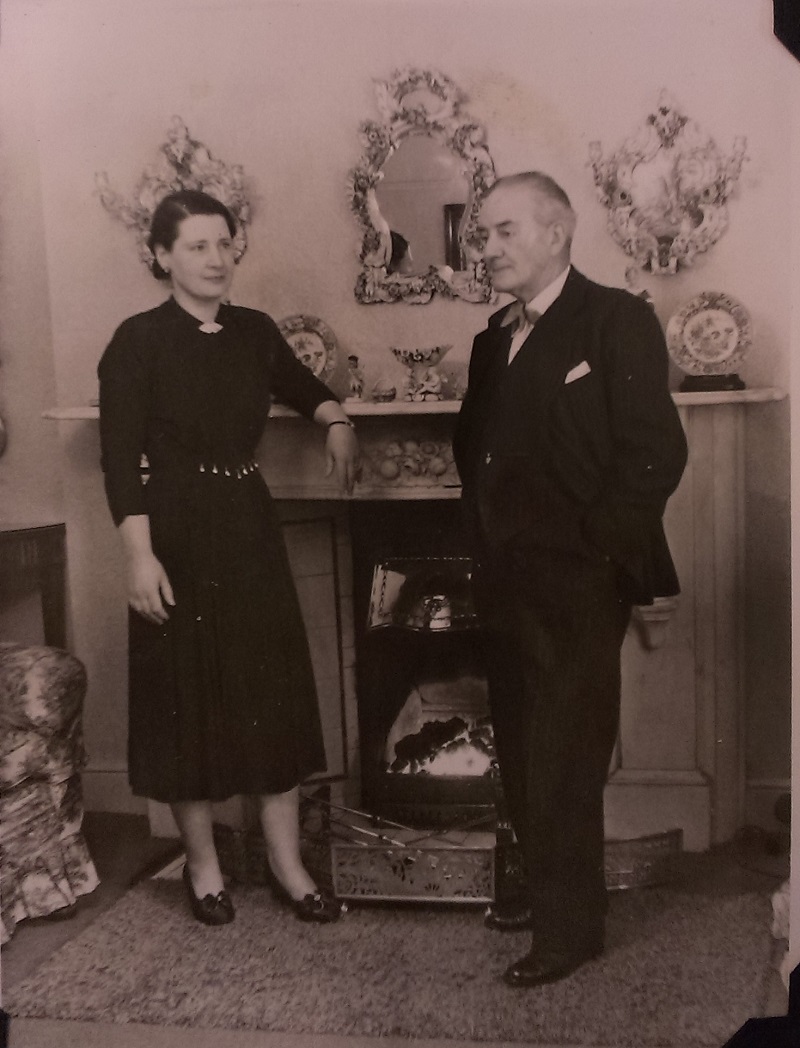
Nora and
Frank, Walkinstown House.
See larger
and full size.
See album page.
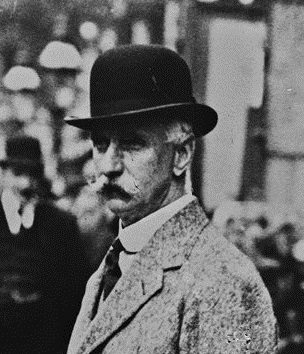
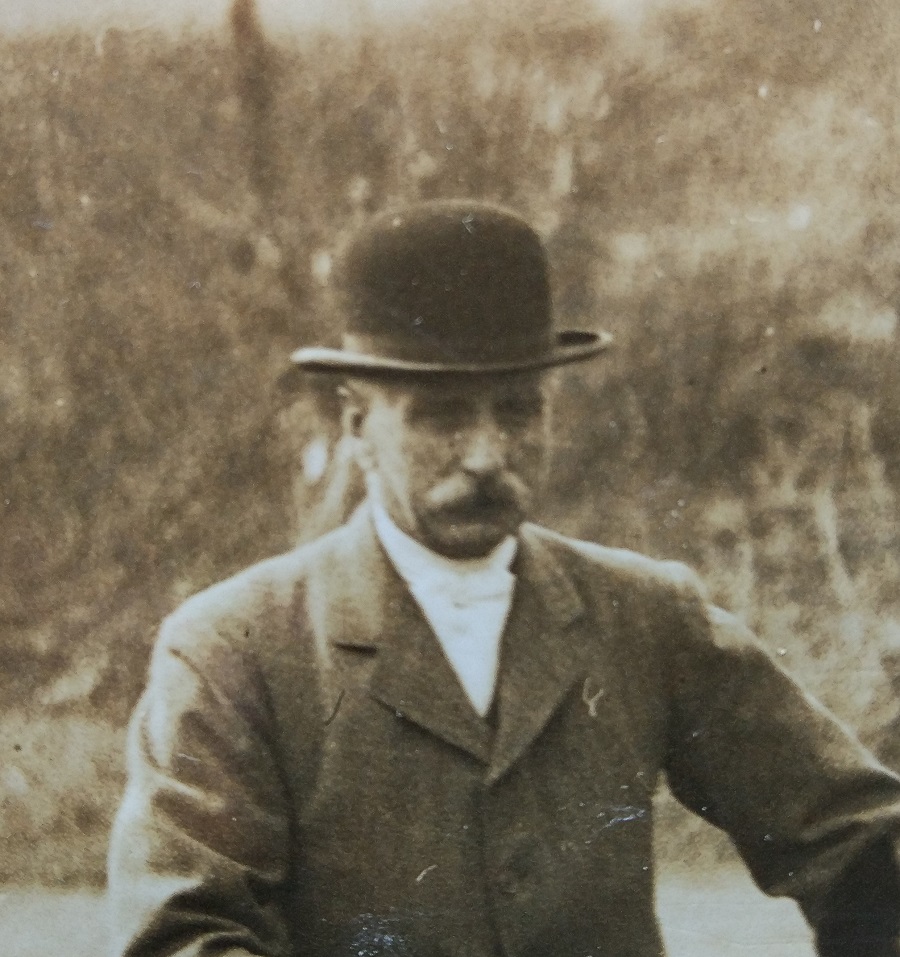
"Davy Byrne's in Duke Street,
the Bailey Restaurant nearly opposite,
and the underground Bodega in Dame Street
are licensed tabernacles sanctified by the past attendances of people
with names like ...
the Bird Flanagan
and his relative, the Pope.
(Who will pretend that these are not ordinary surnames
that can be borne by anybody?)
All three still open their doors at ten o'clock and possibly shelter to-day
the makings of a second fame ... The premises bear openly the marks of their departed guests,
like traces of fresh stout found in a glass by a policeman after hours"
-
"The trade in Dublin", by
Flann O'Brien,
The Bell, vol.1, no.2, Nov 1940, pp.6-15,
[DCU] PER 941.5.
The legendary drinkers referred to are my grandfather The Pope Flanagan
and his brother The Bird Flanagan.
"Any mention of Bird Flanagan makes me uneasy.
He is one of three brothers who would be better had they remained in
Turgenev.
Characters such as these are to be found both in the Russian author
and in Dublin's fair city."
- Oliver St.John Gogarty in
[Gogarty, 1954, Ch.10].
The three brothers would probably be
The Bird, Larry and Frank.
"To-day, I modestly invite knowledgeable readers to share with me
the plan of producing an extended memoir of one who was comparable
with Trojan
Hector
or Finn MacCool
himself.
I mean
the Bird Flanagan
with, perhaps, a supplement on his brother, the Pope Flanagan."
- [Myles na gCopaleen, 1962].
On his 80th birthday in 1966,
Finola asked Frank: "Does it seem a long time?"
Frank replied that it was "gone in a flash".
Please donate to support this site.
I have spent a great deal of time and money on this research.
Research involves travel and many expenses.
Some research "things to do"
are not done for years, because I do not have the money to do them.
Please Donate Here
to support the ongoing research and
to keep this website free.